KUALA LUMPUR: Malaysia and the United States trade relations are expected to remain strong, despite global headwinds such as tariffs, geopolitical conflicts and economic uncertainties, says American Malaysian Chamber of Commerce (Amcham) chief executive officer Datuk Siobhan M Das.
Siobhan said the cooperation between the two countries is in a “good place” and the outlook is “very bright for Malaysia”.
“Malaysia is one of the most competitive places to be, supported by strong institutions and the rule of law,” she told the media on the sidelines of Amcham’s 49th AGM luncheon yesterday.
On concerns over the impact of tariffs and ongoing tensions in the Middle East, Siobhan said such headwinds are not unique to Malaysia and that the country should continue focusing on producing quality products, fostering innovation and remaining open to all industries.
“While everyone should be concerned and pay attention to these issues, we should also be working towards a better future for Malaysia.
“Malaysia’s exports to the United States are very strong,” she said.
“I do not have a crystal ball to tell whether that momentum will continue this year, but as far as we are concerned, the relationship between the two countries is good.”
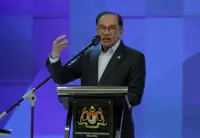
Investment, Trade and Industry Minister Datuk Seri Johari Abdul Ghani said in his keynote address at the luncheon that Malaysia’s trade surplus with the United States was about US$22bil.
That said, Johari said the United States enjoys a larger surplus than Malaysia when taking into account the operations of American companies in the country, as well as trade, services and primary income flows.
Johari said countries have the right to impose unilateral tariffs, but Malaysian companies must continue improving their competitiveness by enhancing product quality and efficiency.
“Any country in the world will want to buy from us because we have those elements. Even if unilateral tariffs are imposed by the United States, for instance, those tariffs are ultimately paid by the Americans.
“What we need to do is ensure that every sector and industry operating in Malaysia remains competitive,” he said.
Johari noted that Malaysia does not have forced labour and has laws protecting against the practice.
He said the US Trade Representative’s (USTR) proposed 10% duty under Section 301 is linked to concerns involving raw materials and semi-finished goods sourced from third countries, which are subsequently processed in Malaysia and exported to the United States.
“This is subject to forced labour, even though they are not in our country, but they are among the many suppliers from whom we buy products, which are then processed and exported to the United States.
“Currently, we do not have a mechanism to evaluate whether a third country engages in forced labour. That is the missing link.
“Moreover, we also do not have a specific law to restrict the import of raw materials, finished products or semi-finished products produced using forced labour.
“That is why we are subject to the proposed 10% tariff,” he said during the event.
On what specific mechanism Malaysia could implement to address forced labour risks in imports from third countries, Johari said the country could source from compliant suppliers even if others in the same country fail to meet forced labour regulations.
He cited the cases of FGV and Sime Darby, whose products were allowed into the United States after labour-related concerns were resolved.
Earlier this week, the USTR said a tariff rate of at least 10% would apply to imports from 60 trading partners as part of Washington’s attempts to rebuild its tariff wall.
Countries like Canada, Mexico, the European Union, Taiwan and the United Kingdom, among other places, were subjected to a 10% rate, while products from other countries, including China, India, Japan, South Korea, Brazil and Switzerland, would be subject to a 12.5% levy instead.
According to the USTR, economies that impose prohibitions on forced labour imports, or pledged to do so, were subject to the lower tariff rate, while those that failed to implement and effectively enforce such measures faced a higher rate.
To this end, Johari said: “Some countries are imposed a 12.5% rate because perhaps some of them do not have measures against forced labour both locally and in relation to imports from third countries, and may not have signed the Agreement on Reciprocal Trade.”
”The US’ Section 301 tariff proposal comes as the 10% tariff imposed under Section 122 of the Trade Act of 1974 — later raised to 15%, the maximum rate allowed under the provision — is set to expire on July 24, 2026, after its 150-day validity period. Section 122 came into force this year after the US Supreme Court, in February, struck down US President Donald Trump’s sweeping 2025 tariffs imposed under the International Emergency Economic Powers Act (IEEPA).
While tariffs under IEEPA have been overruled, Trump has maintained that those imposed under Sections 301 and 232 remain intact, with the former targeting unfair trade practices and the latter allowing sector-specific tariffs on national security grounds.
Apart from forced labour, the US’ Section 301 review also examines excess capacity, the environment and state subsidies. Johari said the investigation involving Malaysia is currently focused on two areas — excess capacity and forced labour.
On excess capacity, Johari said the country has no excess capacity.
“However, if another country has excess capacity and sells its products to Malaysia, and that product is used to produce another product in the country, which is then exported to the United States, maybe that is an issue. We do not know,” he said.
The proposed 10% tariff under Section 301 has yet to be formally approved by the United States and communicated to Malaysia and therefore is not yet an official tariff.
The levies are subject to a public comment and review period before implementation, which may result in changes before any duties are codified. According to the USTR, written submissions must be filed by July 6, and a Section 301 panel is expected to convene public hearings beginning on July 7.
Commenting on whether Malaysia has forced labour, Siobhan of Amcham said “every company needs to be aware of what is in its supply chain”.
“Companies need to establish their own mechanisms to determine whether forced labour exists within their supply chains and they must be conscious of and responsible for their own supply chains,” she said.