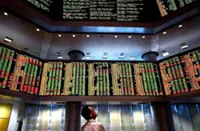
LONDON/SINGAPORE: World stocks were facing a second straight day of falls on Thursday as a glitch in the AI rally and renewed fighting between the U.S. and Iran dampened the mood, while oil prices eased after Israel and Lebanon agreed a ceasefire.
Europe's bourses got off to a steady start as both crude and bond yields dipped, but Wall Street futures were pointing lower again and it had been a difficult session in Asia due to weakness in tech stocks.
Korea's stock market had fallen as much as 2.6%, while Japan's Nikkei 225, Hong Kong and Taiwan all ended between 1.4% and 1.7% lower following a 13% plunge in chipmaker Broadcom's shares in extended U.S. trading on Wednesday.
Not only had the firm's second-quarter revenue numbers missed expectations, but it left its long-range sales forecast unchanged, disappointing traders, who viewed it as a rare sign that a major AI chipmaker may be losing steam.
"You have had a bit of softness in equity markets following Broadcom, which suggests we need a bit of time to consolidate what has been a very strong rally," said Marlborough fund manager James Athey.
"It wasn't about hope and expectation, it raised the notion that demand for chips is not just going to expand exponentially into the future."
Brent crude prices were almost 1% lower at $97 a barrel after Lebanon and Israel agreed a ceasefire, contingent on a complete cessation of fire from the Iran-aligned Hezbollah militia.
There were few obvious signs that a U.S.-Iran peace deal was imminent, however, despite U.S. President Donald Trump saying there could be progress by the weekend.
Bahrain said it had intercepted three missiles and several drones, whilst Kuwait had to suspend air traffic briefly after an attack.
Meanwhile, Iran’s foreign minister Abbas Araghchi posted that "no tangible progress" had been made in talks with the U.S. and that "any hostile act will be met with an immediate, decisive response".
COORDINATED MOVES
In the currency markets, the yen edged up to 159.9 per dollar, opening up a little bit of breathing room from the key 160 threshold viewed as the Bank of Japan's trigger point for FX intervention.
Chief Cabinet Secretary Minoru Kihara had said in Tokyo that he expects the central bank to coordinate its moves with the government after BOJ Governor Kazuo Ueda had given fresh hints that an interest rate hike is on the cards this month.
The U.S. dollar index, which measures the greenback's strength against a basket of six currencies, was broadly steady near a two-month high at 99.45 after better-than-expected U.S. ISM services sector PMI data on Wednesday.
Businesses preemptively placed orders and rebuilt inventories, the figures had showed, in anticipation of shortages and higher prices in the wake of the Iran war.
The Republican-led U.S. House of Representatives had approved a war powers resolution on Wednesday to block Donald Trump from continuing the conflict against Iran.
The measure is largely symbolic, however, as it must still pass the Senate and would need a two-thirds majority in both chambers to override an almost certain presidential veto.
Bond markets saw U.S. 10-year Treasury yields steady at 4.489%, while Germany's Bund yield was down 1.5 basis points at 3.02% ahead of an expected ECB rate hike next week.
The Aussie dollar and gold got a brief lift too after a rebound in resource exports helped swing Australia's trade balance back into the black, although bitcoin fell 2.4% to below $64,000, having now lost almost 25% in recent weeks. - Reuters