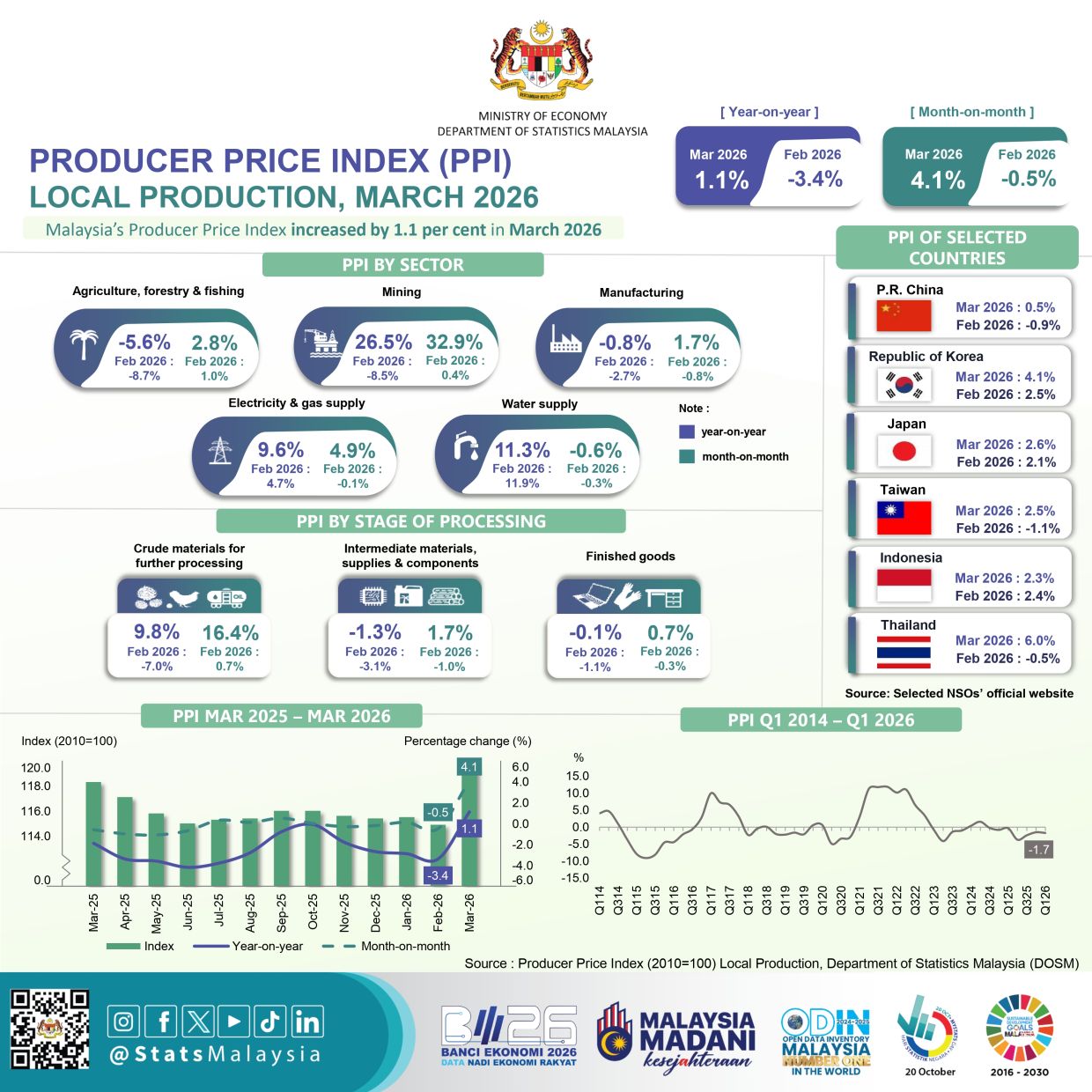
PETALING JAYA: Malaysia’s producer price index (PPI) rose 1.1% year-on-year in March 2026, reversing a 3.4% decline in February, as higher global commodity prices lifted producer costs, according to the Statistics Department.
The rebound was driven mainly by the mining sector, amid a sharp increase in oil prices linked to the ongoing Middle East conflict.
According to the World Bank, average Brent crude oil prices surged to US$103.69 per barrel in March from US$71.11 in February.
Meanwhile, data from the Malaysian Palm Oil Board showed crude palm oil prices rising to RM4,321 per tonne in March from RM4,077.50 in February.
In a statement, chief statistician Mohd Uzir Mahidin said the increase was largely due to a 26.5% jump in the mining sector, supported by a 38.5% rise in crude petroleum extraction.
Utilities also recorded gains, with the water supply index up 11.3% and electricity and gas supply index rising 9.6%.
However, PPI was dragged down by the manufacturing sector which fell 0.8% and the agriculture, forestry and fishing sector which declined 5.6%.
Despite the improvement in March, Malaysia’s PPI remained in contraction in 1Q26, falling 1.7% year-on-year after a 1.5% decline in the previous quarter.
The decline was driven mainly by the agriculture, forestry and fishing sector which fell 7.5%, and manufacturing which declined 1.7%.
However, gains in mining at 1.6% and utilities including water supply at 11.1% and electricity and gas at 6.5% helped cushion the fall.
On a month-on-month basis, the PPI rose 4.1% in March, compared with a 0.5% decline in February, with most sectors recording increases apart from the water supply index which declined by 0.6%.
Mining surged 32.9%, while manufacturing and agriculture rose 1.7% and 2.8%, respectively.
Across processing stages, crude materials for further processing rose 9.8% year-on-year, while intermediate materials fell 1.3% and finished goods edged down 0.1%.
On a monthly basis, all processing stages increased, led by a 16.4% jump in crude materials for further processing.
On a quarter-on-quarter basis, PPI rose 0.9%, slightly higher than the 0.1% increase in the previous quarter, supported mainly by mining and utilities.
Globally, producer price trends were mixed.
In the United States, PPI rose 4%, up from 3.4% previously.
Japan recorded a 2.6% increase, compared with 2.1% in February.
China’s PPI rose 0.5%, rebounding from a 0.9% decline and ending a 41-month deflation streak, driven by higher energy prices and stronger domestic demand.
Closer to home, Thailand’s PPI jumped 6%, reversing a 0.5% decline, supported by higher energy, transport and construction costs.