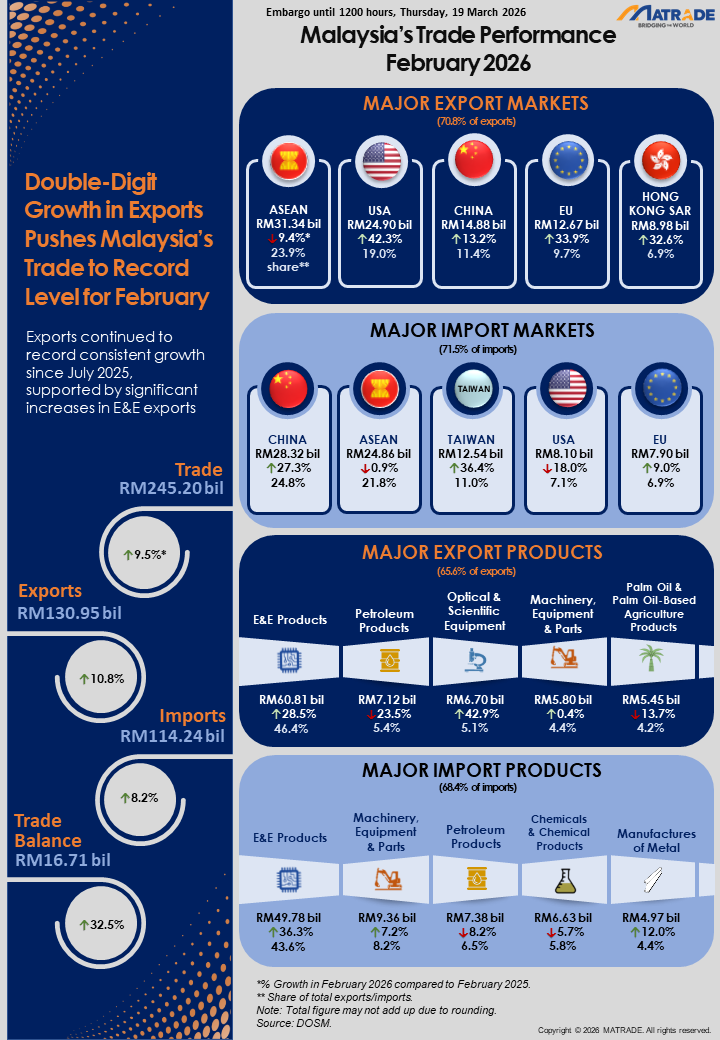
KUALA LUMPUR: Malaysia's export value in February rose 10.8% year-on-year to RM130.95bil, official data from the Ministry of Investment, Trade and Industry (Miti) showed today.
The government report showed the jump in outbound shipments was primarily supported by higher demand for manufactured goods, especially electrical and electronic (E&E) products, optical and scientific equipment, and mining goods.
Imports also remained on an uptrend, rising 8.2% y-o-y to RM114.24bil.
Overall, the country registered a higher total trade value of RM245.2bil for the month, a 9.5% increase from a year ago while the trade surplus came in at RM16.71bil.
In February, Miti said the export of manufactured goods saw 12.8% y-o-y growth to RM114.21bil while exports of mining goods grew 12.3% y-o-y to RM8.12bil.
Agricultural goods, however, saw a 16.4% y-o-y decline in shipments to RM7.23bil due to lower export prices of palm oil and palm oil-based agriculture products despite higher export volumes.
On export markets, Malaysia registered a surge in shipments to the US (42.3%) to RM24.9bil in February, as well as to China (13.2%) to RM14.88bil.
In a statement, Malaysia External Trade Development Corporation (Matrade) CEO Abu Bakar Yusof said the significant leap in the trade surplus is a clear indicator that Malaysia continues to sustain its momentum from the performance recorded in 2025.
However, he highlighted a recent survey that revealed 63.9% of Malaysian exporters are anticipating their exports will be affected by the ongoing turmoil in the Middle East, citing shipment delays and significant increases in ocean freight.
He said the immediate priority is to mitigate the 'double-ended' blockade affecting the country's cargo by leveraging its local presence in West Asia to gauge real-time feedback on the logistical hurdles that are possibly affecting Malaysia’s exports.
“We are mobilising our Middle Eastern offices in Dubai, Jeddah, Cairo and Doha to provide ground-level intelligence and assist exporters in navigating the total Mideast maritime lockdown.
"While we anticipate operational strain, we are positioning Malaysia as reliable alternative suppliers for trade partners seeking to diversify away from regional risks.
"We strongly encourage exporters to explore logistics diversification, such as rerouting shipments to lower-risk ports like Fujairah or Salalah, and to accelerate diversification into less-impacted regions such as South Asia, Latin America and Africa," he added.