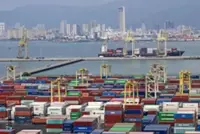
KUALA LUMPUR: Asian ports are increasingly exposed to congestion spillovers arising from the ongoing United States-Iran conflict, with shipping route disruptions in West Asia triggering knock-on effects across global supply chains, according to CIMB Research.
In a research note, it said Asian ports remain vulnerable to secondary impacts stemming from vessel rerouting and suspended shipping activity in the region, although geographically distant from the conflict zone.
“Unplanned vessel arrivals and scheduled disruptions could result in longer turnaround times and port congestion, while reduced network capacity may push spot freight rates higher across major trade lanes,” it added.
Nevertheless, CIMB Research said checks with port operator Westports Holdings Bhd indicate that conditions remain manageable for now, with high vessel volumes but relatively low congestion.
“This is evidenced by yard density staying below 80%t and single‑digit vessel waiting hours as of March 2026.
“Moreover, intra-Asia trade remains Westports’ key trade lane, accounting for 62% of its 2025 throughput volume.”
CIMB Research pointed out that elevated crude oil prices could raise Westport’s fuel costs because it relies on unsubsidised diesel for its terminal truck operations.
“The impact may, however, be partly cushioned by a stronger ringgit, with fuel expenses accounting for 16.6% of total operating costs in 2025,” it said.
CIMB Research further said that Westports is in the midst of a fleet transition, with plans to phase out 60 diesel trucks and replace them with electric vehicles (EVs) by end-2026.
“Currently, the group operates around 600 diesel trucks and two EVs, with greater adoption of EV trucks expected to gradually mitigate fuel cost exposure over time,” the research house said.
It has projected Westports’ container volume to grow 4.5% year-on-year in financial year 2026, driven by normalised gateway cargo after e-waste-related disruptions were resolved and resilient transhipment growth from new Ocean Alliance services and ongoing trade diversion trends.
“Westports is also undertaking initiatives to convert selected on-dock depot and freight station areas into container yards to accommodate rising container volumes.
Westports is the only transport stock under its coverage. Hence, its sector recommendation depends entirely on its performance outlook.
“We remain constructive on the company’s outlook, supported by upcoming tariff adjustments in 2026 to 2027, new Ocean Alliance services and structural growth from global trade diversion,” it said.
CIMB Research maintains its “buy” rating with a target price of RM6.70 and is “overweight” on the transport sector.
Key re-rating catalysts include a resolution to the West Asia conflict, stronger earnings from tariff hikes, recovery in transhipment volumes and sustained gateway growth.
Downside risks include geopolitical tensions, weaker intra-Asia trade, supply chain-driven congestion and higher cost pressures. — Bernama