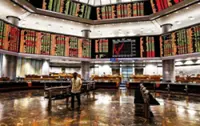
ASIAN stocks and currencies sank on Monday as investors rushed to the safety of the U.S. dollar and dumped risk assets across the region, while oil vaulted back above $100 a barrel as the escalating Middle East conflict threatened a prolonged supply shock.
MSCI's emerging markets equity index fell over 4% and was on course for its worst session since early April last year. The dollar index rose 0.7%, underscoring the scramble to havens.
Brent crude jumped 18% to around $109 a barrel, extending last week's 28% surge, as markets weighed shipping disruptions through the Strait of Hormuz and the risk of a more prolonged supply squeeze.
Global bonds sold off as surging oil and rising geopolitical risks forced investors to reprice inflation and interest-rate expectations.
Weaker-than-expected U.S. labour market data on Friday were largely brushed aside as investors focused instead on the oil shock and fresh political uncertainty in Iran after the naming of a new leader that will likely draw the ire of U.S. President Donald Trump.
South Korea led the region's losses, with the KOSPI plunging 8% and triggering circuit breakers for the second time since the conflict erupted late last month. The won, down 0.7% at 0549 GMT, earlier weakened more than 1% toward the psychologically key 1,500-per-dollar level.
Losses swept across the region, with the Philippine peso and Indonesian rupiah dropping 1% and 0.5%, respectively, to fresh record lows.
The rupiah was on track to breach the 17,000-per-dollar level for the first time. Taiwan's dollar weakened to its lowest level since May 2, while shares in Taipei slid as much as 6.2% and were last down 5%.
Singapore's dollar, now steady, earlier fell as much as 0.5% and the Straits Times Index dropped 2.6%. Stocks in Malaysia, Jakarta and Manila also retreated sharply, losing between 2% and 6%.
Analysts said the pain could prove sharper for Asia's net oil importers, particularly South Korea, the Philippines and Thailand, as higher energy prices widened import bills, strained fiscal balances and complicated central bank policies.
BNP Paribas' Asia-Pacific head of cash equity research, William Bratton, said the bank still expects the market shock to be temporary, though investors remained anxious that it could drag on if Middle Eastern oil and gas infrastructure sustains further damage and keeps energy prices elevated for longer.
In a more prolonged disruption, he noted, China's markets could hold up better than those in Northeast Asia, especially if higher energy costs started to erode consumer demand in the U.S.
Attention now turns to a heavy data calendar that could shape trading through the rest of the week, including final GDP readings from Japan and South Korea and China's trade data on Tuesday, U.S. CPI on Wednesday and Indian inflation and trade figures later in the week.
HIGHLIGHTS:
** Indonesian 10-year benchmark yields rise 17.4 basis points to 6.762%
** Taiwan economy minister: no natural gas shortage before April
** China consumer inflation hits 3-yr high - Reuters