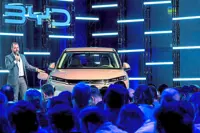
NEW YORK: After nearly a century of Audi AG branding every car with four interlocking rings, the German automaker shed its iconic marker last year in China, betting a sleek, tech-heavy electric vehicle (EV) would reignite consumer interest.
So far, the revamp – it’s now just ‘AUDI’, all caps – has done little to kickstart a turnaround in sales. While the E5 Sportback, the debut model from the sub-brand produced by Volkswagen AG’s (VW) joint venture (JV) with SAIC Motor Corp, has garnered critical acclaim, the view from the showroom floor is less enthusiastic.
It sold just 605 units in January, according to data compiled by Bloomberg Intelligence. Between its launch in September and the end of December, it sold 6,650 units, according to the company.
Even fans of the car, exclusive to China, warn of a number of wrinkles that need to be ironed out.
“I prefer cars that are a bit more niche and I really love the styling,” said Neo Shen, a Shanghai-based engineer who bought the most premium version of the E5 Sportback.
The car retails for between 235,900 yuan and 319,900 yuan.
But “the infotainment system is a total work-in-progress and full of bugs”, he said. The air conditioning turns on by default every time he starts the engine and the driver-assistance features are too slow for city driving, making him miss off-ramps on highways.
Like most foreign automakers, Audi is pouring resources into tailoring its lineup to compete with the digital sophistication of popular local brands like Xiaomi Corp, which effectively offers a smartphone on wheels.
Viewed as better able to meet local tastes, and with the ability to bring advanced EVs to market at a rapid pace, Chinese carmakers have seen explosive sales growth in their home market.
They accounted for about two-thirds of the country’s retail car sales last year, up from less than 40% five years earlier, according to industry data.
“The brand equity of the German premium brands in China has disintegrated much faster than anyone expected,” said Matthias Schmidt, an automotive analyst based near Hamburg.
“Consumers there are increasingly buying local brands, and there’s reasonable concern that those sales won’t come back.”
Audi’s early struggles with the E5 Sportback contrast with both Tesla Inc’s Model Y and Xiaomi’s YU7 – the car’s main direct rivals – which have been hitting deliveries of more than 30,000 units a month. The tepid response underscores ongoing challenges in winning back market share in China. Audi’s sales in the country fell 5% last year to 617,514 vehicles, and the broader Volkswagen group saw an 8% drop.
The decline is even more pronounced among fully-EVs, where sales cratered by 44%. Despite the precarity, China’s significance as the world’s largest auto market means it remains crucial for many global brands. The country is VW’s biggest single market, accounting for roughly 30% of total group deliveries last year, and 38% for Audi.
In an effort to boost sales, the SAIC-Audi JV recently launched an incentive programme which includes a tax subsidy, cash rebate and trade-in premium that, combined, cuts the price by 30,000 yuan.
It’s also offering customers the option of flexible financing options, such as five-year interest-free or seven-year low-interest loans.
The E5 Sportback’s award win as China Car of the Year is encouraging and Audi is committed to its China strategy, focusing on a dual-brand approach with more new models due this year, the company said. — Bloomberg