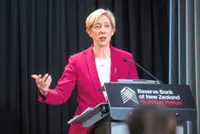
WELLINGTON: New Zealand’s central bank is in the unusual position this year of expecting a strong economic recovery without triggering inflation pressures, according to assistant governor Karen Silk.
The Reserve Bank of New Zealand’s (RBNZ) Monetary Policy Committee this week held the official cash rate at 2.25% and said that policy would remain accommodative because it expects inflation to slow toward its 2% target.
Yet the RBNZ also forecasts annual economic growth will accelerate to 2.8% by March 2027.
“A lot of our discussion in this committee meeting was why should we believe there will be growth at the same time as inflation coming down,” Silk said in an interview yesterday in Wellington.
“It feels like an anathema, but you can have robust growth because of the output gap. It can grow faster than, ultimately, the potential growth in the economy through that period.”
New Zealand’s economy has ample spare capacity following a sharp recession in 2024 and only a nascent recovery last year.
The output gap in the fourth quarter was minus 1.5% of potential gross domestic product, having fallen as low as minus 2.2% in mid-2025, according to the RBNZ.
Inevitably that spare capacity will be used up and the RBNZ will need to move away from stimulating demand.
Investors are fully pricing a 25-basis-point rate increase in December.
Silk said the risks around the forecast cash-rate track are balanced.
While parts of the economy are recovering, there has yet to be a strong pick up in consumption, which partly reflects weakness in the housing market, she said.
Conversely, there is a risk that businesses whose profits have been squeezed start to raise prices and that fans inflation, she said.
The RBNZ currently estimates the so-called neutral cash rate that neither stimulates nor curbs activity at around 3%.
Its forecasts suggest the OCR will only gradually rise toward that level by the end of 2027.
“That’s a reflection of that spare capacity that exists within the economy and the time it will take for that to be absorbed,” Silk said.
Asked if there was a risk of overstimulating the economy, she said that’s why policymakers convene on a regular basis to look at the data and how things are tracking.
“If there were an issue and we were starting to see a recovery happen more quickly, then obviously we’ve got the ability to be able to move,” she said. — Bloomberg