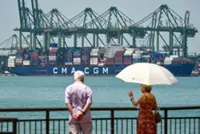
SEOUL: China now controls nearly two-thirds of global ship orders, but for South Korea, the real concern is not volume alone.
It is that its remaining edge is no longer purely technological, but geopolitical, ecosystem-driven and time-limited.
In 2025, Chinese shipyards accounted for 63% of global new vessel orders, far ahead of South Korea’s 21% and Japan’s 5%, according to London-based Clarkson Research Services.
Chinese state data put the figure even higher at 69%, underscoring Beijing’s growing dominance across the industry.
China also led the world last year in the three core metrics of new orders, ship completions and total order backlogs, reflecting the scale of its state-backed shipbuilding system, which combines industrial capacity, financing and shipping demand into a tightly coordinated ecosystem.
Yet, the battle is not decided by volume alone. South Korea still commands high-value segments such as liquefied natural gas (LNG) carriers, where decades of engineering experience and operational reliability make for an enduring competitive edge.
Even that lead, however, is narrowing quickly. Chinese yards are expanding into advanced vessel categories at a rapid pace, backed by steady domestic orders and state support, forcing South Korean shipbuilders to rethink their long-term strategies.
“China has already caught up in many areas of shipbuilding technology,” said Rhee Shin-hyung, a professor of naval architecture and ocean engineering at Seoul National University.
“In traditional shipbuilding techniques, many say there is little gap left, which may allow South Korea to stay ahead for another two or three years at best.
“Without developing genuinely new technologies, it will be difficult to maintain a lasting edge.”
Behind China’s meteoric rise lies the government’s deliberate, all-out efforts to become a maritime powerhouse.
Since the mid-2000s, when Beijing designated shipbuilding as a strategic industry, it has poured billions of dollars into establishing its own ecosystem that links shipyards, shipping companies and financiers in a tightly coordinated system.
The goal was to become the world’s top shipbuilder by 2015.
State support has continued regardless of the market’s boom-and-bust cycles.
The country’s relatively low labour costs and logistics better helped weather the storm in comparison to Japan and South Korea.
Even during global downturns, Chinese yards kept growing capacity through the state owned-lender’s financial support and domestic orders.
China’s ascent was dramatic: Its share of global shipbuilding output climbed from below 5% at the turn of the 21st century to over 50% by the early 2020s.
The post-2008 recovery proved particularly pivotal, as China emerged as the winner in volume and capacity, especially for bulkers, tankers and container ships.
Central to this expansion is China State Shipbuilding Corp (CSSC), the world’s largest shipbuilding conglomerate that was created through the merger of two state-owned companies to curb excessive competition and consolidate market share.
Armed with government-backed funding and policy advantages, CSSC and its vast subsidiaries can set prices that other rivals find difficult to match.
Industry data put the merged CSSC’s global market share at over 20%, greater than the combined market share of South Korea’s three top builders.
“China cannot be matched in terms of sheer output,” said retired Capt Moon Keun-sik, a professor at Hanyang University’s Graduate School of Public Policy.
“It merged the country’s largest yards into a single state-backed shipbuilder.”
Analysts said China’s shipbuilding dominance is further strengthened by a dual-use approach, under which many shipyards that build commercial vessels also produce warships for the Chinese Navy. — The Korea Herald/ANN