
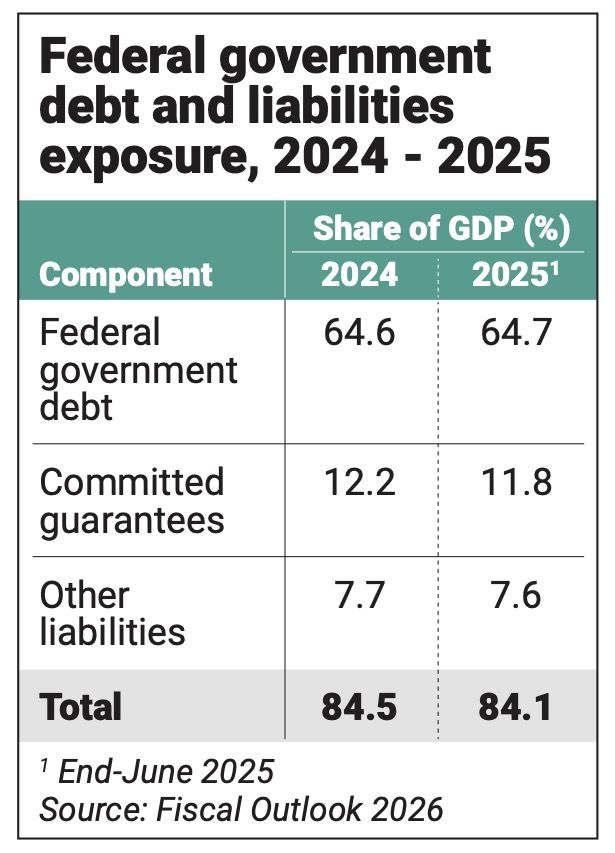
THE combined debt and liabilities exposure as at end-June 2025 amounted to RM1,694.6bil,or 84.1% of gross domestic product (GDP), according to the Fiscal Outlook 2026.
The overall debt and liabilities consist of federal government debt, committed guarantees, and financial obligations from public-private partnership (PPP) as well as private finance initiative (PFI).
Financial guarantees, one of the quasi-fiscal instruments, to enable funding of selected strategic infrastructure projects and targeted lending programmes, stood at 21.1% of GDP – below the 25% limit stipulated in the First Schedule of Act 850.
As for guarantees under Act 96, this grew marginally by 1% to RM336.1bil, or 16.7% of GDP at at end-June 2025 with disbursements mainly for existing projects and programmes.
Based on segmental distribution, infrastructure remains the largest recipient, accounting for 59.6% of total outstanding guarantees.
These were primarily for major public transportation projects such as the East Coast Rail Link (ECRL), Mass Rapid Transit, Light Rail Transit 3, highways and home financing.
The services sector constitutes the second largest share at 29.4%, largely for tertiary student loans and civil servants’ home financing schemes.
Committed guarantees, comprising recipients of financial guarantees which obtain financial allocation from the government to ensure the continuation and viability of strategic projects and programmes, saw a marginal increase of 0.4% from end-2024.
Notably, the report stated that there were additional financing requirements for the ECRL project and Danainfra Nasional Bhd .
.
Coming to PPP projects, there were 108 as at end-June with total outstanding financial commitments to the government amounting to RM112bil, an increase of 5.9% from end-2024.
There were several new PPP projects, which include the assets leasing arrangement, waste-to-energy and agriculture irrigation project.
As for the PFI, outstanding commitments stood at RM41.4bil, compared to RM42.8bil in 2024.
Projects and programmes financed under this approach include public utilities, education, affordable housing, skills development, and maintenance of government facilities.
As such, the Employees Provident Fund and the Retirement Fund (Incorporated) or KWAP provided funding for these initiatives.
Subsequently the government assumed the repayment obligations.
The report said the PPP framework continues to be refined to prioritise user-pay projects and reduce reliance on government funded projects, as recommended under the Public-Private Partnership Masterplan 2030.
Any consideration for new PPP projects requiring government financial commitments will subject to the scope and funding limits
requirements under the Thirteenth Malaysia Plan.
“In addition, PPP governance will be further enhanced, with the view of enacting a legislation on PPP.
“Value at entry evaluation, which was implemented for development projects, will be applied as a mandatory screening mechanism for new PPP projects to ensure only viable, strategic and ready-to-execute projects can be considered.”