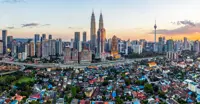
PETALING JAYA: As Malaysia heads into 2025, determined to once again achieve its desired gross domestic product (GDP) target, it faces obstacles in the form of trade restrictions, slowing global markets and geopolitical tensions.
Can these challenges hamper the country’s growth target of between 4.5% and 5.5% this year? What needs to be done to ensure the economy does not get derailed?
Most economists believed that external trade headwinds could weigh on growth.
AmBank Group chief economist Firdaos Rosli opined Malaysia’s GDP growth target for this year is achievable, albeit with some challenges.
“The economy is expected to benefit from strong construction growth, driven by the current investment upcycle and a resilient services sector, which is projected to grow at around 5.2%.
“However, external headwinds in trade may weigh on growth. For 2025, we expect growth to stabilise at 4.6%, slightly lower than the 5.1% in 2024, as global uncertainties persist and domestic demand moderates,” he told StarBiz.
Externally, Firdaos said the potential implementation of US President Donald Trump’s tariffs could drain resources and create volatility in financial markets.
“The overall investment climate is also mired with uncertainties, as lower predictability and stability of many governments’ policies (in response to Trump’s tariffs) may affect foreign direct investment.”

Last week, Trump revealed that his proposed 25% tariffs on Mexican and Canadian goods will take effect tomorrow, along with an extra 10% duty on Chinese imports due to lethal drugs that are still entering the United States from those countries.
Reuters reported that the fresh China tariffs, in addition to the 10% levied on Feb 4, coincide with the start of China’s 14th National People’s Congress on Wednesday, a key event where Beijing is expected to unveil its main economic priorities for 2025.
Centre for Market Education chief executive officer Carmelo Ferlito concurred that the main challenges this year will stem from the global uncertainties.
“American duties and the very high risk of a severe downturn in the Chinese economy, plagued with the effects of decades of socialist central planning, (could have an impact),” he said.
Ferlito noted that China’s numerous stimulus packages will only create “further artificial – and not sustainable” support.
It was reported last week that China plans to inject at least 400 billion yuan or about US$54.9bil into its biggest banks in the coming months as part of a broader stimulus package to revive economic growth.
Ferlito said Malaysia needs to further intensify its path towards liberalisation to boost the local business environment.

“There should be fewer labour restrictions, a more modern banking system and policies to reduce fiscal burdens.”
Additionally, he emphasised the need for more room for “true free trade agreements that are simple and easy to implement.”
“This is particularly true with the European Union, which is still a limited trading partner for Malaysia, considering the fact that it comprises 27 countries and accounts for around 8% of international trade with us.”
Meanwhile, Williams Business Consultancy Sdn Bhd founder and economist Geoffrey Williams believed that the global trade environment will “not be hit too much” by the Trump tariffs, which he opined are largely a “negotiation position” to leverage policy changes.
“Malaysia should not be affected too much directly and might benefit indirectly if there is a transfer of Chinese trade through third-party countries.”
Williams noted many of the headwinds over the past two years have been easing.
“Geopolitical tensions in the Middle East and Ukraine are now heading towards negotiations. Interest rates globally are stable or downwards, and trade is stabilising.
“Overall inflation is at normal historical levels, growth is stable and interest rates are unlikely to change. So this sets a good domestic macroeconomic environment, allowing the government to focus on structural reforms,” he said.
The economy grew 5% in the fourth quarter of 2024, slightly above market expectations and the official advance estimate of 4.8%.
Seasonally adjusted, Malaysia’s economy contracted by 1.1% quarter-on-quarter but grew 5.1% year-on-year.

Williams said the 2024 GDP was within expectations. “The strong investment levels will take some time to impact GDP and will help growth in 2025 at similar levels.
“Domestic consumption is strong, supported by wage recovery and the Employees Provident Fund withdrawals of around RM12bil.”
Williams emphasised that these supported growth in 2024. “Net trade has been weak but overall trade has been strong, especially in the most recent data. This helped final quarter growth.”
For 2025, Williams said higher civil service wages and minimum wage, as well as lower unemployment, should support domestic demand.
“The targeted subsidies rollout for RON95 will be in the second half of 2025 (2H25) and is essentially a transfer, so this will support growth since the savings will be redistributed.”
He opined that to ensure growth is felt by the people, focus should be placed on raising incomes and improving income redistribution, so that both the bottom 40% and middle 40% income groups benefit.
Domestically, Firdaos said the planned RON95 subsidy rationalisation in the 2H25 could pose challenges, particularly for lower-income households.
“We think the government is acutely aware of this, thus we expect clear communication and targeted support mechanisms should be adequate to mitigate the impact on consumers and maintain economic stability.”
Firdaos emphasised that Malaysia should focus on diversifying its economic base and strengthening resilience against external shocks.
“This isn’t easy as our trade-to-GDP is on an increasing trend, post-pandemic.
“As the United States is increasingly becoming more inward-looking, countries around the world will look for another economy to fill in the void. This is where things will get more exciting in 2025.”
According to Firdaos, maintaining a stable and predictable investment climate will be key to attracting both domestic and foreign investments to Malaysia.