




LAST week, officials from Tenaga Nasional Bhd’s (TNB) single buyer unit, together with officials from the Energy Commission (EC) the Energy Transition and Water Transformation Ministry, met with industry players to disclose the suggested charges for third party access (TPA) to the national electricity grid.
These charges are akin to a toll rate to be paid for renewable energy producers who intend to sell their green energy via the grid.
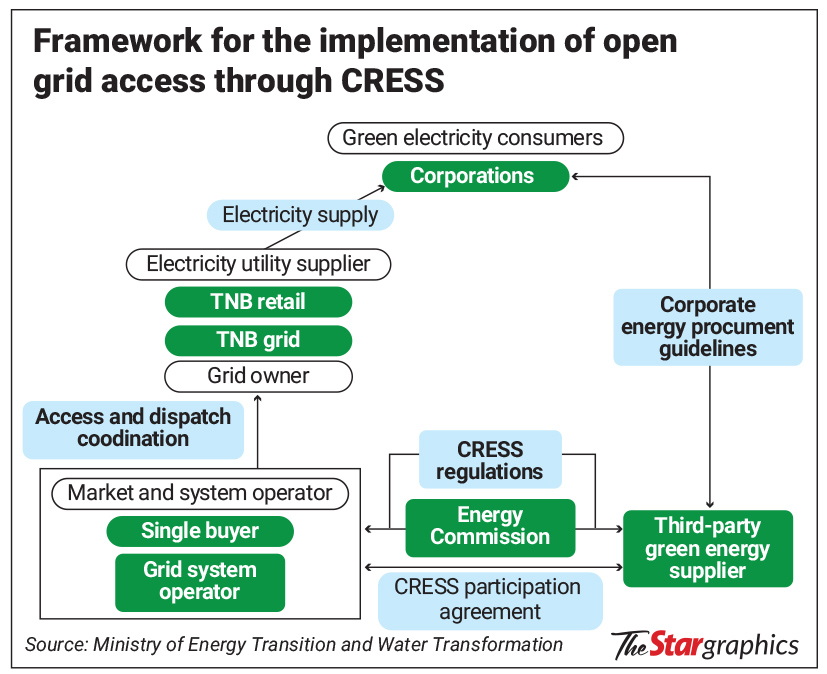
Malaysia’s TPA programme, called the Corporate Renewable Energy Supply Scheme (CRESS), is meant to start next month, as part of a bigger plan to liberalise the energy sector.
Recall that the government announced an elaborate energy transition roadmap last year that promoted the ideas of deregulation and open access for Malaysia, all aimed at positioning the country as a regional hub for renewable energy.
“This has put Malaysia in a pathway so far only achieved in South-East Asia by Singapore and the Philippines,” says John Yeap, a consultant at international law firm Pinsent Masons and who specialises in regulatory advice involving energy, power, renewable energy.
Yeap wrote this in a recent article entitled “Malaysia’s anticipated open access power grid regime could pose challenges”.
However, the access charges revealed last week have got the industry riled up – they are more expensive than what they were hoping for.
RHB Research, in a recent note, said: “We believe the introduction of CRESS represents a progressive step towards power industry reform, leading to a more liberal and competitive market”.
The access charges are 45 sen/kWh for those pumping in non-firm renewable energy into the grid while it is 25 sen/kWh if the producer sorts out the intermittency via his own capital expenditure thus only selling firm output of energy through the grid.
The intermittency refers to solar power which is only generated during certain peak hours of the day.
It is yet to be determined if these rates are written in stone or that thet are being reviewed by the government with industry feedback.
“The rates revealed are so high, that it could mean that the CRESS model will not result in the desired objective which is to bring about healthy competition for renewable energy to be widely available,” points out one solar producer firm’s chief executive officer (CEO) who declined to be named.
To understand why the industry reckons the rates are too high, some comparisons need to be made.
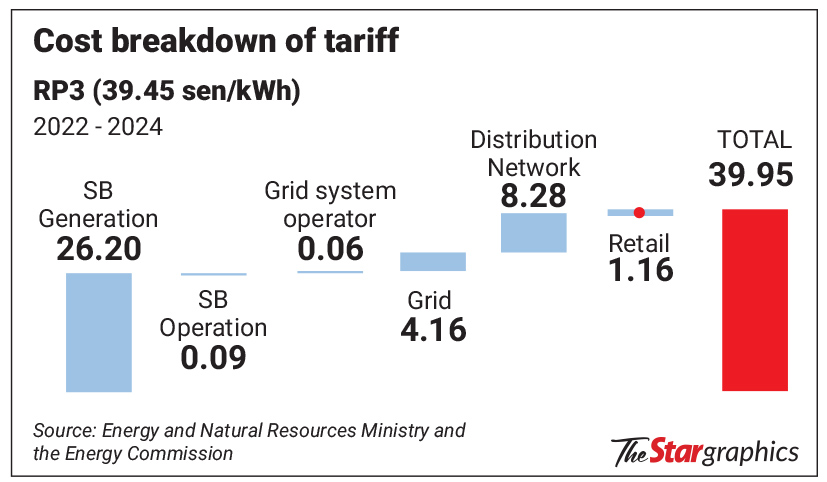
Looking at the 25 sen/kWh charge, where the grid owner doesn’t have to deal with any intermittency issues and is receiving energy in a similar way from what traditional power plants are producing, it is higher than what TNB has stipulated as its transmission and distribution costs. That figure stands at 12.44 sen/kWh.
This figure is cited in the breakdown of all the charges that go into how much electricity is charged in the country, which stands at 39.95 sen/kWh although that doesn’t include imbalance cost pass-through charges (see top chart).
“At 25sen/kWh, it is double what TNB lists out as its transmission and distribution costs. Why these additional charges? This has not been explained or justified,” quips the CEO.
As for the 45 sen/kWh fee, it looks toppish when benchmarked against current rates for green energy in the country.
If the producer has to pay 45 sen/kWh for access charges to the grid, then his end price to his customers will be around 65 sen/kWh, industry experts predict. This price will be more expensive than any green energy tariff in the country.
Breakdown of cost structure would be helpful
On the flip side, the access charges for TPA to the grid are said to be competitive when compared with regional markets. “There are also the transmission costs and of course the additional costs to manage the intermittency of the ‘non-firm’ energy coming into the grid.
“This will have to be done by battery storage systems, which entail a fair bit of capital expenditure (capex).
“Perhaps what is needed is more transparency in how the wheeling charges are being calculated,” says another CEO of a solar producing company.
TNB and EC had yet to reply to queries from StarBizWeek.
TNB intends to invest more than RM90bil over the next six years for its grid infrastructure.
Wheeling or access charges are meant to play a role in helping TNB with that planned capex.
But a fine balance needs to be struck between that and opening up access to its grid on market- friendly terms.
“The move towards open access and deregulation will be central to Malaysia’s ambitions in becoming a regional hub for renewable energy,” writes Pinsent Masons’ Yeap.
He added: “In jurisdictions which have already moved to an open access regime, entrenched monopoly interests can resist unbundling or can attempt to block market entry for third parties – for example, by shielding from public view the system’s availability to accommodate third-party transactions”.
Regulation of open access is key
Liberalisation of any industry can only take place with astute regulation of the sector.
Aside from pricing, execution of TPA will be another challenge.
Even in markets where access to the grid has been opened, there are significant delays in processing applications from producers to gain access.
This has been an issue amid the current boom of renewable energy in Europe.
“Demand for new connections can overwhelm the limited resources of the grid and its operators.
“Since transmission system capacity can only be expanded gradually, it can then be difficult for the grid company to accommodate the upsurge in the number of requested connections.
“The regulatory regime for the independent grid operator should sufficiently incentivise investments ahead of demand to avoid system constraints, while also avoiding stranded costs and assets,” Yeap states.
In markets such as the UK and Australia, the current boom in renewable energy has meant that prospective new projects have had to wait as long as five years to be granted access, though legislation or other measures are being proposed to prevent this from happening in future, adds Yeap.
Meanwhile, another concern of the CRESS programme in Malaysia is that indications are that it will only apply to new investments in the country.
What that means is that existing facilities in Malaysia will not be able to apply to buy green energy under this new third party access.
If that is the case, it would be a shame – it is essentially depriving existing investors in the country from participating in a new green energy scheme.
These are the very companies that have long invested in Malaysia, providing jobs and contributing to the economy.
They should be entitled to all new green energy schemes as they are also under pressure to use more green energy from their stakeholders.
On the flip side, there is a counter argument to liberalisation of the energy sector.
The UK, which has one of the most liberalised energy markets, began that journey in the 1990s and today, all energy network infrastructure is privately owned.
There is increasing unhappiness about this – that the private sector is able to determine energy rates, which some quarters argue are too high, plus the fact that there is seemingly under-investment into the grid by the private companies.
This is more so in light of the plans by governments to transition their energy sources into renewable ones.
The UK government is planning to nationalise some of that infrastructure.
This is why a healthy balance needs to be struck when it comes to energy infrastructure – no mean feat for any government.
Meanwhile, speculation is rife that the recently-revealed third party access charges to the grid have not yet cast in stone.
“There is the possibility that based on industry feedback with all the numbers and implications, that the minister may decide to relook the numbers and request for some adjustments.
“The minister is serious about the liberalisation of the sector, the country’s net-zero goals coupled with the fact that Malaysia is aiming to become a regional hub for renewable energy,” notes one industry observer.
Already a subscriber? Log in
Get 20% OFF The Star Digital Access
Cancel anytime. Ad-free. Unlimited access with perks.

