
THE United States commercial real estate sector still paints a gloomy picture, as it is finding it hard to shake off the troubles the Covid-19 pandemic left in its wake nearly four years ago.
Many office properties in the United States are facing an uncertain future, with some reports going as far as to suggest that the sector is entering a crisis point.
Changes in work patterns and jacked-up interest rates, which tanked property valuations, have resulted in office buildings becoming the biggest casualties post-pandemic.
The commercial real estate segment, once touted as a safe haven for investors seeking reliable returns, is seeing lenders shying away from lending to commercial property for fear of a surge in late payments and loan defaults.
At the heart of it all is the impending US$1.5 trillion debt bubble in the US commercial property sector that is expected to mature before the end of next year, further highlighting refinancing risks for lenders.
ALSO READ: Demand for co-working space remains resilient
Looking at our own backyard, it would seem that the tremors of the US commercial sector have not reached Malaysian shores, judging from the relatively stable performance of the local office sub-sector.
Affirming this observation, Knight Frank Malaysia office strategy and solutions executive director, Teh Young Khean, says real estate markets have traditionally always been driven by local market factors.
“There are still positive signs of demand in the office market, particularly from industries such as global business services (GBS) and other offshore centres which require physical office space,” he tells StarBizWeek.

OCBC Bank (M) Bhd managing director and head of wholesale banking Jeffrey Teoh Nee Teik concurs, saying the domestic commercial real estate market may not necessarily experience a direct contagion effect from a crisis in the US market. Notwithstanding this, he says the inter-connectedness of global financial markets means that disruptions in one market can have ripple effects on others.
“Heightened investor risk aversion and a slowdown in global economic activity resulting from a US commercial real estate crisis could indirectly impact investor sentiment and capital flows into emerging markets like Malaysia, potentially affecting the commercial real estate sector to some extent.
“However, we remain cautiously optimistic about the sector due to the stable underlying economic fundamentals and generally positive economic outlook of the nation,” he says.
Affin Hwang Investment Bank Bhd senior real estate investment trust (REIT) analyst Afifah Ishak also cautions that the possibility of indirect effects stemming from broader investor sentiment, financial system linkages and potential economic slowdowns due to the US Commercial real estate crisis cannot be completely dismissed.
“If financial institutions with exposure to the US real estate suffer significant losses, this could affect their global lending practices, which might, in turn, impact financing for real estate projects in the country. Nonetheless, Malaysian banks generally do not fund the commercial real estate market in the United States, or if they do, their exposure is very minimal,” she says.
Rentals under pressure
Although Knight Frank’s Young Khean is of the view that the office space landscape in the Klang Valley remains generally stable, he notes office rentals continue to be under pressure within the KL City sub-market due to the incoming supply and existing dated buildings.
There were approximately 117.7 million sq ft (equivalent to 8,743 Olympic-sized swimming pools) available in the Klang Valley office market as of December 2023 with an average occupancy rate of 73.2%. About 1.87 million sq ft (equivalent to 139 Olympic-sized swimming pools) of new office supply is expected to enter the Klang Valley market this year.
“REITs and building owners will need to stay competitive by being creative and open to the needs of the occupier’s demands such as those driven by environmental, social and governance (ESG) considerations requiring occupancy in green-certified buildings, as well as the need for Malaysia Digital status to attract technology-oriented companies,” he says.
RHB Research property sector head Loong Kok Wen says the issue of oversupply in the office sector has been a decade-long issue and landlords need to continuously upkeep their properties and ensure that buildings are equipped with modern infrastructure such as fibre optics for Internet connectivity to stand out from the competition.
“Furthermore, on the oversupply issue, we see a lot more supply in the city centre compared with KL Fringe areas like Bangsar and Damansara. There is a trend called decentralisation where office buildings in the KL Fringe areas benefit from relatively cheaper rentals and less traffic congestion than those in the city centre.
“Hence, this attracted some corporates to go for spaces in Bangsar, Petaling Jaya and Damansara,” she says.
Loong observes that the stickiness of investing in office properties hinges upon the quality of the buildings where those equipped with good infrastructure are deemed more marketable.
“There are essentially two categories of investors in the commercial property market. The first types are corporate entities that acquire entire buildings for their own operational use. Institutional funds and property funds constitute another segment of buyers, typically investing in tenanted buildings to generate recurring yields,” she opines.
And yet, there are also some investors who are venturing beyond real estate, exploring alternative asset classes to spread risk and capture opportunities in different sectors and markets, with the overall goal of optimising their broad portfolios.
“In recent years, depending on individual risk tolerance, investment goals and mandates, and response to certain market conditions, some investors have diversified their portfolios to other real estate classes such as industrial, logistics, retail properties and data centres.
“A number of projects within these other real estate classes have shown promising growth and resilience, attracting investors seeking diversification and potentially higher returns,” Teoh says.
Supporting the assessment, Affin Hwang Investment Bank Bhd senior property analyst Nicholas Lim says the oversupply of commercial properties has led to diversification into industrial and logistics properties that are seeing rising demand for leasing and purchases.
“Over the past two years, we observe a growing trend for property developers diversifying and expanding their presence in the industrial segment. The segment is attractive as it not only offers developers enhanced property margins with rising prices, but also boasts shorter construction periods compared to high-rise residential and commercial property development, facilitating a quicker turnaround in the investment cycle for developers,” he says.

Purpose-driven
There has been a shift in the requirements for office space following the pandemic, says JLL (M) head of research and consultancy Yulia Nikulicheva. Now, the purpose of office space is seen as a contributor to increased productivity rather than just a cost.
“Companies may consider lower attendance ratios and provide fewer dedicated desks. However, they will also provide more collaborative spaces such as meeting rooms, quiet areas for focused work, and social areas.
“Therefore, the provision of space per person remains unchanged or may even increase in some cases. We do note that in the face of rent increases, tenants become more cautious about total occupancy costs, and some may choose to lease or move to a new space and have lower space provision per employee,” she says.
Nikulicheva observes that unlike the United States, where work-from-home and hybrid work arrangements are still popular concepts, the majority of markets in the Asia-Pacific and Europe regions have high office return rates where employees are back to offices three to four days a week.
“In the Asia-Pacific region, however, the return to the office trend is even more pronounced. For 20 markets tracked by JLL in the region, we observe an average 78% office re-entry rate.
“Therefore, many investors do not consider changes in office attendance and working patterns in the Asia-Pacific region as risks that would potentially lead to a decrease in office property values,” she adds.
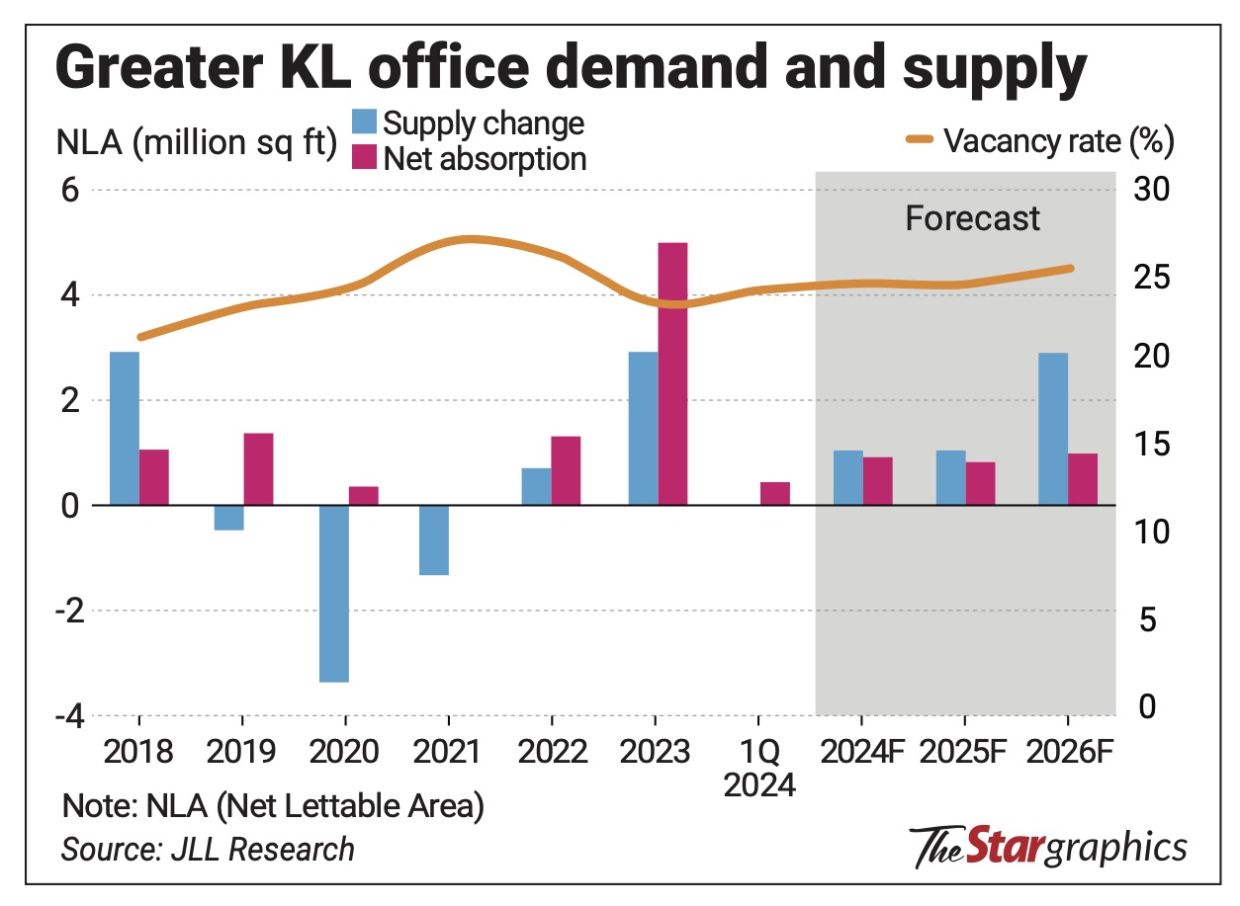
The same goes for Kuala Lumpur where the return to office ratio is also quite high, a trend reflected in the dynamics of net absorption (the difference between the commercial space vacated and the space taken up), which confirms the shift towards office utilisation.
“We observed positive net absorption starting in 2022 in Kuala Lumpur’s prime office market. Positive values that we saw starting from 2022 imply that companies were steadily increasing the volume of occupied space as they were upgrading their space requirements,” Nikulicheva says.
Generally, office buildings in Malaysia are categorised into Prime A+, Grade A, Grade B and Grade C. The grade of an office building is defined by its floorplate sq ft/size, efficiency of the floorplate, certification of building, specification of building, age of building and location address.
Notably, there is also a strong flight-to-quality or flight-to-green trend where Prime A+ and Grade A offices are in demand, largely driven by occupiers with significant ESG agendas. This leaves Grade B and C office buildings to be less than desirable, with many older ones, especially those built more than 30 years ago, seeing an increase in vacancy rates and a downward trend in rents.
“Following a period of weak demand during the pandemic, office properties with green certification experienced a faster absorption rate by tenants. Over the past 21 months, we observed a more significant reduction in vacancy rates for green spaces compared to non-green spaces,” Nikulicheva says.
She further elaborated that there is a rent premium of about 15% to 20% for green spaces. In comparison, there are less positive rent dynamics for non-green spaces.
“We analysed rent dynamics from July 2022 to March 2024. Starting from the second half of 2022, the market began to distinguish between green and non-green spaces. We also noticed that the average rent for green spaces is gradually converging with the market average, as the supply of green spaces in the Kuala Lumpur market is increasing,” Nikulicheva says.
Even so, she stresses that the strategy for revitalising older offices may vary depending on their individual characteristics, and the cost of introducing green features is among the key factors that need to be considered, with others being location, property structural characteristics and availability of parking.
“Depending on the planning and engineering solutions, the cost of introducing green features can be quite significant. While there may be some quick wins for basic green features, achieving silver or gold green certification would require substantial investments.
“Converting an existing property into a green building is costlier than incorporating green features into a newly planned building,” she says.
On this note, Young Khean points out that abandoned offices would be a misnomer, as it is incredibly rare for a building to be left vacant with no other processes being carried out.
“They might be perceived as being abandoned but a potential sale or repurpose would usually be happening behind the scenes.
“Office buildings that are not performing well would usually be repurposed to serve other functions such as transforming into a hotel, hospital, education centre or even columbarium,” he says
Improving environment
Young Khean suggests that for aged office buildings that no longer meet the needs of modern companies, the course of action is to refurbish or redevelop them.
“Refurbishment and upgrading plans are largely considered and practised by older supply of office spaces to stay intact with the market to attract new tenants and retain existing ones.
“Redevelopment, on the other hand, is a large decision and typically requires a thorough due diligence and feasibility study for building owners before deciding to pursue this route,” he says.

Acknowledging the fact that green building accreditation has become an increasing important criterion for large corporates, Sentral REIT Management Sdn Bhd (the manager of Sentral-REIT) chief executive officer Derek Teh says the group has worked with some of its key multinational corporation (MNC) tenants over the years on energy-efficiency enhancement initiatives to reduce energy consumption and improve equipment efficiency as well as incorporate green features to some of its non-green accredited properties, where practicality is deemed important to tenants.
As at the fourth quarter of 2023 (4Q23), three out of 10 of Sentral’s total portfolio or 71% of the group’s cumulative portfolio (by valuation) consisted of green buildings and buildings with green features.
“The company is conducting gap analysis on some of its non-green accredited properties within the portfolio to determine the viability of converting these buildings to green buildings, as part of its efforts to further enhance its portfolio competitiveness,” Derek says.
Be that as it may, Derek says that at this juncture, there is no clear distinction in rental rates between offices that have green accreditation and those that do not.
“Rental rates are also very much dependent on a combination of factors (but not limited) of location, building specifications, size of demised premises, fitted or bare units.
“In general, the reversionary rental (that is escalation of rental) of office space has been flattish over the past few years, and this is mainly due to the incoming supply into the market,” he says.
In this aspect, IGB REIT Management Sdn Bhd chief executive officer Elizabeth Tan Hui Ning offers a differing view, saying there is indeed a growing divide between Prime A+ and Grade A office spaces and others, with higher rental yields favouring green-rated and Grade A buildings, especially those located at strategic locations.
“Global corporations prioritise such spaces for their ESG commitments, driving demand and valuations.
“Additionally, we have observed varying rates of rental income growth across different grades of buildings, influenced by their locations. Properties situated in the Mid Valley City area typically demonstrate stronger rental growth compared to those in the Kuala Lumpur City area. This variance underscores the importance of not only the grade of the building, but also its strategic location in driving rental performance,” she says.

Tan says the foremost considerations in office building selections typically revolve around factors such as location, accessibility, building maintenance and available amenities. In tandem with these priorities, tenants increasingly prioritise newer, technologically advanced and ESG-compliant spaces, driven by a growing emphasis on the latter.
“A subset of tenants is inclined to allocate additional financial resources toward leasing such premises, recognising them as strategic investments in fostering sustainable practices and enhancing the well-being of their employees,” she says.
While Tan is aware of the significant initial costs and rigorous evaluation processes involved in obtaining green certification for office buildings, she says the long-term benefits in energy conservation and reduced operational expenditures justify the investment.
“Many buildings are choosing to refurbish existing infrastructure or incorporate green building standards into new developments to capitalise on these advantages.
“The resulting energy and water savings significantly reduce operating expenses, rendering it both financially prudent and environmentally responsible. As sustainability becomes increasingly prominent, such practices are becoming the new norm in the office market,” she says.
Green-certified buildings
At present, not all IGB Commercial REIT’s office buildings are green-certified. A notable one in this area is the GTower, which stands out as the country’s first fully certified green building. It was awarded the Green Mark Gold by Singapore’s Building & Construction Authority. Presently, GTower holds the GreenRE (Gold) Commercial Category Award. Not only that, IGB Commercial’s Southpoint Offices & Retail has also achieved the Green Building Index Silver Certification.
“The cost of obtaining these certifications can vary significantly depending on factors such as building specification, and existing mechanical and electrical infrastructure,” Tan says.
As at Dec 31, 2023, Sentral-REIT had 10 commercial properties with a total value of RM2.52bil. Boasting a well-balanced and diversified tenancy mix (as at 4Q23) mainly from MNCs and large local corporates, the group has roughly 2.57 million sq ft of net lettable area and recorded a portfolio occupancy rate of 89% as of the end of 2023, including the newly acquired Menara CelcomDigi last year.
Sentral REIT Management (the Manager of Sentral-REIT) chief investment officer Joyce Loh says the healthy portfolio occupancy rate was achieved through intensive leasing efforts in 2023, where the group has recorded an 82% tenancy retention rate.
“In addition, about 285,000 sq ft of vacant space was successfully leased in the previous year with active leasing strategies to fill the vacant office space in Sentral Building 4, retail space in the KL Sentral properties and Plaza Mont’ Kiara. Sentral-REIT’s portfolio occupancy was above the Klang Valley’s office market average occupancy rate of 73.2% in 2023,” she says.
Sentral-REIT’s positive trajectory can be partly attributed to the yearly asset-enhancements efforts that the group carries out for each building, to maintain and improve the quality and physical condition of its properties.
“Part of the group’s tenant management strategies include periodic tenant engagements to understand tenants’ requirements regarding building specifications and common area amenities.
“These requirements will be prioritised when planning for Sentral-REIT’s yearly asset-enhancement plans. The investment into asset enhancement varies, depending on the nature of the enhancement planned during the year,” Loh says.

Looking ahead, Loh says Sentral-REIT will continue to focus on its asset management and leasing strategies that are centred on cost optimisation and tenant retention in the current operating environment.
“The Klang Valley office and retail markets are expected to remain challenging, but with observed uptake in business activities as a result of the various initiatives, subsidies and incentives introduced by the government,” she says.
Loh also notes that the incoming office supply is mainly within the KL City centre and Sentral-REIT’s portfolio is predominantly in the KL Fringe and Selangor areas, with more than 50% of the group’s portfolio (by valuation) anchored by its KL Sentral properties (namely Menara Shell and Platinum Sentral).
“This has provided income stability to the portfolio due to the highly demanded locality of Sentral-REIT’s properties and building specifications that met the business and ESG requirements of its multinational tenants,” she says.
Meanwhile, Tan says the group remains cautiously optimistic that its current strategic initiatives will sustain a consistent and steadily improving prospect for the company’s performance, when considering the impact of new office openings.
“IGB Commercial REIT mitigates risks through building community through active engagement with our tenants while ensuring our buildings remain relevant through strategic investment in asset-enhancement initiatives.
“By balancing cost, efficiency and quality, it strengthens our portfolio and enhances value for tenants and stakeholders. Despite the outlook indicating supply surpassing demand in 2024, leading to increased competition, the group will continue its strategy of prioritising tenant satisfaction, adopt proactive flexibility and build competencies to cater to evolving needs,” she says.
Already a subscriber? Log in
Get 20% OFF The Star Digital Access
Cancel anytime. Ad-free. Unlimited access with perks.