




GLOBAL warming and the net zero transition have far-reaching implications for investors. In particular, embracing a net zero path will impact investors’ asset allocation in two ways.
Firstly, strategic asset allocation decisions will need to consider how the transition will impact economic and financial variables and thereby, the returns investors can expect in the future across asset classes. Our findings suggest that the transition will lower the expected returns of risky asset classes including equity and high yield credit. Corporate cost structures will be negatively impacted, leading to lower earnings growth. Yet, we also recognise that responsible investors will favour sectors and companies which lead the innovation required to make the transition happen.
And secondly, investors can embrace the net zero path within their equity and corporate bond allocations to ensure their portfolios are net zero aligned. In doing so, investors will have to reassess traditional asset allocation approaches, so as to reflect the fundamental shifts in the world’s economy caused by climate change. A bottom-up approach to asset allocation has been gaining traction, as the urgency among investors and regulators to address climate change gathers pace. This urgency is demonstrated by investor and asset manager coalitions, such as the Net Zero Asset Owner Alliance, as well as the Net Zero Asset Managers Initiative. As part of these initiatives, financial institutions are setting science-based climate targets, with the ultimate goal of reaching carbon neutrality by 2050.
Novel strategies
For climate targets to be realised, the asset allocation decision can be implemented in different ways: using a passive climate-aligned benchmark, embracing a net zero active cross-asset allocation or using an active cross-asset strategy which incorporates specific targets for green investments.
Asset owners will inevitably face trade-offs when introducing climate considerations into their portfolios. The most prevalent one is a trade-off between portfolio diversification and the incorporation of climate targets. Our findings suggest that the short term financial cost of integrating net zero considerations into investors’ asset allocation is limited and should be offset over the long run as corporates gradually transition towards low-carbon models. Although our analysis shows that incorporating net zero targets can be costly in terms of tracking error (TE) in the near term, the TE differential should be mitigated as the economy becomes more aligned towards a 1.5°C trajectory over the long term.
On the other hand, the reduction in carbon intensity levels is significant as we incorporate Net Zero pockets into standard asset allocation strategies.
Finally, we believe that embracing climate considerations can have positive effects for investors over the long term and open active management opportunities in themes such as water quality, renewable energy, recycling and waste management, green buildings and green bonds.
The risk-return advantage
Integrating net zero targets into asset allocation can provide benefits from a risk-return perspective. Indeed, the low-carbon transition is likely to bring about significant opportunities for investors, as new business models emerge that will probably perform better in the future.
The benefits of adopting net zero targets can include:
> Identification of new trends: A future net zero economy is likely to be structurally different from the economy we know today, having experienced significant inter- and intra-industry transformations. While it is impossible to predict whether net zero portfolios will outperform business-as-usual portfolios, integrating net zero considerations into portfolios today will allow investors to anticipate these shifts, and thus be better positioned in this future carbon-neutral economy.
> Risk mitigation: Net zero portfolios are less likely to be impacted by transition risks. We define those risks as those relating to regulatory, legal, technological and market changes brought about by the move towards a climate-friendly society. These can arise both at the issuer level — For instance, carbon pricing being introduced for utilities companies; and at the investor level with the Sustainable Finance Disclosure Regulation (SFDR) in Europe, or Article 29 of the Energy and Climate Law in France as examples.
Integrating net zero targets and reducing greenhouse gas (GHG) emissions can also contribute to mitigating the physical risks arising from climate change.
Examples of these risks include a corporate or project exposed to asset damage, and disruptions to supply chains or business operations. This reduction in physical risks will be indirect but, in the long run, the fall in GHG emissions will reduce issuers’ exposure to extreme weather events.
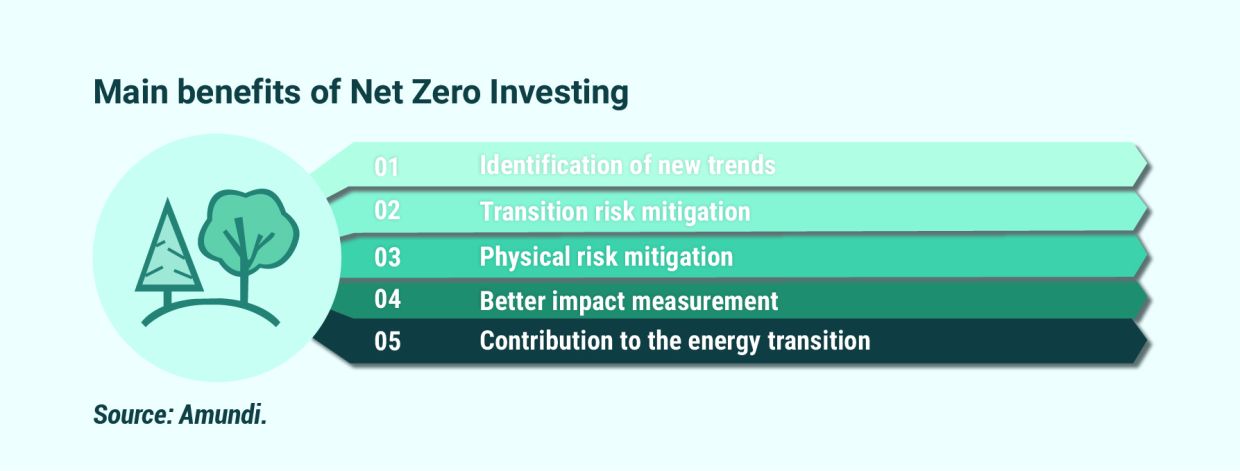
Better impact measurement
Beyond the risk-return argument, integrating net zero targets into asset allocation makes sense from an impact perspective. Long-term institutional investors should consider integrating climate considerations across all asset classes in their portfolios. It is important to note, however, that for now, we focus only on publicly-listed equities and credit for several reasons. There is currently a lack of available metrics to measure the progress of unlisted assets in terms of climate performance while, at the same time, this asset class lacks depth and liquidity.
As for sovereign debt, a net zero methodology is currently being developed by the industry. Hence, we can expect to integrate this asset class in the near future once a robust net zero target-setting process is available.
Moreover, the net zero objective encompasses different sub-objectives such as investing in low-carbon corporates versus investing in companies contributing to the energy transition via solutions and technologies. These would be difficult to include in a single investment strategy.
As a result, integrating net zero considerations into the asset allocation process is a way to target several sub-objectives that contribute to reaching the net zero goal by 2050.
Additionally, to establish a consistent overall carbon emissions trajectory for each asset owner, net zero key performance indicators (KPIs) must be calculated and monitored across all the owner’s investment portfolios.
Vincent Mortier is Amundi group chief investment officer and a member of the company’s global management committee, executive management committee, and other supervisory boards.


