
IF the local stock market is an indication of Malaysia’s well-being, then it looks like a lot more has to be done.
The stock market’s benchmark index, the FBM KLCI is at its lowest in years and it has been this way for some time now.
Part of the reason for this is that foreigners have been showing their disdain for local stocks by continuously dumping shares, choosing to put their money elsewhere in the hope of getting better returns.
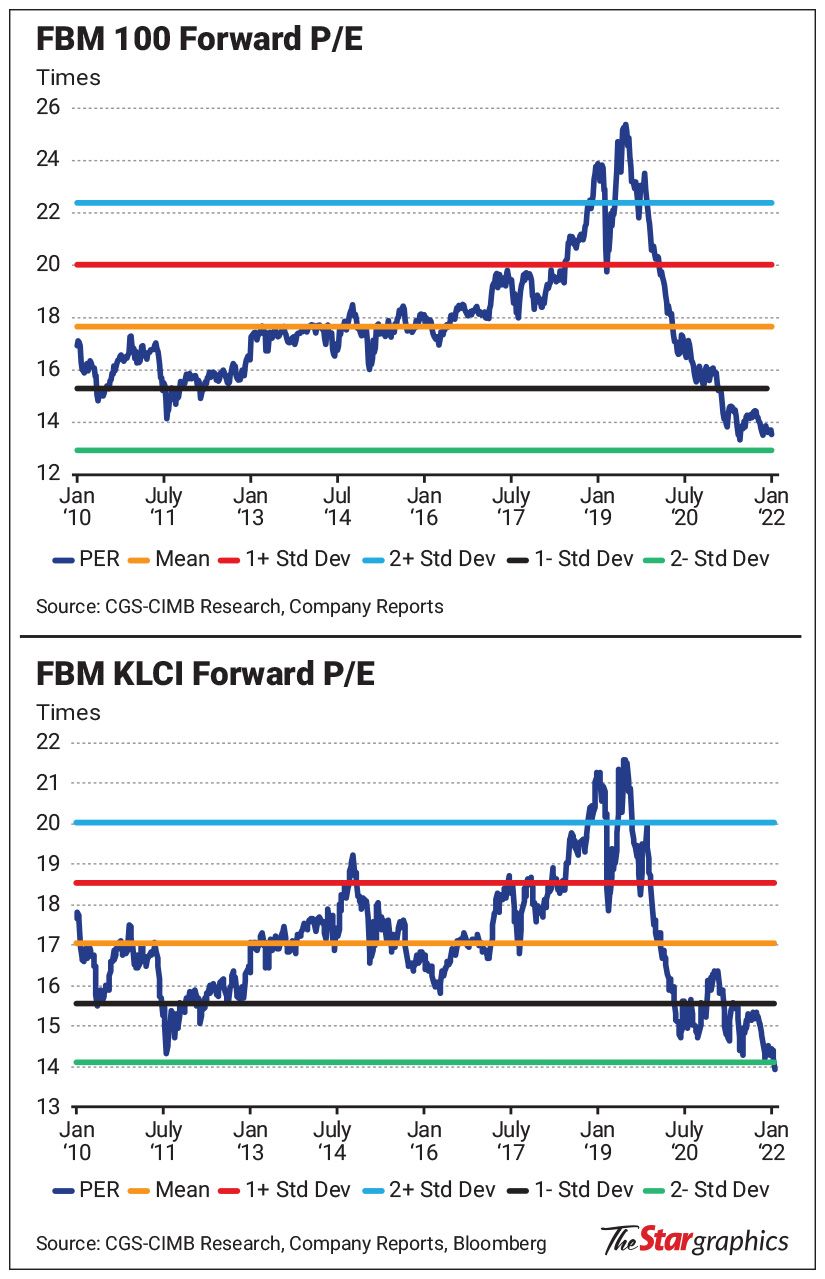
When looked at in terms of a price to earnings (PE) ratio which is a common valuation method used to gauge how a stock is valued by investors, Malaysia’s largest stocks are collectively trading at some 13 times, well below the historical 16 to 17 times they used to trade at.
PEs compare stock prices relative to their earnings, while forward PEs compare stock prices relative to future estimated earnings.This generally means that a higher forward PE indicates a higher level of investor confidence and vice versa.
In the case of Bursa Malaysia’s FBM KLCI, the PE has been trending generally downwards.
So, what gives, you may ask?
And has the Malaysian stock market fallen into a state of “low PE”, suggesting that investors may have lost confidence in Bursa stocks?
Firstly, there is a need to acknowledge that there is indeed a melange of factors that is contributing to the stock market’s overall weakness, say industry players.
AHAM Capital deputy head of equity David Loh reckons the FBM KLCI, which comprises the stock market’s 30 largest stocks, has experienced a gradual derating over the years primarily due to foreign outflows.
“This can be attributed to a combination of factors including political instability, a weak currency and financial scandals,” he tells StarBizWeek.
“As a result of persistent outflows, foreign shareholding for Malaysian equities is at a record low level.
“Additionally, due to a lacklustre performance, pension funds have diversified offshore, which has consequently reduced support for the local market,” he adds.

Fortress Capital Asset Management chief executive officer Thomas Yong says the key drag on the benchmark index over the past 10 years is its lack of earnings growth.
“Investors are constantly weighing potential returns versus risks associated with their investments.
“At the moment, the FBM KLCI comprises mainly heavyweight stocks that do not offer a compelling long-term growth outlook,” says Yong, who manages over RM1bil in client funds.
MIDF head of research Imran Yassin Md Yusof believes that the weak performance of the index is partly due to it being dragged down by the underperformance of some of the stocks which make up the benchmark index such as the glove companies which experienced weak earnings prospects last year, and banks which are being affected by the current banking turmoil in the United States and Europe.
‘Temporary low’
Nevertheless, all three agree, to a certain extent, that the Malaysian stock market has not moved into a low PE market.
At least not permanently.
Imran says while the FBM KLCI is trading below its historical trading band of 16 to 17 times PE at about 13 times, the market’s other indices like the mid-cap benchmark index is trading at about 16 times, well within its historical trend of 15 to 19 times.
“In the case of the FBM KLCI, we believe that this may be temporary due to investors according some discount to its valuation. Furthermore, we have seen that the FBM KLCI has been dragged down by the underperformance of some of its constituents.”
He reckons that it is not correct to compare the Malaysian market with its peers based on PE alone as different benchmarks have different constituents and economic structures.
“What is more suitable in our opinion, is to compare markets with their historical trends. In this sense, the Malaysian market can be said to be undervalued given that we are trading well below our historical trends, hence, we should seem attractive.
Comparatively, regional markets are trading at, or near their historical trends,” Imran adds.
Fortress’ Yong says that the compression in the FBM KLCI is in line with regional markets amid concerns about the global economic growth outlook.
“Regional markets are trading at around 10 to 16 times forward PE and the FBM KLCI is trading within this valuation range.
“Foreign portfolios frequently consider South-East Asian countries to be of a similar risk reward profile, apart from Singapore which is generally considered more advanced with a lower currency risk.”
He notes that with interest rates likely to remain high in the near to mid-term, investors are demanding a higher equity risk premium, hence the market PE has moved lower.
“However, the compression in PE is unlikely to be permanent, it should normalised once major central banks ease monetary policies,” Yong adds.
He reckons the current lower valuation is compensating investors who take risks by participating in equity investments.
“It offers investors a lower momentary downside risk even if earnings deteriorate moderately.”
AHAM’s Loh, however, points out that a lower valuation is essentially a reflection of softer fundamentals.
“If we can address the underlying issues and get our house in order, it presents an attractive entry point for investors.
“The market has the potential to trade at a higher PE multiple once we regain investors’ confidence. This must be anchored by sustained growth in corporate earnings and currency stability.”
Private investor Ian Yoong, who formerly worked as an investment banker, notes that Malaysia’s first quarter corporate results have been generally disappointing.
“The FBM KLCI’s results deteriorated quarter-on-quarter with more than 50% coming in below market consensus as compared to about 20% in the fourth quarter of 2022. The poor business performance is reflected in the market’s deteriorating PE.
“Many listed companies have been adversely affected by low commodity prices, higher electricity tariffs and labour cost as well as a significant slowdown in the global economy impacting our export sectors.”
While he points out that foreign funds have been net sellers of Malaysian equities year-to-date, he notes that global funds have also been net sellers in Thailand and almost all emerging markets with the exception of Indonesia.
In a note to clients on Malaysia’s market this week, CGS-CIMB Research says it expects the poor market sentiment to continue for the next few months.
Moving closer to the fourth quarter of 2023, it expects two significant rerating catalysts – namely a convincing break down of the US Dollar Index and the easing of political uncertainties in Malaysia – to emerge, causing a potential structural shift in liquidity flows and domestic sentiment.
The potential upside, if the two key catalysts materialise, should not be underestimated, it says, because of, among other factors, the current depressed valuations of Bursa Malaysia and improved domestic economic growth.
Reforms a must
Interestingly, Yong points out that over the years, Bursa has generally been regarded as a defensive market with good industry breadth that offers lower volatility.
“Apart from that, if we look beyond the 30 index stocks, there are many small to medium companies that are still offering decent growth.
“As mentioned before, to attract large foreign fund inflows, the large corporations need catalysts for better earnings growth.”
Yong advocates fiscal reforms to stimulate economic growth, tax reforms for a more competitive corporate tax structure and even government-linked company or GLC reforms which he says, could likely attract foreign portfolio inflows.
“Apart from these, foreign investors also expect a stable political environment which can address concerns about policy risks.”
He reckons without clear reforms in policies, the local market is likely to remain status quo.
“With the ease of access to information and the increasing availability of various online trading platforms, investors will invest abroad if they find better opportunities there,” Yong adds.
Loh also hopes to see more reform measures being implemented to ensure better governance and fiscal discipline in the country.
“Besides that, the burdensome subsidy bill needs to be reviewed promptly to provide some fiscal buffer.
“Alongside public expenditure, the government should continue to introduce business-friendly policies aimed at incentivising private sector investments, which is an area that has been showing progress under the unity government,” he adds.

All of the factors, he reckons, will lead to a stronger economy and better corporate earnings which can then serve as key catalysts for the stock market.
“If we can establish political stability, Malaysia certainly presents itself as an attractive market replete with opportunities. From a currency and valuation standpoint, the market is undervalued with both indicators running at multi-year lows.
“Notwithstanding macro noises, the domestic economy continues to display resilience, as evidenced by its solid gross domestic product showing.
“Economic strength will be boosted further once tourism inflows revert to pre-pandemic levels,” he said.
Yoong concurs adding that the flow of information from listed companies to retail and institutional investors has to be improved.
For instance, there is little coverage of micro and small cap stocks, he says. He suggests that Bursa funds reports written on such companies in order to get their stories out to the investing community.
He notes that the current government has made “great strides” in improving public machinery and reducing leakages.
“However, Malaysia is far from perfect and this is reflected in the majority of our stock prices on Bursa. It is likely stock prices will rise when domestic and global economic conditions improve. We are convinced that interest rates will come down over the next 12 to 18 months.”
“I am confident that people investing in the shares of well-managed companies with sound balance sheets, trading at current depressed prices, will be greatly rewarded in the next three to four years.”
In its note to clients, CGS-CIMB Research also says that improved prospects for the domestic economy as a result of the reopening of the country post pandemic, gradual normalisation in Chinese and other tourist arrivals, and better policy implementation are likely to serve as market catalysts.“The best way to play this is via the liquid financial services sector where valuations are attractive at 9.8 times 2023 PE and just one time price to book value.”
The research house adds that construction and materials is a sector that is a good proxy to the domestic economy and potential beneficiary of consistent-policy implementation.
“Despite the estimated 30% recovery in 2022, our forecasts imply a further 11% and 17% net profit expansion over this year and next year.
“Real estate and real estate investment trusts, while benefiting from stronger domestic demand, are potential reflationary beneficiaries should there be a continued period of US dollar weakness,” it says.
It also has an “overweight” call on healthcare due to its positive stance on IHH Healthcare Bhd which accounts for almost 90% of the sector’s market capitalisation.
Additionally, CGS-CIMB Research is bullish on oil service players as it says order visibility is improving, rental rates and utilisation have risen and valuations are reasonable.
Nevertheless, the research house says that it is “neutral” on energy and materials because of its cautious stance on two petrochemical stocks and Petronas Dagangan Bhd which come under its coverage.
Already a subscriber? Log in
Get 20% OFF The Star Digital Access
Cancel anytime. Ad-free. Unlimited access with perks.