
KUALA LUMPUR: Economists remain positive on Malaysia’s growth this year on the back of vaccine rollouts and gradual economic reopening globally despite concerns that the early part of the year may be impacted by the current movement control order (MCO).
MIDF Research said that Malaysia’s leading index (LI) rose 7.1% year-on-year (y-o-y) last December, increasing at the same pace as in November 2020, supported by improved sentiment.
“Despite concerns that the economy could once again slow down going into the early part of 2021, the sustained increase in the LI suggests that Malaysia’s economy will continue to recover in the months to come, particularly in the first-half of 2021.
“The MCO 2.0 enforcement may have less severe negative impact on the economy, compared to the experience last year, as businesses are generally allowed to operate. Moreover, the Permai assistance package will also help to cushion some of the impacts from tighter movement control, ” said MIDF in a note yesterday.
Going forward, the improving sentiment following the implementation of the National Covid-19 Immunisation Programme as well as the easing of restrictions on business and consumer activities will support the economy to continue recovering this year.
It noted that Malaysia was pushed to a recession in 2020, induced by Covid-19 with a -5.6% y-o-y contraction, which was worse than what was experienced during the Global Financial Crisis in 2009 (-1.5% y-o-y), but better than the Asian Financial Crisis in 1998 (-7.4% y-o-y).

“We foresee the economy growing in 2021, reversing the fall observed in 2020 in line with the resumption in domestic and global economic activities, also due to the low base factor in 2020.
“However, the economic performance in the first quarter of 2021 (Q1) will be adjusted lower, taking into account the MCO currently in place and renewed restrictions in key countries due to surging Covid-19 cases.
“By factoring in the restrictions in Q1 in particular, we have revised our full-year gross domestic product growth forecast downward to 5.4% y-o-y from 7% y-o-y previously, anticipating the economy to attain a more gradual normalisation.
“With positive elements such as vaccine distribution and expansionary fiscal and monetary policies, both demand and supply sides are expected to improve particularly from Q2 onwards, ” said MIDF.
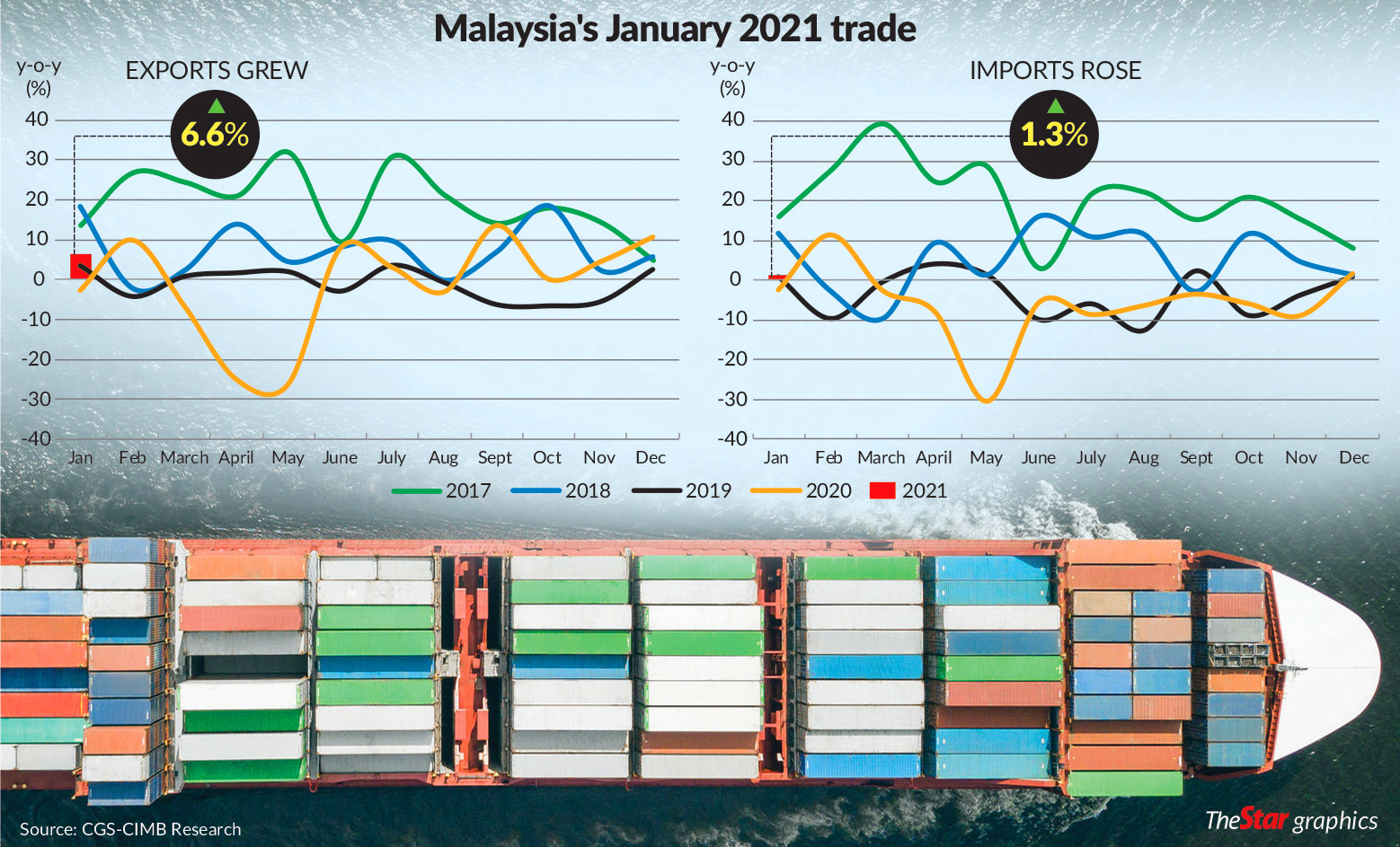
Meanwhile, Malaysia’s trade continued to improve. In January this year, Malaysia’s exports rose 6.6% y-o-y, supported by an 11.7% y-o-y rise in the manufacturing segment, offsetting declines in agriculture (-7.2% y-o-y) and mining exports (-31% y-o-y). However, CGS-CIMB noted that import growth remained subdued at 1.3% y-o-y (+1.6% y-o-y in December) as domestic demand was inhibited by MCO 2.0.
“The trade surplus narrowed to RM16.6bil (+RM20.7bil in December), which remains well above pre-Covid-19 levels (2019 monthly average: +RM12.1bil). Total trade activity was broadly in line with expectations, increasing 4.1% y-o-y in January to RM162.6bil, ” it said.
The electrical and electronics (E&E) sector, which has been a mainstay of the export recovery, saw outbound shipments increase 13.1% y-o-y as did exports of optical and scientific equipment (+9.9% y-o-y).
“We reiterate our gross export and import growth forecasts in 2021 at 10.9% and 11.5% y-o-y, respectively, as the gradual rollout of vaccinations globally are likely to reinforce economic recovery trends, ” said CGS-CIMB.
TA Securities also noted that the recovery in global trade and supply chains will further sustain strong growth for exports in 2021.
The research house projected an increase of 5.3% and 5.6% for exports and imports this year, respectively, noting that the Finance Ministry’s projected exports and imports to increase by 2.7% and 5.3%, respectively, in 2021. Higher demand for semiconductors and commodity-based products is anticipated to drive exports as global economic activities recover.
The headline IHS Markit Malaysia Manufacturing PMI stood at 48.9 in January 2021 from 49.1 in December 2020. Particularly, businesses indicated that the recovery in the Malaysian manufacturing sector was hindered at the start of 2021 by rising Covid-19 cases and stricter restrictions to try and curb the further spread of the virus.
“Nonetheless, we believe manufacturing activity will improve going forward, owing to the speedy Covid-19 vaccine rollout. On top of that, import materials from other countries into Malaysia will directly increase exports, ” said TA Securities. The correlation between imports of intermediate goods and total exports is more than 70%.
Yesterday, IHS Markit reported that Malaysia’s PMI had dipped to 47.7 in February from 48.9 in January. However, it noted that firms operating in the manufacturing sector were increasingly optimistic regarding the 12-month outlook for production.
Already a subscriber? Log in
Get 20% OFF The Star Digital Access
Cancel anytime. Ad-free. Unlimited access with perks.