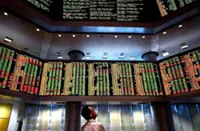
PETALING JAYA: Stocks on Bursa Malaysia are teetering on the brink of a bear market as the rising coronavirus toll in China curbed investor appetite for risky shares.
At the close, the FBM KL Composite Index fell 9.11 points, or 0.6%, to 1,521.95 points, extending its losing streak to the tenth day in a row.
At the current price level, the index has fallen 19.7% from its peak of 1,895 points on April 19,2018.
A bear market is when stock prices fall 20% from their peaks.
The latest round of sell-off on Bursa Malaysia was triggered by sharp declines in mainland China markets following the extended Chinese New Year holiday.
“The real concern now is that China’s growth will be heavily impacted by the deadly coronavirus outbreak, ” Hussein Sayed, chief market strategist at FXTM, wrote in a note.
“With the number of deaths in mainland China overtaking the 2003 SARS epidemic and the number of cases infected, reaching more than 17,000, it is unknown when this epidemic will come to an end.”
The Shanghai Composite index shed nearly 8% and lost about US$400bil of its value even as the country’s central bank cut interest rates on reverse repurchase agreements and pledged to inject US$174bil of liquidity into markets.
The impact of this huge crater on the markets in China reverberated throughout Asia.
Japan’s Nikkei 225 index fell 1% to 22,971.94 points and Singapore’s Straits Times Index declined 1.2% to 3,116 points.
Oil prices also fell on concerns that demand would be impacted from the slowdown in economic activity due to the Wuhan coronavirus.
Brent crude oil fell 0.79%, or 45 cents, to US$56.17 at press time.
Bloomberg reported that oil demand in China has dropped by about three million barrels a day, or 20% of total consumption, quoting people with inside knowledge of the country’s energy industry.
The report said that this drop was likely the largest demand shock the oil market has suffered since the global financial crisis of 2008 to 2009, and it is the most sudden since the Sept 11 Word Trade Center attacks.
Market reports and commentaries were vastly negative yesterday but they also highlighted the fact that China has also announced stimulus measures ahead of the market’s open on Sunday.
The People’s Bank of China said that it will inject 1.2 trillion yuan worth of liquidity into the markets through open market reverse repo operations.
Mainland China’s central bank said the overall liquidity in the system would be 900 billion yuan more from the same period last year.
In its note sent out to investors, JP Morgan Research in a report titled “When China catches a cold, the rest of Asia shivers, ” said that the unexpected coronavirus outbreak in China is a major black swan event for the markets.
Over the past week, the number of confirmed cases have risen rapidly in mainland China and surpassed the SARS episode, and also spread beyond China’s borders.
China government actions have also become more forceful.
The extended Chinese New Year holiday will impact 12 provinces in China that account for 62% of the national GDP and 80% of industry production.
They have delayed school/factory reopening to no earlier than Feb 9.
“In response, we have revised China’s growth forecast down for the first quarter to 4.9% quarter-on-quarter (from previously 6.3%), followed by a rebound in the second quarter to 7%, ” JP Morgan said.
JP Morgan had also lowered China’s full-year growth forecast to 5.80% from 5.93% previously.
“The near term hit is notable in offline retail sales, tourism, entertainment, and transportation, like in the 2003 SARS episode.
We expect retail sales growth will fall from 7.6% quarter-on-quarter, in the fourth quarter to -1.9% in the first quarter of 2020, ” the research house said.
JP Morgan noted that China’s regional influence has increased substantially since 2003 through manufacturing supply chains and via tourism flows.
“With China announcing that it will impose travel bans in Hubei and extending the Lunar New Year holidays by a week in some cities with large industrial belts, the SARS comparison may underplay the risks to growth, especially in the goods-producing sectors.
“That said, if these measures effectively control the spread of the virus this quarter, this would mean a sharp contraction in 1Q20 and a sharp recovery thereafter, ” the investment bank added.
In another report, TA Research said that while market sentiment could be depressed in the near term, it should recover if the fatality rate does not worsen and the rate of increase in new cases starts to dwindle.
This, the research house said, was based on statistics that showed the FBM KLCI had similarly recovered completely by May 2003 following the SARS outbreak then.
Already a subscriber? Log in
Get 20% OFF The Star Digital Access
Cancel anytime. Ad-free. Unlimited access with perks.