
The slowing deposit growth in the country to an almost three-year low is reflective of the environment of rising costs that has been building up.
This scenario may suggest that higher inflation, which has been sparked by higher energy costs, among others, may be starting to put a dent in the overall savings rate of consumers and businesses alike, the two biggest constituents to deposits in the country.
According to the latest banking statistics for August 2014 released by Bank Negara recently, deposits growth decelerated on a year-on-year basis and it contracted month-on-month which resulted in a higher loans to deposits ratio.
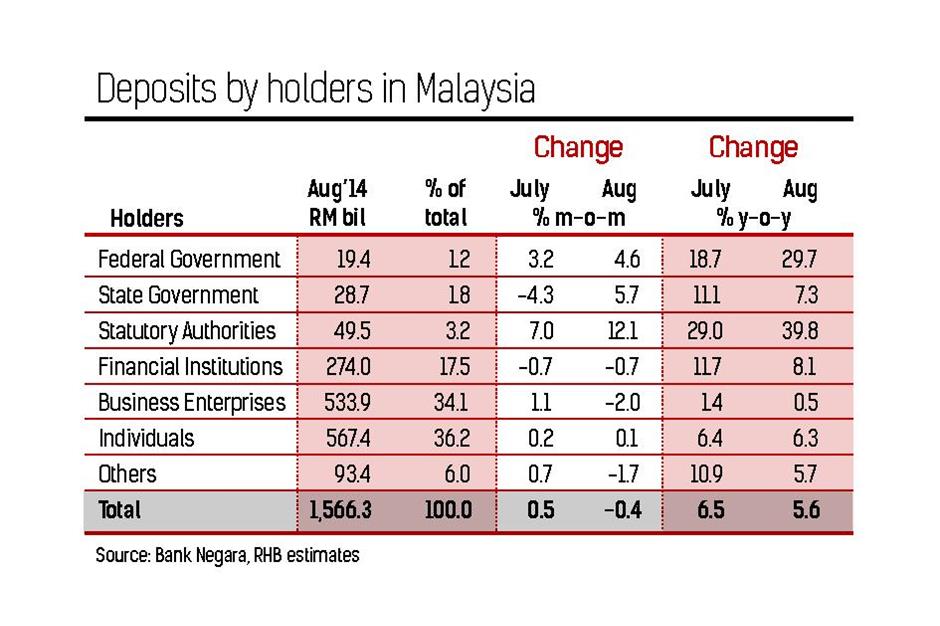
Deposits growth decelerated to 5.6% year-on-year in August against 6.5% a year ago while on a month-on-month basis, it contracted by 0.38% against a growth of 0.52% in July.
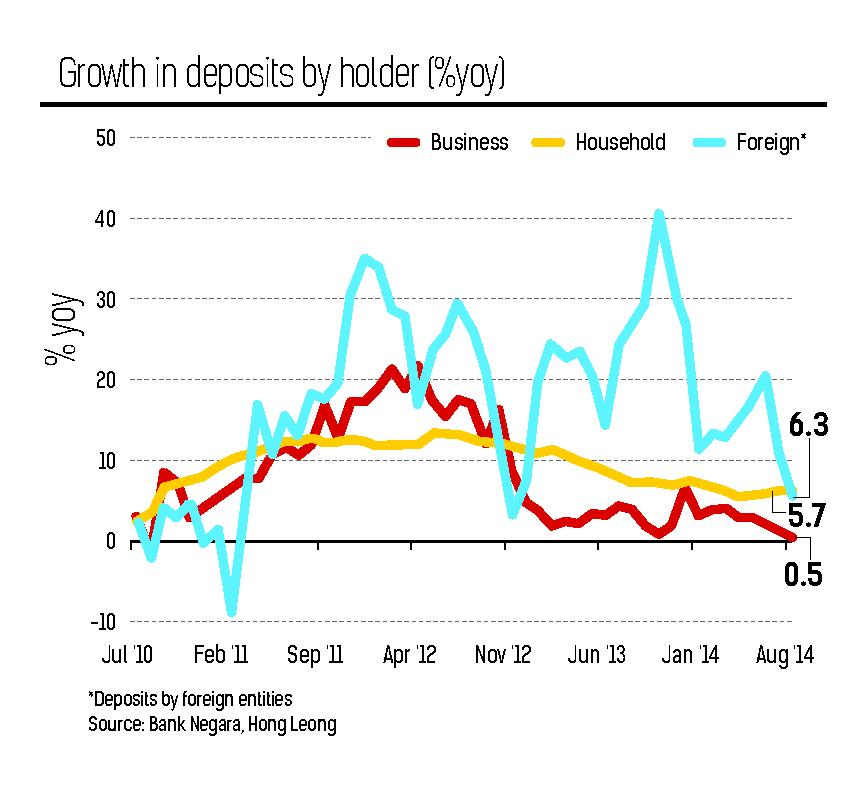
Notably, the deposit growth that reached near 15% in 2012 had seen a slowdown ever since to an almost three years low.
RHB Research’s Peck Boon Soon and Shafizal Shafaai said in their report the latest Bank Negara stastistics reflected to a moderation on deposits placed by financial institutions and state governments, while a smaller increase in deposits placed by individuals during the month also made it worse. (see table)
An analyst from Affin Hwang Capital Research says this slowdown trend, if prolonged and sustained moving forward, may feed into higher funding costs as banks may need to more aggressively compete against one another for short and medium term deposits.
This is because banks would need to maintain their loans to deposits ratio at a healthy pace.
The analyst added that the slowdown may be due to various factors namely either due to the higher base or businesses and individuals deciding to park their savings overseas instead.
“It also could be that the businesses are opting to finance their capital expenditure investments through their own means rather than resorting to the bank borrowings on the possible hike in rates,” the analyst adds.
Despite the concerns that it may be prolonged, Hong Leong Research in a recent report says excess liquidity is still ample to fund domestic economic growth.
The excess liquidity as measured by the deposits to loans gap narrowed to a six months low at RM284.3bil in August and was lower month-on-month against RM299.3bil in July.
The statistics released by Bank Negara is also in sync with a Malaysian Institute of Economic Research (Mier) survey that consumers in the third quarter were feeling more wary about their future.
The Mier’s Consumer Sentiments Index (CSI) fell below the 100-point threshold level of confidence in the third quarter to 98 points, down 2.1 quarter-on-quarter (q-o-q) and 4 points (y-o-y) basis respectively.
Mier attributes the drop to flat employment prospects and noted that current and expected finances have also softened q-o-q and y-o-y.
“Things such as fuel costs has a very significant impact on the economy as it affects (almost) every area of the supply chain with many linkages,” said Mier’s executive director Zakariah Abdul Rashid in a news conference earlier in the week.
Its survey report released earlier in the week also indicated that global uncertainties, flagging domestic demand and rising costs have likely excerbated inflation fears among consumers of late.
Despite that, the Mier survey also notes that consumption is due to rise toward the end of the year but only because of cost push pressures as consumers choose to buy ahead of any hike in interest rates and before the implementation of the goods and services tax (GST) in April 2015.
The rising in consumption trend would likely have a positive spillover effect in the short term to both property developers, automotive and consumers equities alike as consumers would likely bargain hunt for good deals.
“I would think companies that offer a good and value for money deal would stand to benefit from this anticipated rise in consumption especially towards the end of the year when employers typically pay their bonuses and more big ticket items are purchased,” says a consumer stocks analyst with a local brokerage firm.
Already a subscriber? Log in
Get 20% OFF The Star Digital Access
Cancel anytime. Ad-free. Unlimited access with perks.