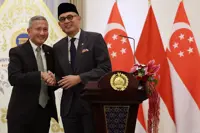
Health minister Budi Gunadi Sadikin (pic), who is vying for the World Health Organization’s top job, said he was in favour of countries paying higher mandatory contributions to offset the slash to its budget from the US withdrawal.
He told reporters on Monday that the UN’s health agency should focus on reprioritising its spending rather than chasing replacement funding – allocating bigger amounts for fewer projects.
“The priority is to review the functions (of the WHO), get the agreement of the countries and then ... we look for the (new) money,” said the minister, who is one of seven candidates for the post of WHO director general.
The first place to look for new funding would be from within, he said.
“Every country says the WHO needs to be sustainable. You cannot be sustainable if your membership contribution is only 20 or 30%” of the total budget, Budi said.
“If you want to be sustainable, then at least the regular funding ... should be more than 50%.”
Member countries make mandatory payments called “assessed contributions” to the WHO, which are calculated every two years based on income and population size.
The rest of the budget – the bulk – comes from voluntary contributions from governments and donors.
Budi insisted that raising the threshold to 50% would not be too onerous for countries, even at a time of global financial strain.
“I’ve seen the numbers. ... You’re not talking about billions of even a hundred million. It’s not a big number,” he said.
Divided by the body’s 100 plus member countries, it would amount to tens of thousands of US dollars each.
Budi said he would also push for WHO member states to adopt a global pandemic treaty along with a fund to back it up.
The goal would be to ensure “everybody has the same right to access” to vaccines, treatments and diagnostics if a new worldwide pandemic strikes.
That would avoid a situation in which: “some country can stock six times the population (worth) of vaccine while the other country cannot get the vaccine because it’s already bought by some rich country,” Budi said.
He said the WHO was “not ready” for a new global outbreak, nor doing enough to deal with the Democratic Republic of Congo’s deadliest Ebola epidemic in history.
“The problem with this type of outbreak, if it happens specifically in a low-income country, the attention is not as big as like with Covid, where it also hit the high income” countries, he argued.
“We should be ... putting more money ... to address the issue for our African friends,” he said.
In January, WHO’s 34-member executive board will nominate up to three candidates to be submitted to the World Health Assembly of member states, which will choose its next head in May 2027.
Budi is running against candidates from Botswana, Qatar, Saudi Arabia, Belgium, Spain and China. — AFP