
The Philippine ambassador to the United States signalled possible meetings of the “Squad” bloc ahead of the Association of Southeast Asian Nations gathering in Manila, as Washington confirmed that the Quadrilateral Security Dialogue would hold its first leaders’ summit in more than two years on the sidelines of the regional talks.
An informal defence grouping, the “Squad” forms part of a US-led regional strategy to counter China’s growing influence in the Asia-Pacific region. It comprises the US and three of its treaty allies: the Philippines, Australia and Japan. The Quad, by contrast, includes India in place of the Philippines and is not a formal military alliance.
Speaking exclusively with the South China Morning Post in a recent interview, Jose Manuel Romualdez also voiced hope that Asean would evolve into a Nato-like alliance capable of handling its own security.
The “Squad” and Quad meetings are expected to take place in the Philippines just days before US President Donald Trump is set to meet Chinese leader Xi Jinping on the sidelines of the Asia-Pacific Economic Cooperation summit in Shenzhen next month.
“This type of meetings regularly happen, and if it’s an opportunity that is there, I’m sure that they will do it,” Romualdez said when asked about a possible “Squad” defence ministers’ meeting.
On whether the grouping would be raised to the leaders’ level, Romualdez – who is also President Ferdinand Marcos Jnr’s second cousin – said it would depend on “what kind of an agreement” or meetings that officials “will have on the sidelines of the Asean summit”.
A source familiar with the discussions said the probability of the “Squad” meetings was “very high” and added that since many US allies and partners would be in the Philippines, the “pretence” of US diplomatic commitment could be “cheaply done”.
Before the leaders’ summit from November 16 to 18 in Manila, the Philippine Department of National Defence will host the defence ministers’ meeting and related engagements on October 28 and 29 in Cebu.
Manila’s ambassador to Washington stressed that Marcos had consistently pursued a “multilateral approach” to the Asia-Pacific region, backed by a network of defence agreements with other countries.
“We’re counting now about seven or eight of them, but more importantly, between Japan, Australia, the United States and the Philippines,” he said.
Romualdez confirmed, however, that Marcos would attend the Apec summit in Shenzhen, expressing hope that he could at least have a “possible good conversation” with Xi even if no formal meeting took place.
US Secretary of State Marco Rubio announced on Tuesday that the Quad leaders would meet in the Philippine capital next month, marking the group’s first summit in more than two years.
“It’s been agreement now that we’re going to do it; we’re going to do it in Manila, at the Asean conference,” Rubio said in an interview with Indian news channel CNN-News18.
“We don’t have the specific date yet, but that’s going to happen, and we’re very enthusiastic about it.”
The Squad and the Quad were part of the previous Joe Biden administration’s strategy of building a “latticework” of coalitions to counter China’s clout.
The first meeting of “Squad” defence ministers took place on the sidelines of the Shangri-La security dialogue in Singapore in June 2023, followed by a series of interactions.
The Trump administration has continued the dialogue, with the most recent engagement between defence chiefs taking place on the sidelines of the Asean summit in Kuala Lumpur, Malaysia, last November.
Military officials of four countries also convened for a defence cooperation council meeting in May in Singapore.
Beyond deepening security ties with regional powers, the Philippine envoy to Washington also floated the idea of an “Asean Nato”, reviving a proposal rejected by the country’s defence secretary, Gilberto Teodoro Jnr, in 2024.
“I’m even hoping that Asean will become like a Nato, that it can take care of its own security,” Romualdez told the SCMP.
He added that “having an integrated security” is more efficient as the Asean countries are “all together” and “live in the same neighbourhood”.
“Then we can make agreements with countries like China as a whole, agreements with the United States,” he said.
“I hope that one day we will be able to have not only our economies integrated, but even our defence and military.”
Teodoro in November 2024 had dismissed the prospect, saying that Asean’s complex “dichotomies and divergence in country interests” would make it challenging to set up a unified military alliance.
The ambassador’s statements come as the Trump administration recalibrates its priorities in the Asia-Pacific, prompting concerns among regional partners over the durability of US security commitments and Washington’s strategy for competing with China.
In June, the US renamed the Indo-Pacific Command as Pacific Command, reversing a change made in 2018. In August, Trump ordered the annual US-South Korean military exercise be cut from 11 days to five.
Washington has redeployed the Japan-based USS George Washington to the Middle East for operations against Iran, leaving no US aircraft carrier permanently stationed in the Indo-Pacific.
The Trump administration has also pressed regional allies and partners to shoulder more of their own defence costs.
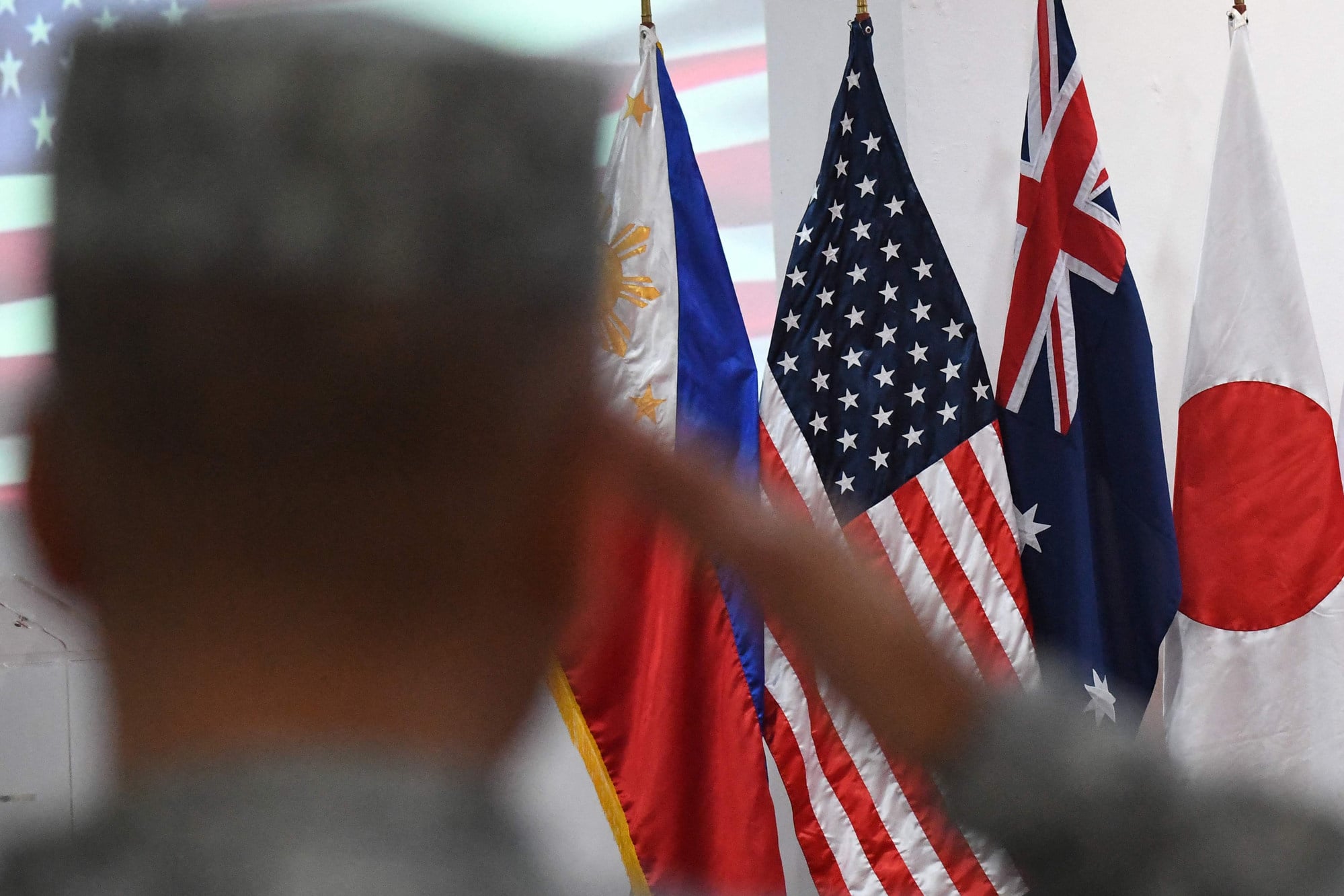
Romualdez argued that he saw no sign of US commitments weakening for now, but stressed that Manila had to be “ready for any kind of eventuality”.
“We remain focused on strengthening our armed forces to where we want it to be, so that we would be able to defend ourselves.”
He also ruled out any possible involvement in a Taiwan crisis, saying the Philippines was not part of any security arrangements related to the island and that his country adhered to the one-China policy.
“The only role that Philippines right now has in Taiwan is the fact that we have 250,000 workers. We obviously are concerned about that,” he added, referring to Filipino migrant workers living on the island.
The ambassador’s stance is in sharp contrast to that of defence chief Teodoro, who has rejected Beijing’s warnings over Manila’s engagement with Taiwan.
“We define the one-China policy. We define it. Not them,” Teodoro said in September.
Under an expanded defence pact, the Philippines has granted the US military rotational access to strategic sites in northern Luzon, including bases in Cagayan province near Taiwan.
The two countries have also expanded joint military exercises in the northernmost Batanes islands, where Manila is strengthening its own military infrastructure.
Beijing views Taiwan as part of China to be reunited by force if necessary. Most countries, including the island’s main international partner, the United States, do not recognise self-ruled Taiwan as an independent state. Washington is opposed to any attempt to take it by force and is legally bound to supply it with weapons to defend itself. -- SOUTH CHINA MORNING POST