SHANGHAI (AFP): With China's economy still struggling to recover from the pandemic, even global fashion icons are beginning to feel the pinch as consumers turn instead to the second-hand market or buy upstart new homegrown brands.
Chinese were once massive buyers of luxury Western brands, accounting for around a third of worldwide spending and earning firms such as LVMH and Hermes billions of dollars.
But consumers' belt-tightening has forced them to rethink their strategies, with Louis Vuitton closing five stores in mainland China in the past two years -- including a chocolate boutique in Shanghai -- while Galeries Lafayette shut its Beijing flagship in May.
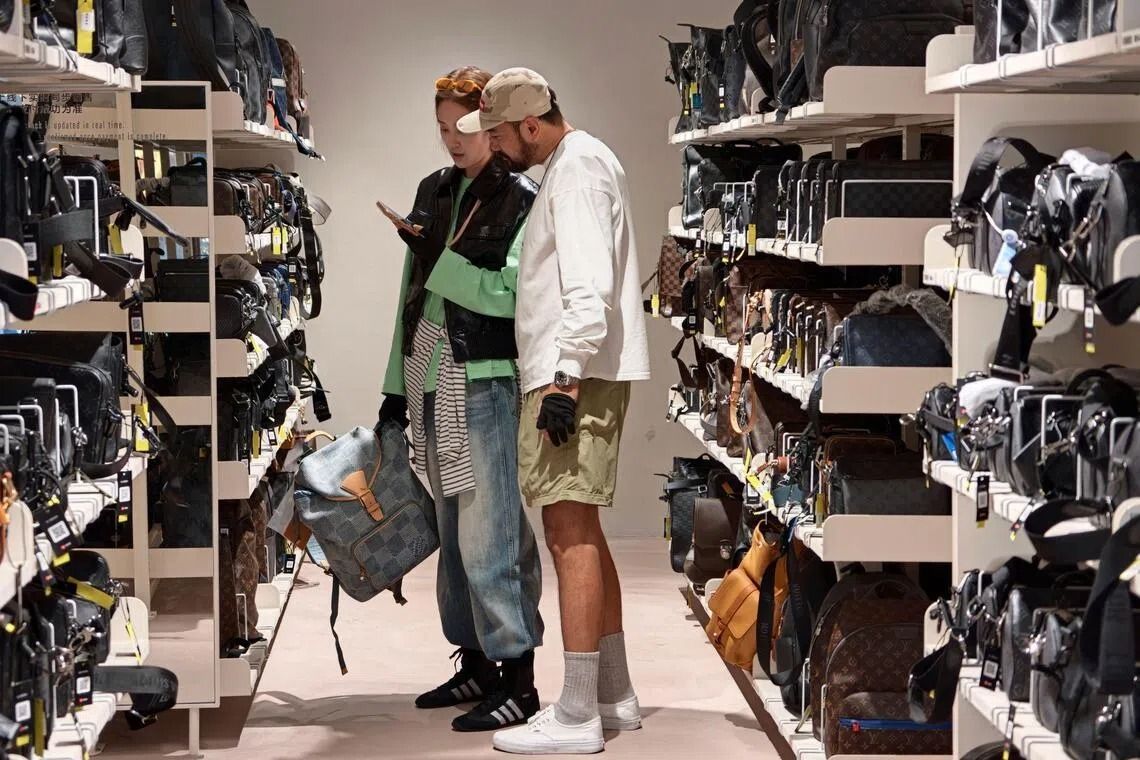
"People used to compare who had spent more," dance teacher Yuan told AFP at a new retail space in central Shanghai filled with luxury handbags, belts and jewellery items -- all second hand.
"But now everyone compares who got a better deal and spent less," the 24-year-old said at the two-storey warehouse-style store in the centre of the Chinese financial hub.
After plunging as much as 19 percent in 2024, mainland China's personal luxury market contracted another three to five percent in 2025, according to consultancy Bain & Company.
LVMH recently blamed a "slowdown in demand in China" for a drop in organic sales in the third quarter in its fashion and leather goods unit, a slump expected to be mirrored in its peers' results.
China's second-hand luxury market meanwhile exploded 15-20 percent in 2025, according to Bain & Company.
And domestic industry consultancy Insight & Info Consulting estimates total sales reached 38.4 billion yuan ($5.7 billion) in 2025, while forecasting it could top 100 billion yuan by 2030.
At the new Shanghai store Super Zhuanzhuan, shoppers have to wear black gloves to avoid their greasy fingers touching the products.
Customer Phoebe Ma, 24, said that when her mother's generation was young, China "wasn't so developed" and people were initially familiar with only a handful of luxury brands.
"Consequently, they formed a deep-seated impression that, OK, Louis Vuitton was the absolute best and most prestigious," the freelancer told AFP.
"I just feel that the [LV] monogram is dated. It suits my mother's generation, but Gen Z would rather buy trendy Korean brands," she said.
- 'Work hard to stay relevant' -
Chen Luo, head of China consumer research at Bank of America, said shoppers were moving away from associating luxury solely with social status and towards "self-identity, distinction, experience, quality, emotional value (and) cultural relevance".
"Apart from that, China's retail landscape is very digital/social media driven, and China's digital ecosystem is also very unique," Luo told AFP. "Foreign brands should work very hard to stay relevant in this context."
Adding to the headwinds for Western brands is growing cultural and legal friction.
LVMH recently successfully sued Chinese beverage chain Molly Tea for trademark infringement over a four-petal floral pattern resembling the French firm's monogram.
But the lawsuit sparked an online backlash after Chinese internet users and state media pointed out that the motif shares roots with ancient Chinese traditional patterns.
"It feels a bit absurd," said shopper Echo Wang, 31, who works in marketing.
"Molly Tea may be doing well in China, but it's nowhere near Louis Vuitton's global profile... I think some people feel the lawsuit was inappropriate," she told AFP.
LVMH management called its intellectual property "an absolute key asset", but admitted the furore had "had a negative impact".
Analysts emphasise that China remains vital for the global luxury industry.
"In our view, China will still be an important market, although it may not be a growth engine in two to three years," said Luo.
"Luxury spending is normally rebounding in sync with the economy, as usually the wealthy class will be among the first to benefit from economic recovery." -- AFP