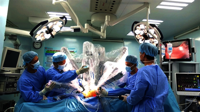
HANOI: Vietnam’s organ transplant sector has advanced from single-organ procedures to more complex techniques, including multi-organ and domino transplantation, and related research is being considered for the Ho Chi Minh Prize for Science and Technology.
According to the Department of Medical Examination and Treatment Management under the Ministry of Health, the country now has 34 transplant centres capable of performing heart, liver, lung, kidney and cornea transplants. Beyond single-organ procedures, Vietnam has also mastered multi-organ and domino transplant techniques.
Dr Ha Anh Duc, director of the department, said the country’s capacity to perform these techniques had reached a level comparable to that of the world’s leading transplant centres.
Multi-organ transplantation involves transplanting two or more organs into the same patient when clinically indicated. Compared with single-organ transplantation, it places greater demands on patient selection, donor organ assessment, surgical organisation and complication management.
Domino transplantation is a specialised form in which an organ removed from a transplant recipient can be transplanted into another patient, provided strict professional criteria are met.
Performing these procedures depends not only on surgical skill but also on coordination among multiple teams, an effective organ coordination system, and the capacity to handle complex situations.
This also reflects the development of the transplant speciality, from adopting advanced treatment techniques to performing procedures with increasingly demanding professional requirements.
Within the speciality's broader development, liver transplantation is one of the fields with the highest technical and treatment-organisation requirements.
A research work entitled “Application, Development and Successful Transfer of Liver Transplantation Techniques Contributing to Raising the Standing of Vietnam’s Organ Transplant Speciality” focuses on applying, developing, and transferring liver transplantation techniques, a field of considerable importance to treating serious liver diseases and to developing the transplant speciality.
Its nomination for the Ho Chi Minh Prize means the work will be reviewed and evaluated against high standards of scientific and technological value and practical effectiveness.
Under Article 10 of Government Decree No 18/2024/NĐ-CP, a technology application work considered for the Ho Chi Minh Prize must be exceptionally outstanding, of very high technological value and of great service to the revolutionary cause. It must also have a broad and lasting influence on people’s lives and make an important contribution to the country’s socio-economic development and to science and technology.
These criteria show that the Ho Chi Minh Prize does not merely recognise technical achievement but also places high value on creativity, practical applicability, and enduring contributions.
For the liver transplantation work, the scientific dossier, evidence of real-world effectiveness, and specific contributions to the speciality must be assessed.
Across the sector, the progression from single-organ to multi-organ and domino transplantation is expanding capacity to treat complex cases. However, many Vietnamese medical institutions share these achievements, and they cannot be attributed solely to the liver transplantation work mentioned above.
The speciality's development also highlights the need to further improve the system for organ donation, retrieval, co-ordination, and transplantation to ensure treatment quality and protect patients’ interests.
From advances in organ transplantation to research being considered for State-level science prizes, science and technology are playing an increasingly important role in enhancing Vietnamese medicine's capabilities. — VNS