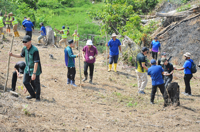
BANDAR SERI BEGAWAN: As part of continuous efforts to strengthen skills-based rehabilitation programmes and human capital development, the Prisons Department, through its Rehabilitation and Reintegration Division, has implemented a hill padi cultivation project at Maraburong Prison.
Permanent Secretary (Security, Enforcement and Legal Affairs) at the Ministry of Home Affairs Nor Hamidah Hamidon was the guest of honour.
Acting Director of Prisons, members of the Board of Directors and Shariah Advisory Body of Bank Islam Brunei Darussalam (BIBD), senior BIBD officers, heads of departments, special invitees, and officers and staff of the Ministry of Home Affairs were also in attendance.
The guest of honour carried out the symbolic planting of hill padi to mark the project’s launch. The ceremony was also enlivened by tausyeh and selawat performances by Al-Muslihun, a group comprising inmates of Maraburong Prison.
The hill padi plantation project forms part of an ongoing collaboration between the Prisons Department and BIBD, focusing on human capital development, education, and skills empowerment among inmates.
The partnership reflects their shared commitment to providing meaningful learning opportunities and helping inmates build a stronger foundation for life after serving their sentences.
Covering an area of one hectare, the initiative involves 14 inmates who previously participated in the hybrid padi plantation project introduced last September.
Continued involvement in both projects enables participants to broaden their knowledge and gain hands-on experience in various aspects of agriculture, including land preparation, planting, crop management, and harvesting.
The crop is expected to be ready for harvesting in approximately three months. Throughout this period, inmates will undergo practical training that emphasises the development of technical skills while fostering discipline, responsibility, perseverance, and teamwork.
The experiential learning approach is expected to boost their self-confidence and cultivate positive attitudes essential to successful reintegration into society.
In addition to the hill padi and hybrid padi cultivation projects, the collaboration between both parties encompasses the O-Level Education Programme, vocational and technical training, and the Greenhouse Fertigation Programme.
The comprehensive approach aims to broaden inmates’ access to education and skills development, enhancing their readiness to re-enter society and contribute positively to national development.
Beyond agricultural activities, the project demonstrates how hands-on learning can serve as an effective means of rehabilitation.
Through direct involvement in crop management and agricultural production, inmates have the opportunity to acquire economically valuable skills with broad practical applications, including in employment and entrepreneurship.
The initiative equips inmates with practical capabilities, values, and experience they can draw upon following their release.
At the same time, the project supports the country’s efforts to strengthen food security by encouraging agricultural activities and local food production, while raising awareness of the sector’s potential to contribute to economic growth and community well-being.
The collaboration between the Prisons Department and BIBD further highlights the important role of public-private partnerships in supporting sustainable social development. By emphasising individual potential, character development, and second chances, such initiatives contribute to more effective rehabilitation and reintegration efforts.
The Prisons Department will continue to strengthen and expand rehabilitation programmes focused on skills development, enhancing employability, and the personal development of inmates to assist them in making a smoother transition back into society.
With the continued cooperation and support of various parties, the initiative is expected to help shape individuals who are more resilient, self-reliant, and confident in building a better future for families, society, and Brunei Darussalam. – Borneo Bulletin/ANN