




Mainland Chinese prefer coercion over military force to settle the “reunification question” with Taiwan, and their opinion of the US remains low, although they favour engaging with Washington on trade and security.
These are the results from the latest survey of mainland citizens, conducted between April 16 and June 26. This straddled the first summit between US President Donald Trump and Chinese President Xi Jinping in Beijing but came before the second one in Washington last month.
“The Chinese public attitude towards Taiwan fits very well with domestic messaging on Taiwan in China,” said Nick Zeller, lead researcher with The Carter Centre, which conducted the biannual China Pulse survey with Emory University.
“Peaceful cross-strait relations are far and away the preferred option. But if de jure independence were declared, if Taipei says, ‘We are now formally governing ourselves,’ you are going to see a military response.”
Mainland favorability towards Taiwan was the highest of any other economy at 61 out of 100. The survey of 2,500 people found opinions split on unification by force.
Preferred responses if Taiwan declared independence included attacking Quemoy and Matsu islands at 77 per cent; conducting a naval blockade at 59 per cent; and economic sanctions at 56 per cent.
Those who favoured non-coercive approaches preferred greater cultural exchanges and trade promotion at around 82 per cent, and eased work and residency policies at some 72 per cent.
Notably, respondents who opposed the use of force rose significantly after Trump visited Beijing, to 40 per cent from 32 per cent.
This may have reflected the transactional president’s decision to delay a US$14 billion arms sales package to Taipei and his comments on the plane home and in a Fox News interview that weapons sales were a “very good negotiating chip for us, frankly”.
On their view of the US, mainland public sentiment remains low, falling slightly to 32 out of 100 since the last survey six months ago.
Nearly three-quarters viewed the US as a national security threat, led by concern over Taiwan and trade, with younger and better-educated Chinese the most dovish after the May summit.
Zeller said he expected the same trend to continue when results are polled from last month’s summit in Washington and the coming Xi-Trump meetings at the Asia-Pacific Economic Cooperation in Shenzhen and the G20 in Miami.
“The US and China are both going to be locked in a sort of frenemy convergence,” he added, “but still looking for opportunities for cooperation”.
While faith in education exchanges has fallen sharply, there were calls for ongoing engagement involving national security, trade and, less so, science and global security.
“These findings should be read as cause for cautious optimism for those seeking more stable US-China relations,” the survey said, but added: “The Chinese public continues to express low favourability towards the United States.”
Added Zeller: “My master key for understanding how they see the US is: we don’t like you, but we’re as strong as you, so we’ll work with you.”
Beijing sees Taiwan as part of China to be reunited by force if necessary. Most countries, including the US, do not recognise Taiwan as an independent state, but Washington is opposed to any attempt to take the self-governed island by force and is committed by law to supplying it with weapons.
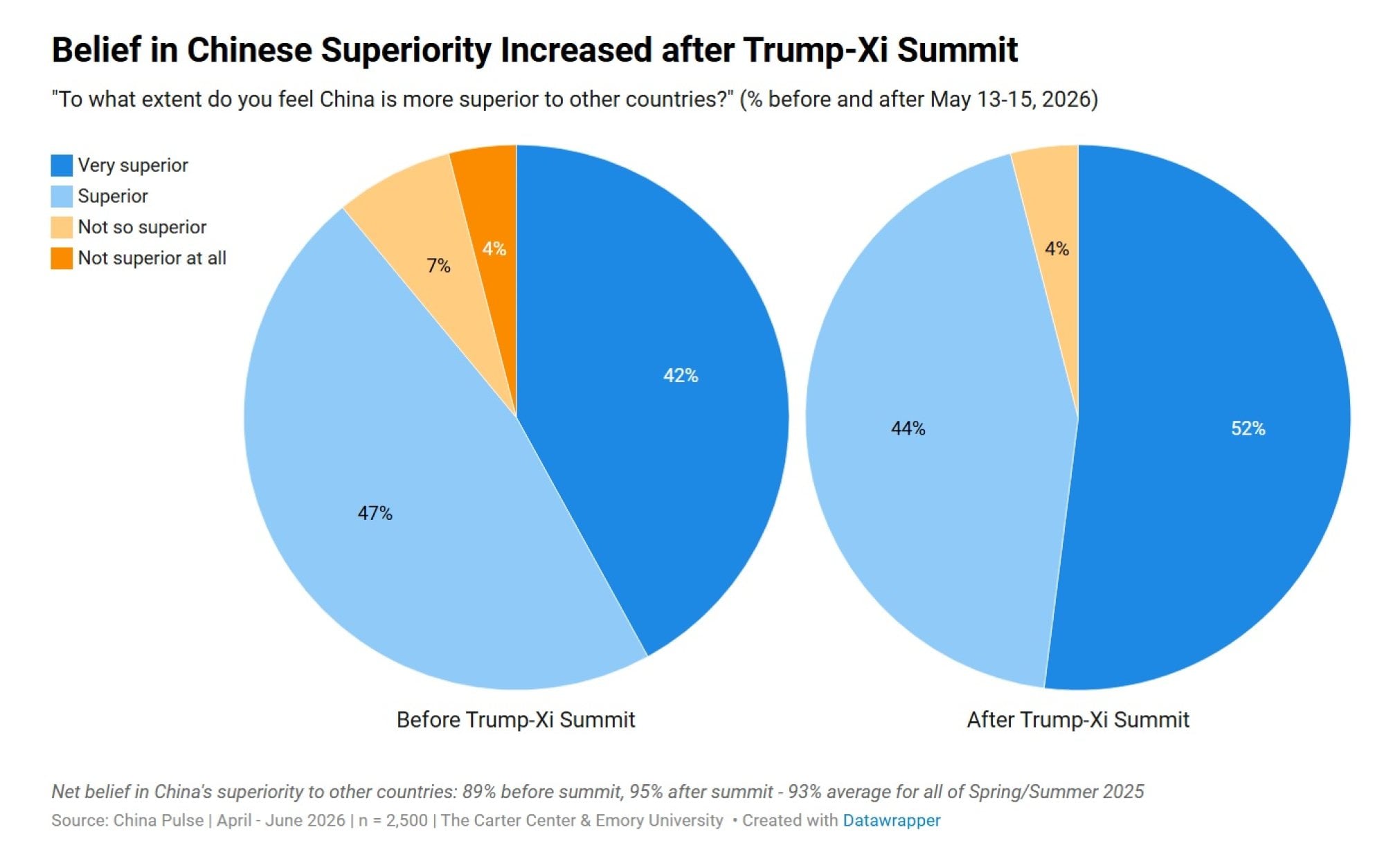
Turning to the rest of the world, Chinese belief in their country’s superiority rose from an already “staggering” 89 per cent to 95 per cent after the May summit.
The Chinese view of most countries other than the US fell after the summit, led by Singapore, Iran and Russia, although Russia was among those viewed most favourably with a rating above 50 indicating a net positive view.
“Accompanying this increased nationalist belief in China’s superiority, Chinese favourability towards most other countries in this survey decreased in the spring and summer of 2026,” the survey said. -- SOUTH CHINA MORNING POST



