




Online claims that archaeologists have identified the source of mercury in the mausoleum of Qin Shi Huang – China’s first emperor, who unified the country more than 2,000 years ago – have revived interest in ancient cinnabar sites in northwestern China’s Shaanxi province.
The claims, which sent related hashtags trending on social media late last month, centred on three sites in Xunyang where archaeologists last year found evidence of cinnabar mining, processing and transport during the pre-Qin and Qin-Han periods.
The underground burial complex, at the northern foot of Lishan Mountain, has never been opened, but one of the most enduring accounts of what lies beneath comes from Sima Qian, the early Han dynasty (206BC-AD220) historian who described a vast subterranean realm, elaborate in its design and ambition, that mirrored the heavens above and the Earth below.
In his masterwork, the Shiji, or Records of the Grand Historian, Sima Qian wrote that mercury was used to recreate the “rivers and seas” inside the tomb, with a mechanism designed to keep the metal flowing.
Cinnabar, a naturally occurring mercury sulphide mineral, was the main ore used to produce mercury in ancient times. The identification of ancient cinnabar sites in Xunyang has therefore raised the possibility that the region could have supplied some of the mercury described by Sima Qian.
For decades, archaeologists and historians have used non-invasive surveys and historical records to assess how far the surviving evidence supports Sima Qian’s account of the tomb.
There has also been renewed debate over whether the tomb should ever be opened.
In a 2024 interview with state broadcaster CCTV, Wu Yongqi, honorary director of Emperor Qinshihuang’s Mausoleum Site Museum, which oversees the first emperor’s burial complex, said fragile underground relics should not be disturbed unless excavation was necessary for their protection.
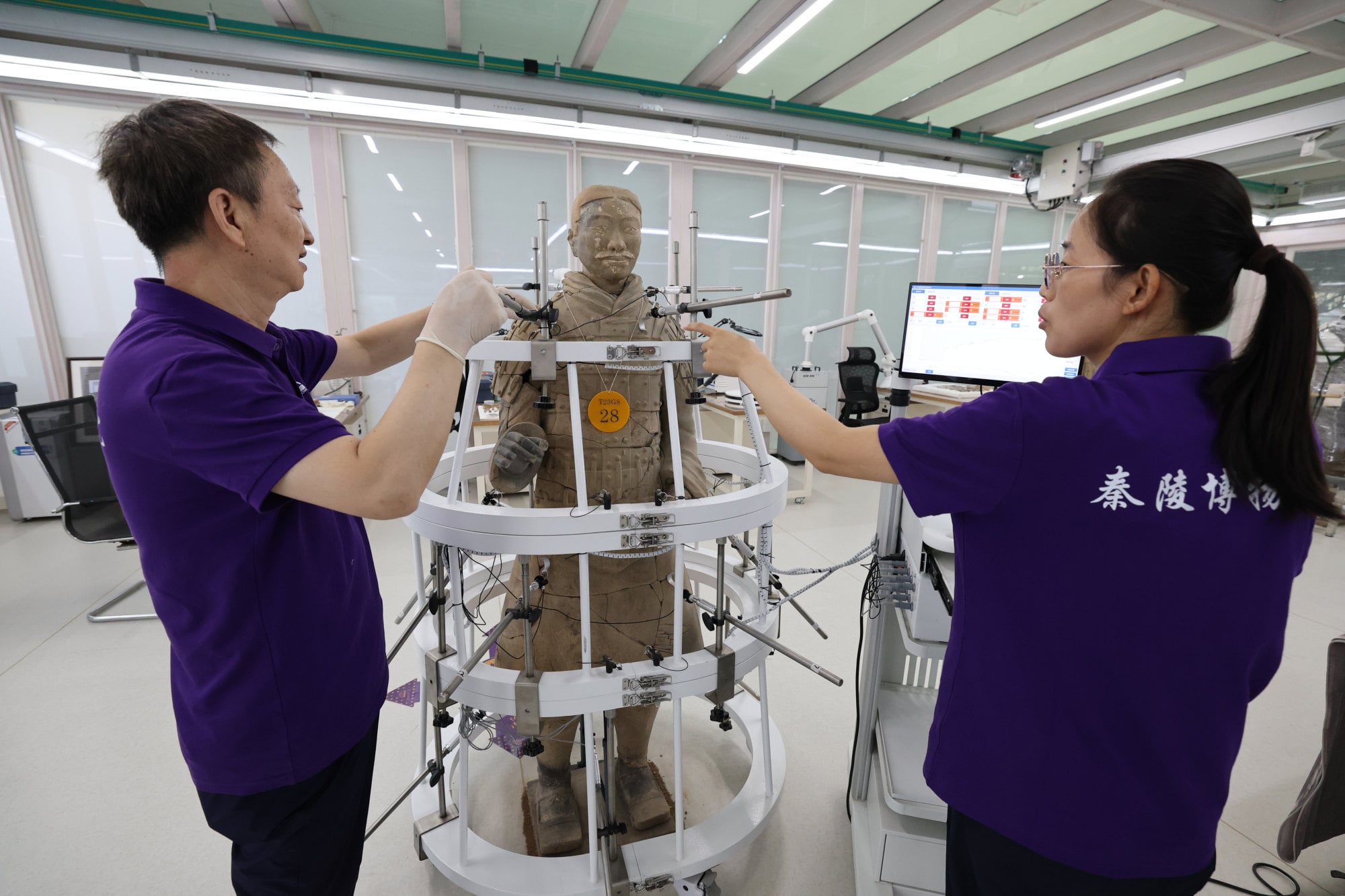
“Underground cultural relics are indeed very fragile,” he told the state broadcaster at the time.
“We should have a sense of awe and respect for heaven and Earth, nature and our ancestors.
“If we have advanced technology that allows us to understand what is inside the tomb without opening it from above, and without disturbing this old man who has been sleeping for 2,000 years, then from the bottom of my heart, I would say: don’t touch it in the future.”
The mausoleum is one of China’s most significant archaeological sites, built for Qin Shi Huang after he unified the warring states in 221BC.
Tens of thousands of square metres of burial pits and the imperial tomb itself remain underground, with thousands of statues still to be unearthed.
The sprawling complex includes the terracotta warriors, discovered in 1974, as well as numerous burial pits containing figures, weapons and other objects intended to accompany the emperor in the afterlife.
There is consensus among archaeologists that imperial tombs should not be proactively excavated in China.
This principle was reaffirmed by the State Council, China’s cabinet, in 1997, when it said in a notice on cultural heritage conservation that large imperial tombs should not be excavated until the necessary scientific and technical conditions for protecting relics were in place.
Between 2002 and 2003, Chinese researchers used remote sensing and geophysical techniques to conduct a large-scale, non-invasive survey of the mausoleum, producing the first outline of the underground palace’s structure and layout without opening or disturbing the tomb.
Wu said previous surveys had indicated the presence of mercury in the mausoleum, with mercury concentrations in the soil above the tomb more than 70 times those of the surrounding ground.
Although the contents of the underground complex remain unknown, Wu said the tomb should be left undisturbed unless a rescue excavation was needed to protect the relics.
In particular, artefacts made from plant and animal fibres could deteriorate immediately if the tomb were opened without adequate preparation, he warned.
Huang Songtao, a Chinese history blogger and cultural relic restorer, told Chengdu-based Fengmian News that the discovery of the three cinnabar sites was an important lead, but did not conclusively establish that Xunyang supplied mercury for Qin Shi Huang’s mausoleum.
The report, published on September 21, said current surveys could show only that mercury levels in the soil above the tomb were abnormally high. They could not determine the total amount of mercury underground nor link it directly to any particular mining site.
Xunyang alone may not have been able to meet demand if the mausoleum contained hundreds of tonnes of mercury, raising the possibility that the metal came from multiple sources, the report continued.
Qin Shi Huang was a controversial and often brutal ruler, but his measures to achieve da yitong, or “great unity”, are considered to have established China’s first unified, centralised, multi-ethnic state.
The concept of “great unity” has featured prominently in China’s ethnic governance narrative, with the Qin unification often cited by President Xi Jinping and Chinese scholars as a historical foundation for national cohesion. -- SOUTH CHINA MORNING POST


