




US President Donald Trump said on Tuesday he does not want to work with China on addressing artificial intelligence (AI) risks, arguing that cooperation could undermine America’s lead in the fast-moving technology, as he announced a voluntary accord signed by the leaders of six major US tech companies to address growing concerns surrounding the technology.
“Whoever wins superintelligence wins. You’re gonna have a winner and a loser, and you’re probably not gonna have a second place,” Trump said on Tuesday morning.
“We’re leading now over China and everyone else, and I want to keep it that way ... The only way you can keep it that way is to do exactly what we’re doing right now.”
In recent weeks, there have been growing calls for the US and China to collaborate on mounting concerns that frontier AI systems could be misused for cyberattacks and bioweapon development, following a string of high-profile incidents involving US companies OpenAI and Anthropic.
However, Trump claimed that any suggestion of a “joint venture” with China on AI would risk the US giving up “secrets” to China. Instead, he told reporters after a lunch meeting with 17 US tech industry leaders at the White House that “self-policing” would be enough to address AI risks.
Trump released a two-page document, including the signature page, outlining the “White House Accord on Super Intelligence” in a Truth Social post after meeting with tech leaders, which he said will be “morally binding”.
The document outlined four layers of controls and audits that the companies “should” implement.
These include internal controls to ensure their respective AI systems do not conduct “unintended” hacking and working with external auditors to independently evaluate whether the internal controls are working.
The six participating companies – Google, Nvidia, Anthropic, OpenAI, Meta Platforms and SpaceXAI – will also “meet regularly” to establish best safety practices, though the document did not say how regularly.
The voluntary accord came days after a high-profile summit between President Trump and Chinese President Xi Jinping in Washington, where the two countries agreed to launch an AI incident notification hotline and an ongoing dialogue on AI risks, with the next round slated for November in Shenzhen.
Details about what the two sides will discuss have yet to be announced. However, an early point of contention is what the technology will be called.
Trump also signed an executive order on Tuesday directing all agencies of the US executive branch to use the term “superintelligence” (SI) in place of AI in all official communications, as the term “more appropriately captures the promise, potential, and rapidly advancing capabilities of these technologies”.
Earlier in the day, Trump repeated claims that President Xi also “loves” the term, though Beijing has so far continued to use the term AI.
Another uncertainty is what the new risk management mechanisms between the two countries will achieve. On Tuesday, Trump presented US AI leadership as his administration’s top priority, in line with previous statements dismissing the most extreme warnings about AI risks as a “hoax”.
“President Xi knows that we’re leading by a lot and we don’t want to mix it up too much either,” he said, noting that the US already had guardrails in place to ensure that AI companies stay “honest”, such as the US Department of Justice and the FBI.
Trump made his remarks part of a day-long event on Tuesday in Washington that touted the importance of AI and featured members of his Cabinet.
The lunch meeting drew most of the US’ top tech leaders, including Meta’s Mark Zuckerberg, Nvidia’s Jensen Huang, Tesla’s Elon Musk, and Amazon’s Jeff Bezos, along with US House Speaker Mike Johnson.
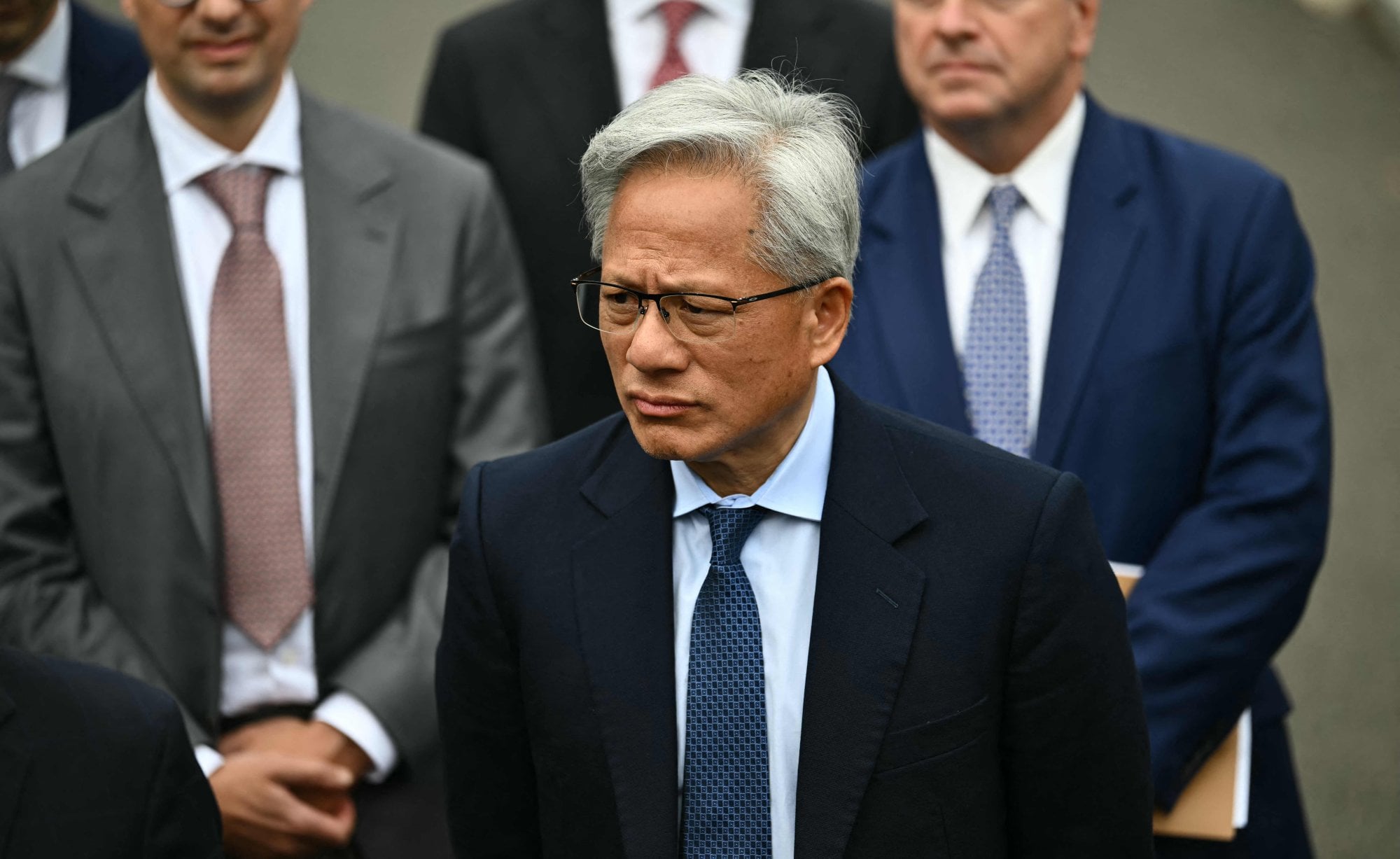
Anthropic chief executive Dario Amodei and OpenAI president Greg Brockman were also present, representing start-ups whose recent AI hacking incidents have sparked calls for tighter scrutiny of the AI industry.
The administration’s AI push comes as the technology and its accompanying infrastructure, most notably data centres, grow increasingly unpopular among the US public.
A poll from The New York Times and Siena University, published earlier this month, found that 61 per cent of likely voters opposed building data centres to power AI.
Trump on Tuesday also signed an EO directing every federal government agency to integrate their public-facing services with America.gov, a one-stop-shop website that lets US residents access federal government information and services more easily.
“This is a day all Americans will be extremely proud of your country,” he said. “[It’s] gonna save you a lot of accuracy.” -- SOUTH CHINA MORNING POST


