
Taiwan’s military plans to spend more than NT$27 billion (US$850 million) to quadruple critical ammunition stocks to 120 days’ supply, strengthening its ability to sustain combat operations during a wartime blockade.
The proposed six-year “urgent ammunition replenishment” programme, running from this year until 2031, comes as Taipei seeks to strengthen its ability to keep fighting if a cross-strait conflict cuts external supply lines.
The spending proposal was revealed on September 26 and still requires legislative approval. The programme is expected to cost NT$27.59 billion, with NT$7.3 billion allocated this year through a supplementary budget. A further NT$7.3 billion is proposed for 2027 to accelerate procurement of various types of critical ammunition.
Lieutenant General Huang Wen-chi, the strategic planning director of Taiwan’s defence ministry, said this month that the military aimed to gradually increase its combat-ready ammunition stocks from the current 30 days to 120 days.
He said more frequent combat-readiness drills and exercises in recent years had also increased ammunition consumption, requiring stocks to be replenished more quickly.
The programme covers critically needed munitions, including 120mm and 105mm tank rounds, 30mm cannon ammunition, propellant charges for 155mm artillery shells and high-powered explosives.
The military is also separately replenishing missile stocks, including thousands of additional Stinger missiles, while seeking to expand local ammunition production, according to the spending proposal.
The push reflects concern in Taipei that the People’s Liberation Army could seek to blockade the island during a conflict, disrupting overseas supplies and forcing Taiwan to rely on existing stockpiles and locally produced ammunition.
Beijing sees Taiwan as part of China to be reunited by force if necessary. Most countries, including the United States, do not recognise Taiwan as an independent state, but Washington is opposed to any attempt to take the self-ruled island by force and is committed to supplying it with weapons.
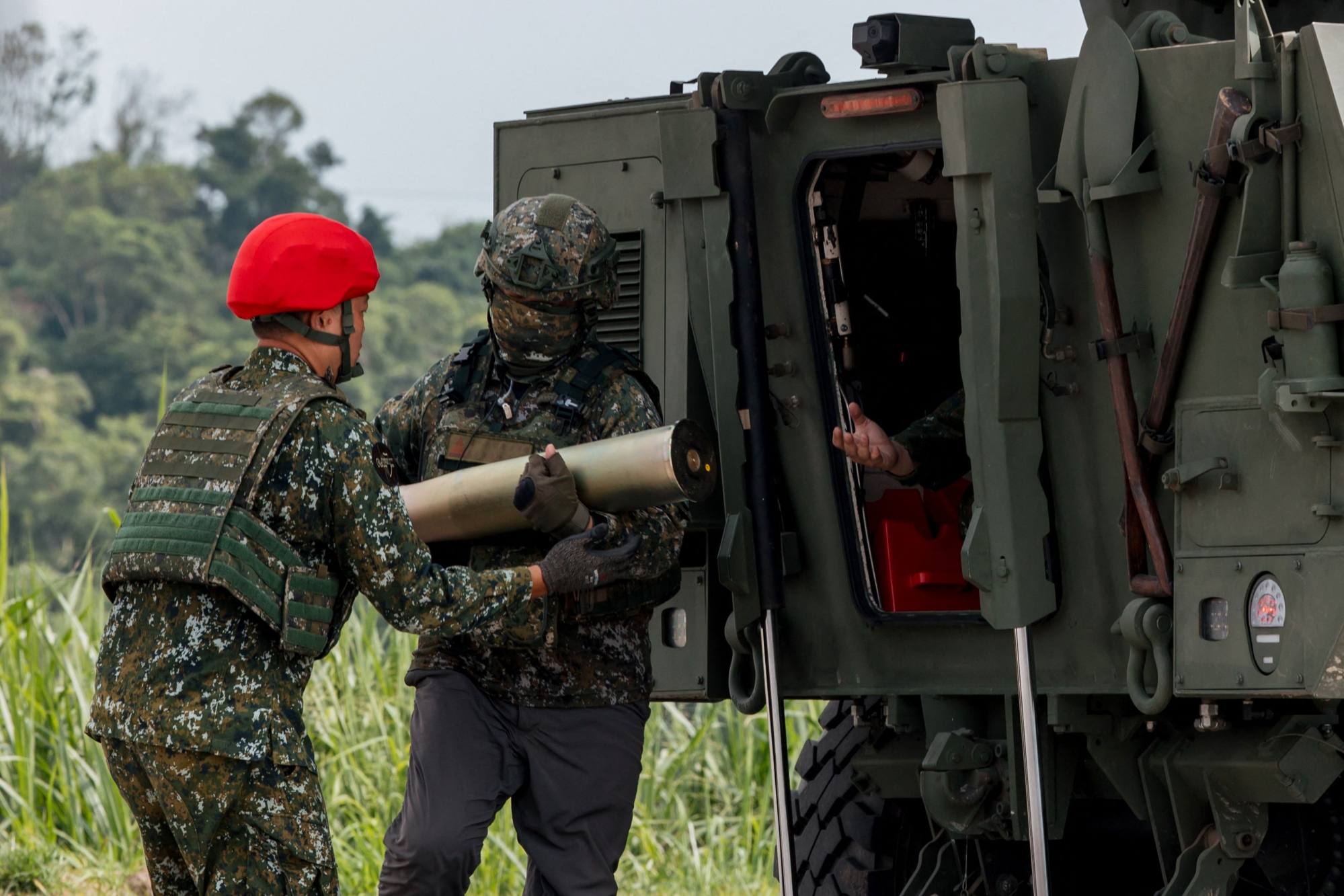
In a report to the legislature earlier this year, Taiwan’s defence ministry said the island’s geography made it particularly vulnerable to a PLA blockade intended to cut supply lines and prevent outside forces from intervening.
It originally proposed using a special defence budget to make large one-off ammunition purchases and build 14 additional munitions production lines, arguing that gradually replenishing stocks through annual budgets would not meet wartime requirements. Officials said the additional lines would double production capacity.
But the legislature in May reduced the ceiling of the government’s proposed NT$1.25 trillion special defence programme to NT$780 billion and limited it largely to US arms purchases, excluding general-purpose ammunition and the expansion of local production lines.
Wellington Koo Li-hsiung, the defence minister of Taiwan, told lawmakers that plans to build the 14 production lines and raise ammunition stocks to 120 days had been removed from the special legislation.
The ministry has since sought to fund some of the requirements through supplementary and annual budgets.
Lawmakers have questioned whether Taiwan has sufficient ammunition to sustain a prolonged conflict.
Lin Pei-hsiang, a legislator from the main opposition Kuomintang, said lessons from the Ukraine war showed that even sophisticated weapons could be systematically destroyed without adequate survivability, camouflage, mobility and dispersed deployment.
“What really determines combat capability is ammunition stockpiles, resupply capacity and the ability to sustain production during wartime,” Lin said, questioning how much precision-guided ammunition Taiwan would have if fighting lasted more than two weeks.
Chen Kuan-ting, from the ruling Democratic Progressive Party, said security investment should extend beyond weapons to broader resilience, including energy reserves, backup power, critical supplies, communications, ports and other infrastructure.
“We need to look at what our opponent is preparing and ask ourselves whether we are sufficiently prepared,” he said.
Taipei is also expanding storage capacity to accommodate the larger ammunition stockpile.
From next year, the army plans to spend about NT$4.18 billion on six blast-resistant ammunition depot projects with a combined capacity of 10,250 tonnes. Together with depots already under construction, the projects are expected to add 18,250 tonnes of storage capacity by 2033.
Analysts said larger reserves were important because Taiwan could face high ammunition consumption while waiting for outside assistance.
Chieh Chung, a researcher with the Taipei-based Association of Strategic Foresight, said that even if US forces were to assemble in Hawaii, they could take another two to three weeks to reach the first island chain and would have to contend with a PLA maritime blockade and other threats.
“If it becomes a protracted war, and the PLA lands and we enter the territorial defence phase, we will inevitably consume huge quantities of conventional ammunition,” Chieh said.
He said Taiwan should increase conventional ammunition stocks through local production while asking Washington to accelerate deliveries of precision-guided weapons that the island could not produce itself.
Wang Hung-jen, executive director of the Taipei-based Institute for National Policy Research, has also said Taiwan must recognise how much ammunition is consumed in modern warfare and move beyond a defence strategy focused mainly on deterrence.
Speaking at a Taipei seminar in April on the global impact of the US-Iran conflict, Wang said long-term planning should also cover ammunition and other supplies, as well as the protection of critical infrastructure.
“Taiwan’s security does not come only from external support,” Wang said. “Taiwan itself must have sufficient preparedness and manage risks in advance.” -- SOUTH CHINA MORNING POST