
US President Donald Trump addressed the global community on Tuesday morning with a speech that sought to justify his war with Iran, touted how he has “made peace” and argued that his “make America great again” policies benefit the world.
His speech before the UN General Assembly came as the world grapples with years of conflict in Ukraine, Iran, Gaza, Sudan, Yemen and Lebanon, with no relief in sight.
“I can report to you with pride that America is back, and our country is stronger today than ever before,” he said. “Our country is doing better than ever before, and our future is very, very bright.”
In a speech that seemed at times more suited to a US campaign stop than the global community, he touted his record on cutting crime, encouraging US innovation, ending illegal immigration and enacting US tax cuts, selling them as wins for the global community.
“While others have talked, I have acted. While others have spoken of peace, I have made it,” he added. “The entire world is being lifted by the wealth, strength, spirit and momentum of a newly energised and a very powerful United States of America.”
Trump largely kept to his prepared comments, other than a tirade against the “rogue” UN International Criminal Court and against critics of artificial intelligence.
“This is the group that came up with the Russia, Russia, Russia hoax, the Ukraine, Ukraine, Ukraine hoax, climate change, open borders,” he said.
“Whoever wins super intelligence, wins. That’s the group that wins. And we’re leading now over China by a lot, and everyone else, and we’re going to keep it that way.”
The relatively on-message address – which even included a few kudos to the UN for passing favoured resolutions – was in sharp contrast to last year’s UNGA speech. Twelve months ago, he riffed on the UN escalators and teleprompters, its substandard building materials and environmental policies that “kill all the cows”.
Trump spent a significant part of his remarks laying out his case for his war of choice in Iran.
But even as Trump has called the Iranian leadership “vicious,” “violent” and “scum” on social media, his administration has teased a possible meeting this week with Iranian President Masoud Pezeshkian, who is also attending the General Assembly.
Both sides were being coy, however. Shortly before boarding his plane in Tehran, Pezeshkian said Iran was wary of more talks, having twice been attacked by the US and Israel during active negotiations.
‘To the victor belong the spoils’
Trump also highlighted on Tuesday his administration’s strategy for ending violence, instability and foreign interference in the western hemisphere, a region increasingly contested on the economic front with China, which has invested billions of US dollars.
He revisited the US military operation in January that captured then-Venezuelan president Nicolas Maduro and said Washington was “working closely with the leaders of Venezuela to forge a much better future”.
Venezuela’s acting president Delcy Rodriguez sat motionless and stern-faced as Trump referred to her government and did not applaud him at any point, a South China Morning Post correspondent in the hall observed.
Trump praised an oil agreement signed with Rodriguez’s government last month, which he said covered 65 billion barrels.
“It was a war, but it’s perhaps the biggest deal ever made,” he said. “To the victor belong the spoils.”
The deal gives the US 55 per cent of the effective output of 17 oilfields, including the right to buy oil at cost. Several of those fields had been operated or targeted by Chinese firms such as Sinopec, while Chinese lenders are still owed at least US$10 billion by Caracas, according to analysts.
Trump said the operation proved “the United States will no longer permit threats to America to gain a foothold anywhere in the western hemisphere”, adding that Washington would use its military might when necessary.
Without naming a specific country, he accused previous administrations of letting the region be “infiltrated by hostile foreign adversaries” and mocked Venezuela’s imported hardware.
“Venezuela had the finest equipment in the world from other countries, and guess what? It didn’t work [against US forces],” he said.
Caracas relied on Russian missile systems and Chinese-made radars that Beijing had promoted as capable of detecting stealth aircraft.
Trump also called drug cartels “the ISIS of the western hemisphere” and claimed US strikes on alleged drug boats had cut seaborne drug flows by 97 per cent. The campaign has killed at least 231 people since September last year, according to US Southern Command.
He described Mexico as “the epicentre of the cartel violence” but praised ties with its government, which has repeatedly rejected US military action on its soil.
The US president also predicted that Cuba’s communist government “will fall”, prompting the Cuban delegation to walk out of the hall.
“Communism will never be coming to America, but freedom will be coming to Cuba,” he said, “and safety and security will be coming to Mexico.”
Greenland and the UN succession
Trump’s speech came as his poll figures hit new lows at home and abroad. According to a Pew survey in June, a median of just 23 per cent of adults from 36 nations expressed confidence in his leadership of global affairs, citing tariffs, Gaza, Iran, Greenland and the Russia-Ukraine war.
Even as Trump has repeatedly slammed the United Nations, questioning its purpose and inability to solve conflicts, he has relished the opportunity to address a large audience on a prominent stage.
This year’s speech went ahead without the technical mishaps of last year, when an escalator halted as Trump and his wife, first lady Melania Trump, stepped onto it on their way to the hall.
His teleprompter then failed for roughly the first 15 minutes of his 57-minute address, and he complained about the UN several times from the podium.
UN officials later said a White House videographer had accidentally triggered the escalator’s emergency stop and that the teleprompter was operated by the White House.
Trump nonetheless called the episodes “triple sabotage”, adding a claim that the sound in the hall had failed.
In the days before this year’s general debate opened, the South China Morning Post saw UN staff working to rule out a repeat. On Monday, security officers were seen testing the escalator, the teleprompter and the earpieces that carry the audio feed from the podium microphone.
In his address, the US president claimed the Pentagon had no shortage of munitions, called on Russia and Ukraine to “stop the killing” without mentioning that Moscow had invaded, and gave a shout-out to his wife.
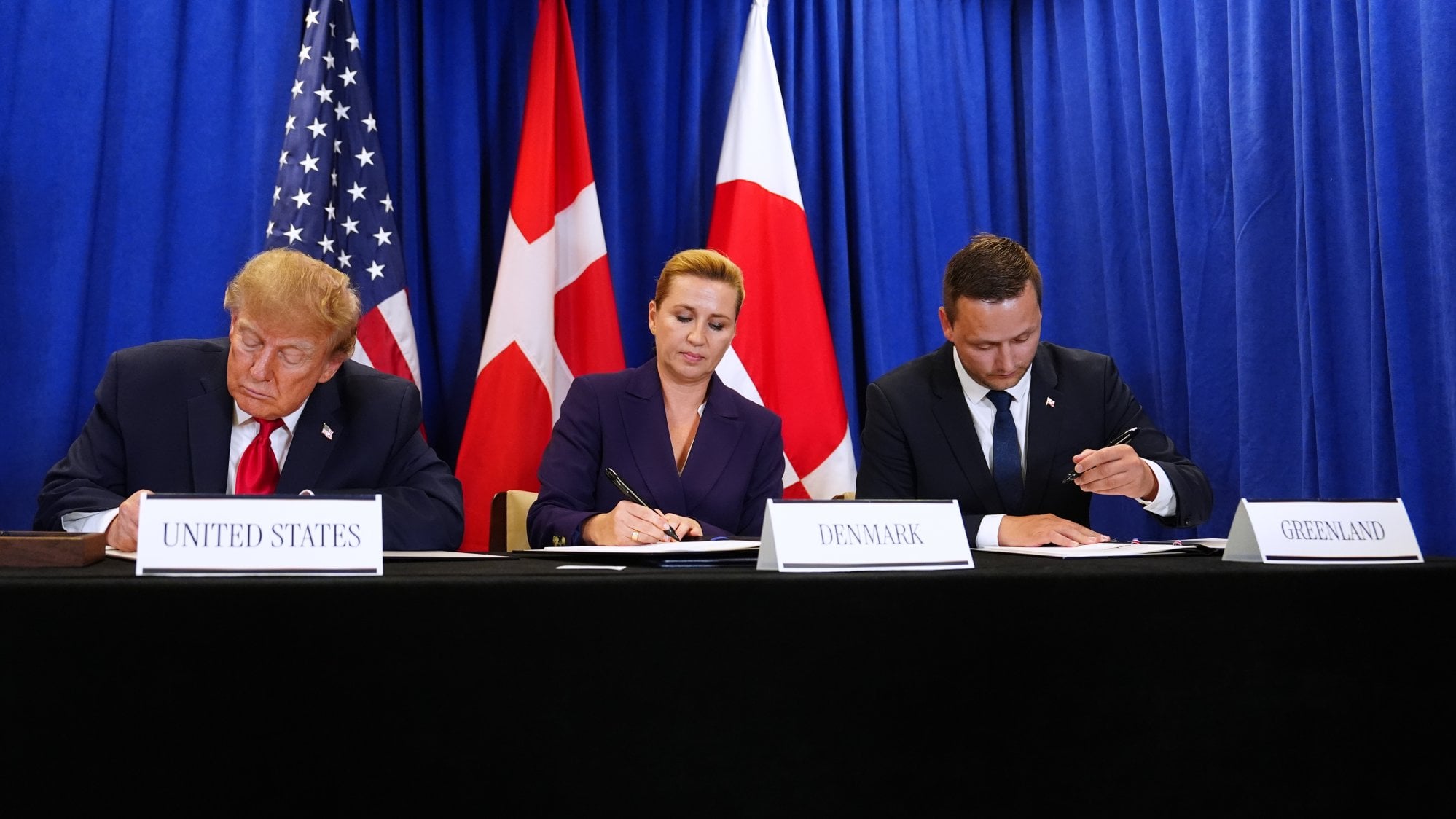
Trump also met with the leaders of Greenland and Denmark after his speech and signed a deal allowing a larger US military presence on the world’s largest island, territory he has long coveted, that could end a stand-off over the strategically located and mineral-rich territory.
US Secretary of State Marco Rubio said on Tuesday morning that the deal allows Washington “to put as many military bases as we need in order to defend everything”, adding that the US will screen potential investors in Greenland to block those linked to China or other adversaries that are not North Atlantic Treaty Organisation members.
He also called for UN financial reform, slamming the UN’s human rights activities.
“With all the genuine atrocities in the world, the UN’s top human rights officials spend their time criticising the United States for protecting our children from transgender mutilation and transgender insanity,” he said. “The craven hypocrites of [the] Human Rights Council have little to say about the persecution of Christians.”
In his last major speech to the 193-member global body, UN Secretary General Antonio Guterres opened the assembly with a plea for “a world built on interdependence”.
“The fault lines in our world are widening,” he said, citing wars, climate change and artificial intelligence, among other crucial issues.
The UN assembly comes as speculation heats up about who will replace Guterres when his second five-year term ends on December 31.
No clear successor has emerged but the issue may well be on the agenda when Trump and Chinese President Xi Jinping hold their summit on Wednesday in Washington. The US and China are the UN’s largest funders and most powerful Security Council members.
Guterres on Tuesday also called for AI superpowers, widely viewed as the United States and China, to start a dialogue on the technology’s future akin to US-Soviet engagement at the height of the Cold War.
AI is expected to be a significant issue during the Trump-Xi sit-down following a pre-summit meeting on Monday between US Treasury Secretary Scott Bessent and Chinese Vice-Premier He Lifeng in New York.
In an apparent dig at Trump, Guterres said superpowers must realise “that their power isn’t so super” and military power alone can’t secure peace. -- SOUTH CHINA MORNING POST