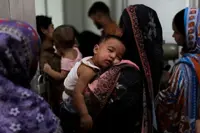
DHAKA: When Raisa Begum reached Khulna Medical College Hospital (KMCH) after suddenly falling ill, all she wanted was a bed where she could receive care. Instead, the pregnant woman has to spend the past several days in a cramped corner outside the maternal care and labour ward, beside a staircase, with her young son and husband.
The family came to the hospital from Sreefaltala in Rampal, Bagerhat, on Sept 17, after Raisa was first taken to Rampal Upazila Health Complex.
But there was no bed for her at KMCH either.
“I am already sick. My son and his father are also becoming sick in this situation. Sometimes it is difficult even to find a doctor. Before a doctor can properly examine one patient, another patient takes them away,” Raisa told The Daily Star.
“I have asked my husband to take me home. Otherwise, I fear I will become even sicker.”
Her experience is being repeated across the 500-bed hospital, where the number of admitted patients has recently reached nearly four times its official capacity.
On Saturday (Sept 26), KMCH had 1,933 admitted patients. The figure was 1,888 on Sept 25; 1,933 on Sept 24; 1,915 on Sept 22; 1,920 on Sept 21; 1,996 on Sept 20; 1,917 on Sept 19; and 1,934 on Sept 18, according to hospital sources.
Patients are spilling into corridors, stairways, verandas and every available corner, while their attendants struggle to find even basic space and facilities.
The situation is particularly acute in the dengue wards.
KMCH had 244 dengue patients on both September 20 and 21, and 267 on September 19. Yet only 32 beds are designated for dengue patients.
The overcrowding also poses a particular risk for dengue patients and those around them.
Patients lying in corridors and verandas often struggle to keep their mosquito nets properly in place as people are constantly moving around. That leaves patients and attendants exposed to mosquitoes that can transmit dengue.
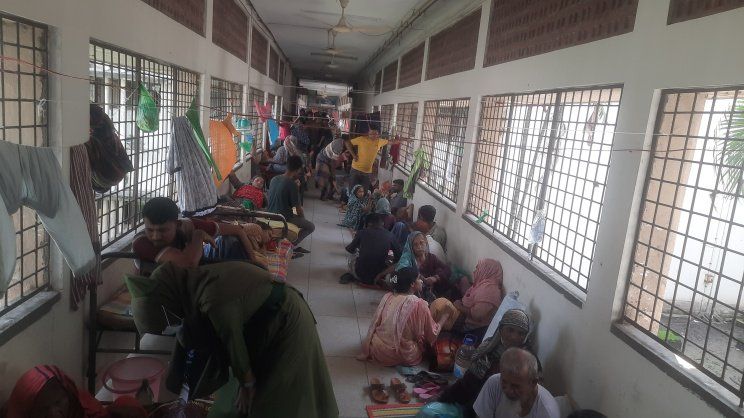
Raisa said three dengue patients were being treated about 10 feet from where her family has been staying.
“When I came to this hospital, I was unconscious. But after regaining consciousness, the situation became even worse,” she said.
“Patients, doctors, attendants, nurses and vendors are everywhere. It is chaotic. There is a waste bin beside us, and it gives off a foul smell all the time.”
The lack of space is also affecting elderly patients.
Around 75-year-old Arman Sheikh is being treated in a corridor, with no bed available and no fan above him. After he spent three days suffering in the heat, his son Aslam bought a battery-powered table fan.
“There was no fan above my head, and I could not get a bed. After suffering in the heat for three days, my son bought this fan,” Arman said.
There is no power socket nearby, so the family has to take the fan elsewhere to charge it.
“People are constantly walking around, raising dust. It gets on our bodies. It feels suffocating,” he said.
The scenes reflect the growing pressure on KMCH, one of the largest public hospitals serving Khulna and surrounding areas.
The hospital was established as a 250-bed facility in 1989 and upgraded to 500 beds in 2008. But its infrastructure and facilities have struggled to keep pace with the growing demand. According to hospital sources, around 1,800 to 1,900 patients were admitted on average in August and September.
Dr Sujat Ahmed, assistant director of KMCH, said the hospital had become accustomed to operating under severe pressure.
“Patients and their attendants can see for themselves the conditions in which we provide treatment,” he said.
“Doctors often cannot move from one ward to another because of the number of patients occupying the verandas. There is simply no space. Patients are putting beds under staircases, in corridors and beside lifts wherever they can find room.”
Despite the limitations, he said, hospital staff were continuing to provide services around the clock.
The pressure is compounded by shortages in the workforce.
KMCH has 278 sanctioned posts for doctors, of which 18 are vacant. Authorities said some physicians are currently attached from other institutions to help meet the demand.
Of 510 sanctioned nursing posts, 492 are filled. But 212 posts for third- and fourth-class staff remain vacant.
Dr Md Akhtaruzzaman, superintendent and deputy director of KMCH, said the hospital was providing treatment under severe limitations.
Patients from all 10 districts of Khulna division, as well as neighbouring areas, continue to come to the hospital, placing enormous pressure on its limited infrastructure.
“Despite the overwhelming number of patients and various limitations, we are doing our best to provide treatment and address the problems,” he said.
Dr Sujat said the large patient load also reflected people’s confidence in the hospital’s services.
“Patients come from all 10 districts of Khulna division and other areas because they consider our services good,” he said.
“But if the shortage of doctors, equipment and other facilities could be addressed, we could provide much better treatment.” - The Daily Star/ANN