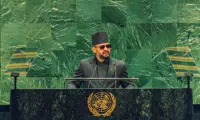
KATHMANDU: It was around 5 a.m. in Kathmandu on Friday when Prime Minister Balendra Shah stepped up to the General Assembly rostrum in New York.
He was in his usual element: black dhaka topi and dark glasses he had been wearing since the election campaign.
He was given 15 minutes to speak.
Across Nepal and among the global diaspora, there was anticipation and a level of impatience about Shah’s speech.
The impatience was for two reasons.
Since March, Nepalis have rarely heard their prime minister deliver a speech, let alone make an argument out loud, from beginning to end.
Second, after the Bhotekoshi floods, the whole world’s eyes are on Nepal: what is the world’s youngest head of state going to say to the world?
Six months into his term, Shah has given no interviews and held no press conferences.
In May, he got up and left the joint session of Parliament while President Ramchandra Paudel was reading his government’s policy and programme.
By our own count, Shah has only spoken in the House twice: his first speech in May reignited a border dispute with India, and the second time he spoke was earlier this month, briefing the lawmakers on the Bhotekoshi floods.
Beyond that, Shah seems mostly comfortable explaining himself in long Facebook posts.
Until last month, the prime minister was not meant to be in New York at all.
The original plan was to send Foreign Minister Shisir Khanal to head the Nepali delegation.
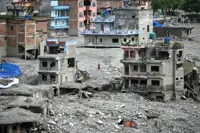
But the August 26 floods, which have killed nearly 1,500 people and left more than 5,500 missing, changed that, as there was a growing call within the party and the country for him to represent Nepal.
Even before Shah landed in New York on Thursday, Secretary-General António Guterres had already raised Nepal’s floods in his opening statement.
Shah’s speech was built for the audience — a gathering of representatives from the member states of the global body.
“The Bhotekoshi-Trisuli disaster was not just a local tragedy.
It was a warning to the world.
And I ask you today: have we really heard that warning?” he began.
He reminded the room of the moment when Guterres stood in the Everest region nearly three years ago, and he put the failure to act on political leaders.
Whoever prepared the speech also chose the numbers very carefully: Nepal produces under 0.1 per cent of global emissions and faces recovery needs of about 10 per cent of GDP.
“We did not create this crisis, yet we are paying a colossal price for it,” Shah said.
He cited the UN climate convention’s principle of common but differentiated responsibilities and the UNDP’s 1994 Human Development Report.
His one concrete proposal, which is already making headlines and is being highlighted in video clips across social media, is a Himalayan Climate Resilience Mechanism, led jointly by Nepal, India and China, for shared satellite data, glacial-lake monitoring and early warning.
The diplomatic choreography was also worth noticing in Shah’s address.
In the days after last month's floods, the administration made a case for climate justice — and compensation — from the world’s largest emitters.
In New York, Shah named India and China first, and only to thank them for their help after the flood.
“We are not here to blame any country or continent,” he said.
He then proposed a trilateral mechanism with the two neighbours whose representatives he had kept at a distance for a long time since taking office.
One of his sharpest passages in the address was also the one that sounded most like him — something that appeared clearly intended for his audience at home.
Nepal’s farmers could not get fertiliser during monsoon planting season, road builders could not get bitumen, and families are running short of cooking gas.
“Intercontinental missiles arrive on time.
Rifles and ammunition cross borders, clear every bottleneck, meet each deadline,” he said.
“But a peasant in Nepal cannot procure his fertiliser or fuel at market price at a time of need.”
The economic fallout of the US and Israel’s war on Iran has deeply impacted daily lives in Nepal.
Earlier this month, the industry minister resigned over her remarks about gas shortages and the role of industrialists who import it.
“We have built a world with flawless logistics for war and broken logistics for food,” Shah continued.
The UN is not a stranger to leaders who use the podium to boost their approval — or aura — at home.
El Salvador’s Nayib Bukele paused his debut address in 2019 to pose for a selfie.
In 2012, Israel’s Benjamin Netanyahu held up a cartoon bomb and drew a red line across it with a marker.
In 2009, Muammar Gaddafi of Libya ran far past his slot and tossed aside a copy of the UN Charter from the rostrum.
For many heads of state, the international stage extends the persona.
Shah, who is known for his conscious image-building on social media, chose to go the other way in his words at the world’s biggest stage.
(He did have his moment during his photo-op with António Guterres, when the black shades came out first and the handshake came a few beats later.)
The one time he spoke about himself, it was to set the subject aside: “I am told I am the youngest head of government to address this assembly this year.
I did not come here to make that a story,” he said.
Unlike Bukele, Netanyahu or Gaddafi, he left the persona to the image.
The remarks, which were prepared in advance with the foreign ministry and outside experts, closed with Shah invoking Pashupatinath and the Buddha in Nepali.
But Shah’s speech, which has been largely hailed online, is significant for another reason.
Since taking office, at home, his silence has often been the story.
The ruling party lawmakers defend it as a man working quietly, while his critics call it an evasion of democratic accountability.
When Shah returns to Kathmandu this weekend, the fuel and fertiliser shortages he raised in his speech will be waiting for him.
But so will an opposition — as well as his own party supporters — that have spent six months demanding he answer questions in the House.
A question perhaps many will be asking after today is: If the prime minister can make an impassioned case to 193 member states of the United Nations, what is stopping him from communicating with 275 members of his own Parliament — and beyond them, with citizens he represents at home? - Kathmandu Post/ANN