
Before setting off for Washington on Wednesday, Chinese President Xi Jinping had some correspondence to attend to.
Dozens of students from 10 US universities, including Harvard, had written to Xi about their experiences on an exchange trip to China this year.
According to the State Council, Xi responded with a call to the students to advance cooperation between the two countries.
The gesture extended a pattern.
For decades, Beijing has often turned to unofficial channels, from prominent individuals to bridging organisations between the two powers, to get its diplomatic messages across to Washington.
The tradition has been pronounced in recent years, as the fierce China-US strategic rivalry makes direct governmental contact challenging.
For example, when the trade war sent shock waves through the trans-Pacific relationship in 2018, Beijing placed particular value on influential “old friend” and former US secretary of state Henry Kissinger, channelling its views on relations with Washington in multiple meetings with him.
When Kissinger, the principal architect of the US’ rapprochement with China in the early 1970s, died in 2023, the baton for that intermediary role for Beijing appeared to pass to his student, Graham Allison.
Allison, the former dean of Harvard University’s Kennedy School of Government, visited China in March and June, meeting high-level Chinese officials on both occasions, including an encounter with Wang Huning, the country’s fourth-ranking official.
Allison is the author of The Thucydides Trap, a book that popularised the theory that a rising power and an established hegemon are prone to conflict. Xi referred to the term in his talks with Trump on Thursday.
With trade and investment such a large part of the relationship between the world’s two biggest economies, Beijing has also emphasised engagement with the American business community as a way to signal its intentions to Washington.
Just days before Xi’s latest trip, Chinese Premier Li Qiang met a visiting delegation from the US-China Business Council in Beijing.
The council was founded in 1973 with support from the White House and the State and Commerce departments, and has played a prominent role in the development of bilateral relations.
Apple, Boeing and Nvidia are among its more notable member companies and their executives have made high-profile trips across the Pacific.
Nvidia chief executive Jensen Huang has made repeated trips to China and met several senior Chinese officials. He also accompanied Trump on his May visit to Beijing.
And on Wednesday, Chinese state broadcaster CCTV released interviews in which Elon Musk, the US trillionaire and Trump ally, described Xi as “a great leader”.
The National Development and Reform Commission, China’s top economic planning agency, also invited the American Chamber of Commerce in China for a roundtable on September 10.
The influence of those potential messengers in the White House or on Capitol Hill has long been open to debate. Still, history shows that such players do not necessarily need to have official credentials to make a difference.
In 1970, then Chinese leader Mao Zedong appeared with American writer Edgar Snow on the Tiananmen Rostrum to send a diplomatic signal to then US president Richard Nixon that Beijing was ready to reopen communications with Washington.
The process was aided by “ping-pong diplomacy”, which helped to normalise China-US relations and remains a recurring reference in Beijing.
The Chinese government has found contemporary successors to that legacy.
In the past two years, for example, there have been multiple pickleball exchanges between Chinese and American teenagers.
At a pickleball event in May, Beijing’s top envoy to Washington Xie Feng called on participants to “carry forward the spirit of ping-pong diplomacy” through the sport and to “write new stories of China-US friendship with the passion of youth”.
It underlined Beijing’s broader emphasis on people-to-people exchanges as another channel that could help convey its views on the bilateral relationship.
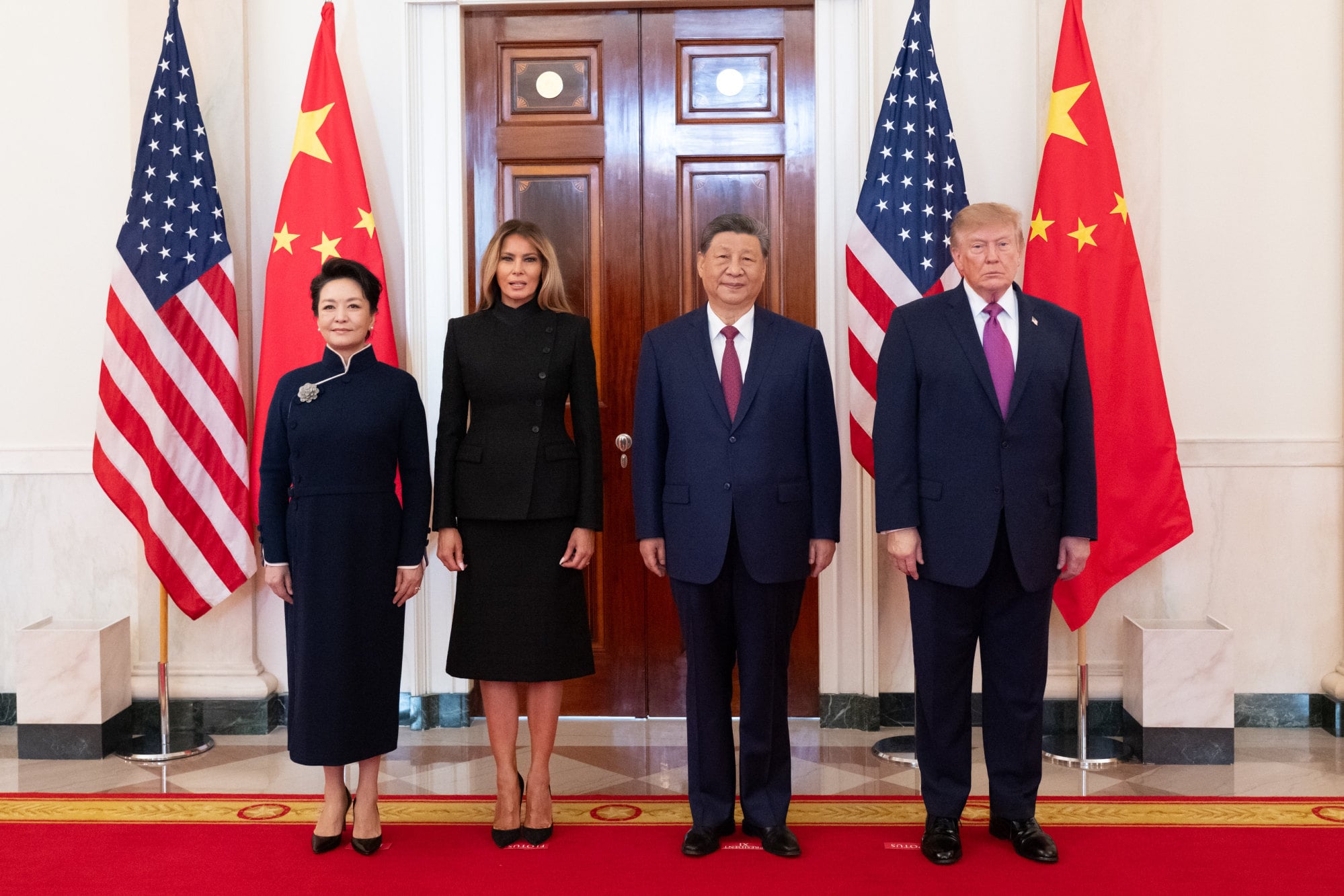
At the White House on Thursday, Xi announced that 100,000 young Americans would be invited to take part in exchanges and study in China over the next five years.
The move followed his initiative in 2023 to invite 50,000 US youths over five years – a target Beijing said months earlier it had reached 2½ years ahead of schedule.
Those initiatives came after years of escalating pressure from Washington led to the large-scale closure of Confucius Institutes in the US, stifling a key channel long regarded by Beijing for educational and cultural exchanges between the two nations.
In recent years, Beijing has repeatedly used events commemorating the legacy of the Flying Tigers – the group of American volunteer pilots who fought Japanese forces in China and Burma during the Word War II – to invoke memories of close cooperation between the two countries. Trump also mentioned the US pilots in his remarks when hosting Xi on Thursday.
In September 2023, when relations were beginning to return from a particularly low ebb, Xi replied to a letter from Jeffrey Greene, chairman of the Sino-American Aviation Heritage Foundation, and Flying Tigers veterans Harry Moyer and Mel McMullen, noting that China and the US “should, and must, respect each other, coexist in peace and pursue win-win cooperation”.
During his visit to the US in November that year, Xi also referred to the Flying Tigers in a speech, as well as the friends he made in Iowa during his first visit to the United States in 1985.
In February, he sent a reply letter and a Chinese New Year card to long-time friends in Iowa, underscoring continued China-US exchanges.
Another similar people-to-people diplomatic channel is “Bond with Kuliang”, a cross-cultural initiative built around the historic ties between residents of a mountain resort in Fujian province and American families who lived, worked or vacationed there from the late 19th century. -- SOUTH CHINA MORNING POST