




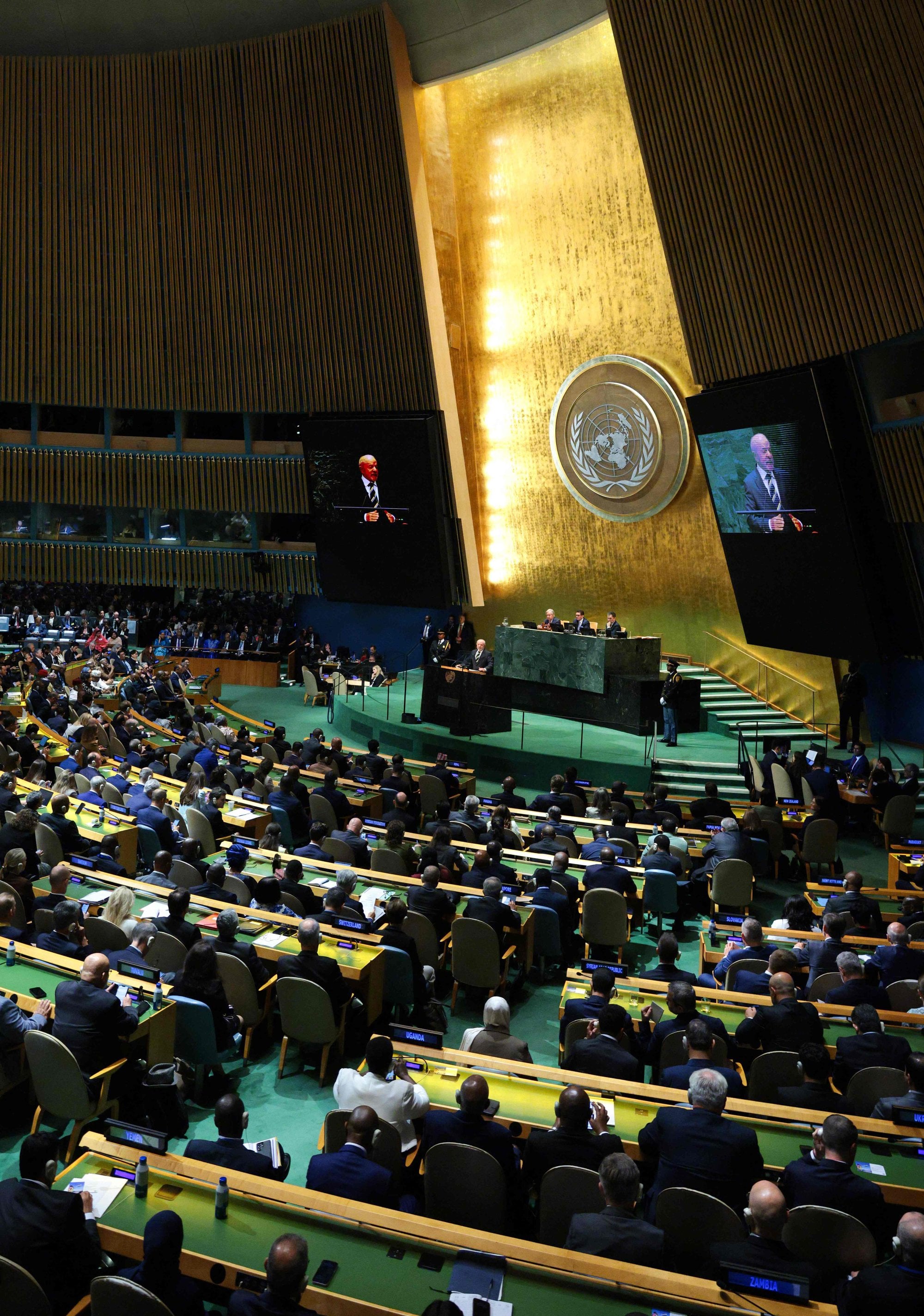
Brazilian President Luiz Inacio Lula da Silva renewed his backing on Tuesday for a peace initiative he launched with China to end the war in Ukraine, using his opening speech at the UN General Assembly to take thinly veiled aim at the United States over tariffs, military pressure and access to critical minerals.
Speaking in New York just days before Brazilians vote in a tight presidential race, Lula described the war between Russia and Ukraine as a five-year humanitarian drama that “continues to claim lives”.
There will be “no winners on the battlefield” and “diplomacy is the only option”, he told the assembly, pointing to “the Group of Friends for Peace, created by Brazil and China”, as proof that “there are forces in the international community willing to work for dialogue”.
Beijing and Brasilia launched the group at the UN in September 2024, gathering representatives from 17 developing countries behind a call for a negotiated settlement. China received no criticism in the address.
Lula framed the appeal within a wider indictment of the UN, telling delegates its credibility had “never been so low” and that members were “hostages to the immobility of a Security Council that does not fulfil its role”.
“War is not the continuation of politics by other means. It is the total bankruptcy of politics,” he said.
Criticism of US foreign policy
The United States was not named during the speech but was the clear target of several passages.
In one, Lula described the proximity of Latin America and the Caribbean to “the world’s greatest military power” as inescapable, “especially in a context of resurgent hegemonic temptations”.
“Brazil does not fit in anyone’s backyard,” he said.
He also rejected foreign military involvement in fighting organised crime, months after Washington designated Brazil’s two largest gangs, the Primeiro Comando da Capital and Comando Vermelho, as terrorist organisations. Brazilian officials had opposed the designation.
Brazil “will not outsource the responsibility of defending our borders”, the president declared. “We do not need aircraft carriers watching over our waters.”
Lula instead pointed to a proposal he had personally handed to US President Donald Trump for cooperation against arms trafficking and the laundering abroad of money by Brazilian criminal groups.
He paired those warnings with a message to the foreign powers competing for Brazil’s rare earths, a contest in which Washington and Beijing are the main players.
Brazil holds the critical minerals and rare earths “that the world needs to carry out the energy transition”, the president told delegates, and those resources will be exploited for the benefit of the Brazilian people.
Foreign access to them, in his words, “will have as a mandatory counterpart the generation of value in our territory, the transfer of technology and the supply of strategic national sectors”.
The remarks came six days after Lula signed a national critical minerals policy into law.
It offers up to 7 billion reais (US$1.4 billion) in incentives for domestic processing and creates a council under the presidency with powers to vet changes of control at mining companies and international agreements involving strategic minerals.
The issue has become a campaign flashpoint since April, when US-based USA Rare Earth agreed to buy Serra Verde, owner of Brazil’s only commercial rare earths mine, for about US$2.8 billion. Lula’s ruling Workers’ Party called the deal an attack on national sovereignty.
Lula’s main challenger, Senator Flavio Bolsonaro, has taken the opposite line.
The Trump ally argued that Brazil should position itself as an alternative supplier for a US still dependent on China, and a memo bearing his campaign’s branding, reported by the South China Morning Post this month, proposed a rare earths supply chain with Washington designed to isolate Beijing.
The new rules apply equally to Chinese capital, which has been flowing into Brazilian mining at a record pace. Brazil was the top global destination for Chinese investment last year, receiving US$6.1 billion, and Chinese investment in mining more than tripled, according to the Brazil-China Business Council.
The largest pending Chinese bet is MMG, controlled by state-owned China Minmetals, which agreed in February last year to buy Anglo American’s Brazilian nickel operations for up to US$500 million. That is the kind of change of control the new council is empowered to review.
Brazil is also on course for a record in exports this year “despite the tariff barrage against our economy”, according to Lula. Exports reached US$250.9 billion between January and August, the highest on record for the period, while sales to China rose 15 per cent to US$77.1 billion and accounted for 30.7 per cent of the total, trade ministry data showed.
A tradition that puts Brazil before the US
Brazil has opened the General Debate every year since 1955, a custom that places its president at the rostrum immediately before the leader of the United States, the host country. Trump spoke after Lula on Tuesday.
That running order produced an unexpected thaw last year, when Trump and Lula crossed paths backstage and embraced after months of trading barbs publicly over US tariffs of up to 50 per cent on Brazilian goods, which Trump tied to the trial of former president Jair Bolsonaro over a coup plot.
Trump told the assembly minutes later that they had shared “excellent chemistry”, opening a thaw that led Washington to roll back much of the tariff package.
The combative tone of Lula’s speech this year, aimed squarely at US geopolitical decisions of recent months, was followed by a brief encounter on the floor.
As the hall emptied after Trump’s address, as it usually does once the US president finishes speaking, US Secretary of State Marco Rubio quickened his pace to reach Brazilian Foreign Minister Mauro Vieira, the SCMP observed.
Rubio was accompanied by Treasury Secretary Scott Bessent, first lady Melania Trump and White House Chief of Staff Susie Wiles. He pointed towards Lula as he spoke to Vieira. Their words were inaudible, but Vieira appeared to answer with a hand gesture suggesting the conversation would have to wait.
Brazil’s foreign ministry and the US State Department had not responded to requests from the SCMP for comment on the exchange by the time of publication.
Lula left UN headquarters at around the same time and went straight to John F. Kennedy International Airport for his flight back to Brazil. It was a break with his practice of holding a press conference after addressing the assembly.
Tariff dispute
No bilateral meeting between the two presidents is scheduled this year, according to Brazil’s foreign ministry.
Relations have soured again since July, when the US Trade Representative imposed a 25 per cent tariff on some Brazilian goods. The action followed an investigation that targeted Brazilian policies on digital trade and electronic payments, among other areas.
Lula addressed that directly in his speech, vowing that Brazil “will not give in to pressure from multinationals that want to privatise our PIX”, the free instant payment system run by the central bank.
He also described the World Trade Organization as “on life support” and warned that “when governments capitulate before those who use tariffs as weapons of coercion and blackmail, the consequences are dire”.
A source on the Brazilian side confirmed to the SCMP that negotiations with US officials are ongoing and that, to keep the talks going, Vieira is expected to remain in the country until the end of the month.
Vieira is scheduled to attend the G20 trade ministers’ meeting, which is set for September 30 and October 1 in Milwaukee, Wisconsin, the source said. -- SOUTH CHINA MORNING POST



