




US President Donald Trump praised his strong relationship with Japanese Prime Minister Sanae Takaichi in New York on Tuesday, days before he is due to meet with Chinese President Xi Jinping.
The talks, held on the sidelines of the United Nations General Assembly, come as relations between Beijing and Tokyo show no signs of thawing.
Both leaders hailed their good working relationship, with Takaichi saying the two countries looked forward to deepening ties.
Trump lavished praise on the Japanese leader, saying she had “done a tremendous job” and was “going to go down in history”.
“It’s an honour to be with her. She’s a friend of mine. We’ve gotten to know each other very well over the last period of time,” Trump said at the start of talks.
He added that he kept a close eye on Takaichi’s approval ratings and was “pleased” with what he saw, describing her as “tough and smart”.
Refraining from naming specific countries or crises, Takaichi said the meeting came as the security environment in Asia had become “so severe”, adding that her bilateral meeting with the US president “shows the world the strength of the Japan-US alliance”.
Takaichi thanks Trump
She also thanked Trump for his commitment to the alliance and told him that the cabinet reshuffle she carried out last week, which replaced 10 of her 18 ministers, had left his administration’s main interlocutors in Tokyo untouched.
“All of your counterparts have stayed on,” she told him, naming Foreign Minister Toshimitsu Motegi, Finance Minister Satsuki Katayama, Trade Minister Ryosei Akazawa and Defence Minister Shinjiro Koizumi.
This represented a continuity, Takaichi said, that would allow policymakers on both sides to deepen their personal ties and make the alliance “unshakeable”.
She also told Trump that the two countries were making headway on economic security cooperation, pointing to artificial intelligence, semiconductors and critical minerals. “There are a lot of issues I’d like to discuss,” she said, without going into specifics.
Taking aim at Beijing
Takaichi did not mention Beijing or Taiwan in her first address to the UN General Assembly on Tuesday, but much of the speech appeared to answer the pressure Beijing has put on Tokyo since her remarks on Taiwan in November last year.
When she turned to the rule of law, she repeated the language that Tokyo uses to describe Beijing’s activity in the East China Sea and around Taiwan.
“Any attempts to unilaterally change the status quo by force or coercion are contrary to the principles enshrined in the Charter of the United Nations and must never be tolerated anywhere in the world,” she said.
The venue carried its own weight, since Beijing had already taken the dispute to the UN.
Weeks after the row began, Chinese ambassador to the UN Fu Cong wrote to Secretary General Antonio Guterres accusing the prime minister of violating international law, and the letter was circulated to every member state as an official General Assembly document.
That same month, the Chinese embassy in Tokyo posted on social media the charter’s so-called enemy state clauses, written to constrain the Axis powers after the second world war.
The embassy said founding members such as China could take military action without Security Council approval against a former enemy state that renewed a policy of aggression.
Beijing returned to the clauses in August, when foreign ministry spokesman Lin Jian endorsed a remark by Russian Foreign Minister Sergey Lavrov that Japan was still an “enemy state” under the charter.
Takaichi used the podium in New York to demand their removal, citing a 2005 resolution in which member states had pledged to drop the references.
“In accordance with this resolution, these clauses must be deleted,” she said, adding that she wanted to “strongly emphasise this position” because Japan took “pride and honour” in its 70 years of work at the UN.
She also pushed back on Lin’s accusation, made at the same briefing, that her government was steering Japan away from pacifism and towards remilitarisation.
Japan had contributed to peace for seven decades “as a peace-loving nation under its exclusively defence-oriented policy”, she said near the end of the speech, and “this policy will remain unchanged in the future”.
In response, Beijing criticised Tokyo for “openly challenging the post-war international order” and “threatening regional peace and stability” by denying history and accelerating militarisation.
“The international community pays far more attention to what Japan does than to what it says,” Chinese foreign ministry spokesman Guo Jiakun said on Wednesday.
“We urge the Japanese side to take history as a mirror, reflect deeply on its past, and earn the trust of its Asian neighbours and the international community through concrete actions.”
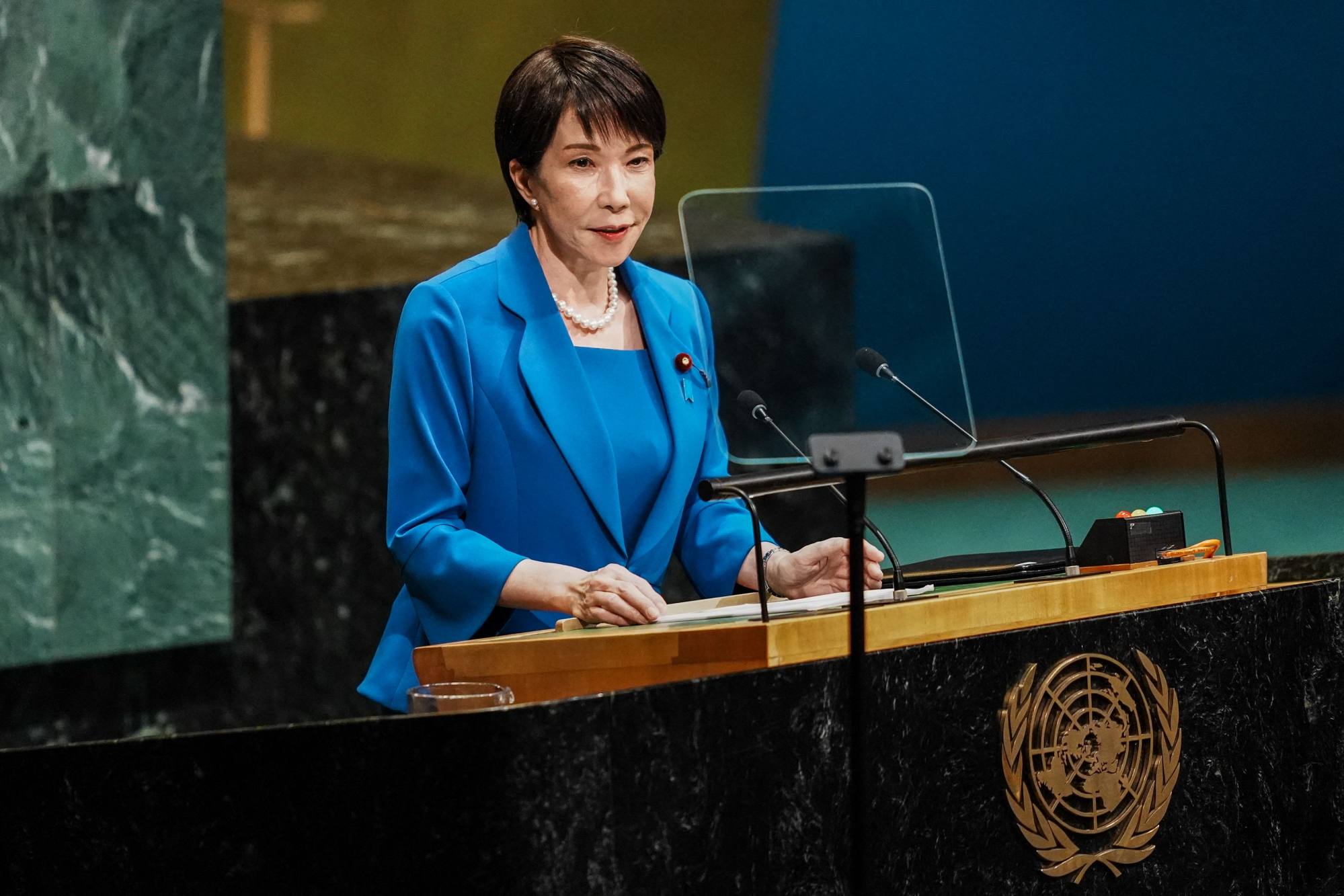
The economic side of the dispute also surfaced when the prime minister spoke on critical minerals. She told delegates that “concerns about arbitrary export restrictions are growing throughout the international community”, in a clear reference to China’s rare earths export controls.
Beijing banned exports of dual-use items, a category that includes rare earths, to Japanese military users in January.
A month later, it placed 20 Japanese entities under export controls, among them the aerospace units of Mitsubishi Heavy Industries and Kawasaki Heavy Industries.
Souring ties
Ties between China and Japan soured dramatically after Takaichi suggested in November that Tokyo could deploy its military forces in the event of a conflict in the Taiwan Strait.
Beijing viewed her comments as a sign of Tokyo’s desire to return to its pre-war path of militarism. It has since urged its citizens to avoid travelling to Japan and has restricted exports of rare earths and related materials to the country.
Beijing views Taiwan as part of China to be reunited by force if necessary. Most countries, including the US and Japan, do not see Taiwan as an independent state but are opposed to any unilateral change in the status quo.
As Beijing’s trade curbs continue to bite, Tokyo has sought to appeal to Washington – its long-time ally – to urge China to ease its rare earth restrictions against Japan. Trump reportedly discussed Japan with Xi during their sit-down in Beijing in May.
Against that backdrop, the US, Japan and South Korea announced a new trilateral consultation on economic security on Monday aimed at strengthening supply chains and cooperation on critical technologies.
Without naming China, the three governments pledged to oppose economic coercion, non-market practices that produce harmful overcapacity and arbitrary export restrictions. They also reaffirmed the importance of peace and stability across the Taiwan Strait, sending a coordinated message ahead of Trump hosting Xi at the White House on Thursday.
The Trump-Takaichi talks came a day ahead of Xi’s arrival in Washington, his first state visit to the US in more than a decade. Xi is expected to hold talks with Trump on Thursday.
The South China Morning Post understands that Japanese officials have grown anxious about how forcefully Trump will discuss Japan with Xi and how hard he will press the Chinese leader on Beijing’s measures against Tokyo this time.
Tokyo, viewing Trump as “flirtatious” with Xi, was worried he would “go soft” on Beijing, one source said.
Crucial timing
Jeremy Chan, a senior analyst at political risk consultancy Eurasia Group, said Trump’s meeting with Takaichi was particularly significant given its timing – on the eve of Xi’s arrival in the US – and the signal it sent about the continued strength of the US-Japan alliance.
“Tokyo’s ties with Washington remain remarkably strong given how frayed the US’ ties have become with so many other erstwhile allies and partners,” he said.
“For Takaichi, this meeting will allow her to be the last person to speak with Trump before he meets Xi and she will use it to underscore to Trump the centrality of Japan to his broader goals in Asia.”
Chan suggested that while Takaichi would likely not directly ask for Trump’s support in persuading Xi to ease pressure against Japan, she would emphasise the damage Chinese rare earth export restrictions were doing to US companies that relied on Japanese suppliers for key inputs.
“Takaichi will want to remind Trump of the value of the US-Japan alliance and everything that Japan has done to support his policy agenda,” Chan said. -- SOUTH CHINA MORNING POST


