




On the eve of this week’s summit between US President Donald Trump and Chinese President Xi Jinping, Americans feel better about China, according to a poll released on Monday.
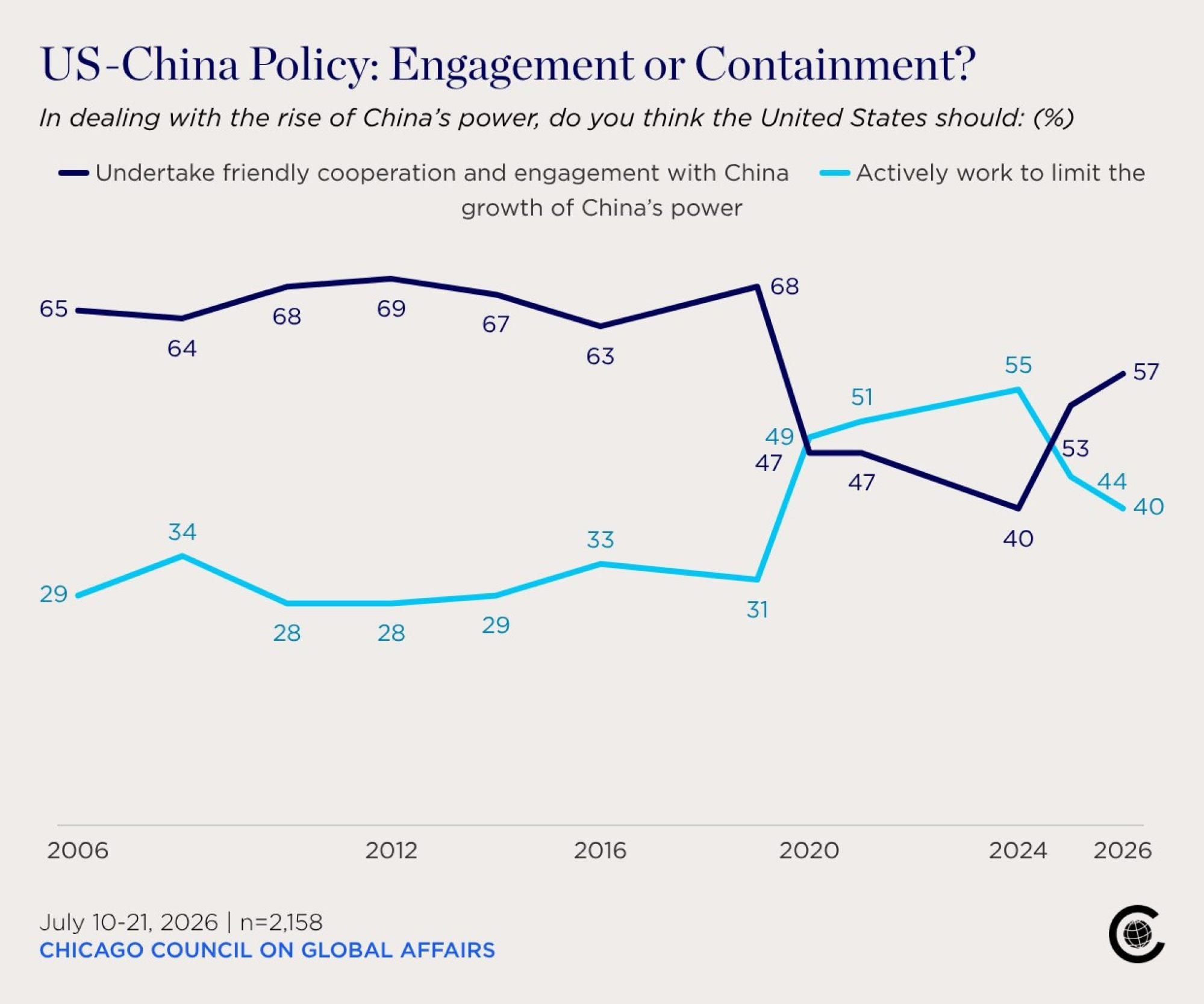
They see Beijing as less of a threat, are less supportive of Taiwan and are more likely to favour engagement over containment than last year or in 2024, when views hit an all-time low.
As with almost everything in the US these days, the Chicago Council on Global Affairs survey revealed a partisan divide. And while the views expressed were less hawkish than in recent years, 40 per cent of Americans still supported limiting China’s power.
“There’s not a bipartisan consensus among the public in favour of a competitive containment approach,” said Craig Kafura, the Council’s public opinion and foreign policy director. “If Americans were really hawkish on China, I think that would bode poorly for stability.”
The survey found that 57 per cent of Americans favoured engaging with China, an increase from the all-time low in 2024 and the highest result in Council polling since 2020 during the Covid-19 pandemic. But it is still below the high mark of 68 per cent in 2019.
Using a “feeling thermometer” that measures cold to hot views on a 0 to 100 scale, Americans rated China at 39 this year, still relatively cool but warmer than the 26 in 2024. The highest heat rating for China was 53 in 1986.
This year’s figure is also below the 44 level posted in 2015 during the last summit between a US and Chinese president on US soil.
“After a year of escalating economic tension between Washington and Beijing, Trump’s May 2026 trip to China ended with agreements to stabilise the relationship,” the report said. “This marks only the second US state visit for Xi, the first held in 2015 under US President Barack Obama.”
“American public opinion of China has also shifted over the past decade, with views turning sharply negative in the late 2010s and early 2020s – and now shifting again.”
Trump’s approval rating in recent US polls, as low as 32 per cent, appeared to be lower than China’s, one senior Chinese diplomat recently noted.
US views of China steadily declined from 2020 to 2024 in part because of the steady parade of negative news, Kafura said, including the pandemic, former House Speaker Nancy Pelosi’s visit to Taiwan, the strained summit in Anchorage, Alaska, and the “spy balloon” overflight.
In another survey result most likely to please Beijing, just 38 per cent of Americans favoured using US troops if the mainland attacked Taiwan, down from 52 per cent in 2022.
This comes as Trump, a transactional president, has made several statements about the self-governing island that are closer to China’s view than those of past US presidents.

After meeting with Xi last October, Trump openly questioned why the US should fight a war involving Taiwan 9,500 miles (15,000km) away and suggested that US defence guarantees involving the island were conditional.
“The president sees Taiwan security as something that’s negotiable,” said Mark Montgomery, a senior fellow with the Foundation for the Defence of Democracies.
Beijing sees Taiwan as part of China to be reunited by force if necessary. Most countries, including the US, do not recognise Taiwan as an independent state, but Washington is opposed to any attempt to take the self-governed island by force and is committed by law to supplying it with weapons.
The survey also highlighted the partisan divide endemic in US politics. Democrats were far more supportive of engagement with China, with 72 per cent of liberal Democrats and 64 per cent of moderate or conservative Democrats saying as much.
This reflects in part a negative response to Trump’s unpopular trade tariff policy and a desire for less confrontation, Kafura said.
Meanwhile, as with other issues such as military interventions and the lack of disclosures related to convicted sex offender Jeffrey Epstein, Trump increasingly diverges from his base.
Sixty-three per cent of Make America Great Again (Maga) Republicans advocated limiting the expansion of Chinese power, compared with 40 per cent for Americans overall. And just 36 per cent were in favour of engagement.
“This shift towards cooperation and engagement matches the general direction that Trump has taken since his May 2026 meeting with Xi in Beijing,” the survey said. “But it is not one embraced by his base: most Maga Republicans continue to favour limiting the growth of China’s power rather than cooperation.”
Analysts said this harder line among Republicans dovetails with Beijing’s long-standing contention that Washington is keen to prevent China’s development.
The survey also found many Americans believe China’s position in the world is improving while their own country is not doing very well.
One-third of Americans said China was more respected than a decade ago, more than double the percentage who said so in 2021. And 62 per cent felt the US was losing global respect relative to a decade ago, roughly consistent with the view in 2021.
Looking at the partisan breakdown, some eight in 10 Democrats and two-thirds of independent voters said the US was less respected in the world relative to 10 years ago, compared with four in 10 Republicans.
One ongoing question as Trump becomes increasingly unpopular at home and abroad is how much of China’s improved – or less negative – popularity is attributed to China’s actions and how much is related to its standing relative to Trump and US policies, an issue this survey did not address directly.
“Yes, countries have a more favourable view of China today than they did three years ago,” said Ryan Hass, China director at the Brookings Institution. “How much of that is because China is doing well? How much of it is because people are angry at Donald Trump?”
The Council survey was carried out between July 10 and July 21 by polling firm Ipsos involving 2,156 Americans from all 50 states and the District of Columbia, with a margin of error of 2.3 percentage points. -- SOUTH CHINA MORNING POST


