




The first vice-chairman of the nation’s top political advisory body is overseeing an 87-member committee of political and business heavyweights to arrange the state funeral for Hong Kong’s first chief executive, Tung Chee-hwa.
A vigil will be held from 3pm to 10pm on Saturday at the Hong Kong Funeral Home in North Point and a public memorial service will start at 9am on Sunday, according to an obituary placed by Tung’s family in the South China Morning Post on Tuesday.
“In lieu of flowers, please make donations to charities of your choice,” the obituary read.
The government announced on Wednesday night that members of the public could sign condolence books between Friday and Sunday at Moreton Terrace Activities Centre in Causeway Bay, Kai Tak Community Hall or Sai Lau Kok Garden Multipurpose Room in Tsuen Wan.
Details of the state funeral were also announced in an advertisement published in the SCMP, with Shi Taifeng, Politburo member and top vice-chairman of the Chinese People’s Political Consultative Conference (CPPCC), heading the funeral committee.
The committee has four deputy directors: Leung Chun-ying, a CPPCC vice-chairman and former Hong Kong chief executive; Wang Dongfeng, a member of the Central Committee of the Communist Party of China and CPPCC vice-chairman and secretary general; Xia Baolong, director of the Hong Kong and Macau Affairs Office (HKMAO); and current city leader John Lee Ka-chiu.
The remaining 82 members include tycoons, political and business leaders from Hong Kong and mainland China. Among them are: Wang Yonghong, deputy secretary general of the State Council and a Central Committee member; Zhou Ji, liaison office director; Dong Jingwei, head of Beijing’s Office for Safeguarding National Security in Hong Kong; and local foreign ministry chief Cui Jianchun.
Other members are billionaire businessmen Li Ka-shing, Peter Woo Kwong-ching, Henry Cheng Kar-shun and Peter Lee Ka-kit, former Macau chief executive Edmund Ho Hau-wah, former secretary for justice Elsie Leung Oi-sie, former Legislative Council presidents Jasper Tsang Yok-sing and Rita Fan Hsu Lai-tai and ex-chief executive of Bank of East Asia David Li Kwok-po.
Also on the list are former city leaders Donald Tsang Yam-kuen and Carrie Lam Cheng Yuet-ngor, former chief executive of the Hong Kong Monetary Authority Joseph Yam Chi-kwong and president of the Legislative Council Starry Lee Wai-king, who is also Hong Kong’s sole delegate to China’s top legislative body, the Standing Committee of the National People’s Congress.
Financial Secretary Paul Chan Mo-po, Secretary for Justice Paul Lam Ting-kwok, Chief Justice Andrew Cheung Kui-nung and various legislators are also committee members.
The Hong Kong Jockey Club said on Wednesday that the race meeting scheduled on Sunday at Sha Tin Racecourse would be cancelled as a mark of respect for Tung’s funeral.
All off-course betting branches will also be closed on Sunday.
The SCMP previously reported that Tung would be honoured with a state funeral for his service as a deputy national-level leader and his contributions to the “one country, two systems” governing framework.
The former city leader died peacefully in hospital with family members by his side last Tuesday at the age of 89.
Following his death, Beijing’s liaison office in Hong Kong issued a statement describing Tung as a “close friend of the Communist Party of China”, an “outstanding contributor to one country, two systems” and a “renowned patriot”.
Since the 1997 handover, only two other local figures have been granted state funerals: industrialist Ann Tse-kai in 2000 and tycoon Henry Fok Ying-tung in 2006.
Similar to Tung, both served as vice-chairs of the CPPCC.
The state funerals of Ann and Fok were coordinated by the central government, with the committees handling the arrangements each chaired by a CPPCC vice-chairman. The committee for Ann’s funeral had 65 people, while Fok’s had 74.
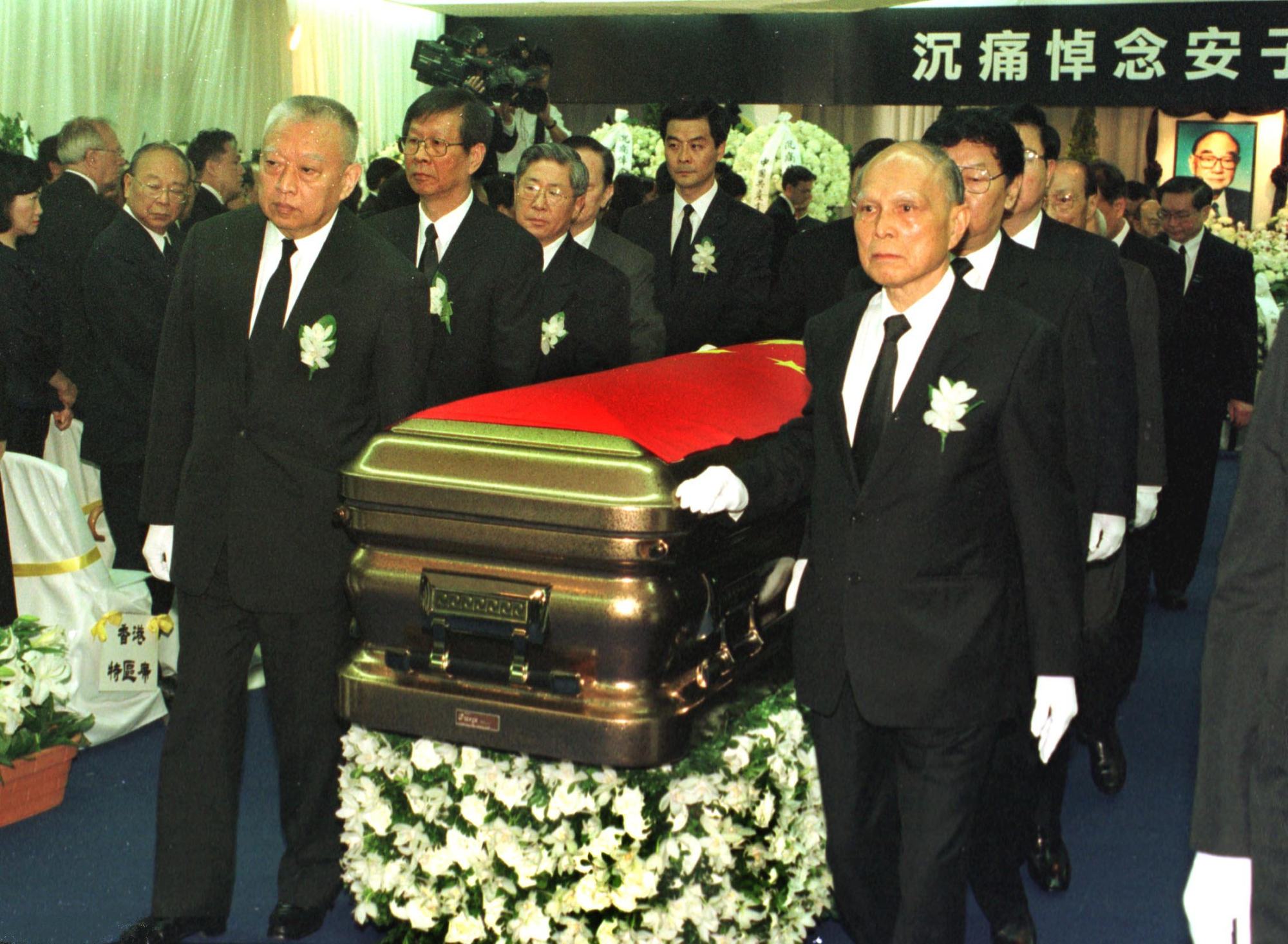
Both funerals were also attended by senior mainland Chinese officials, including the HKMAO director, with the coffins draped in the national flag and state leaders laying wreaths in tribute.
Ann, a textile entrepreneur, was regarded as one of a handful of capitalists who had the ear of Chinese president Deng Xiaoping in the early 1980s and held key positions in major bodies that Beijing formed to prepare for the handover.
Tung and Fok served as two of the eight pallbearers at Ann’s funeral at the Hong Kong Funeral Home after he died of heart complications at 88. Ann was buried in Dapengwan Cemetery in Shenzhen.
The other pallbearers at the time included both mainland and local officials, including Leung, as well as the late entertainment tycoon Run Run Shaw and two of Ann’s long-time business partners.
Fok, a tycoon with gambling, port and property interests, died on October 28, 2006, in Beijing at the age of 83 after a long battle with cancer. His coffin was flown to Hong Kong several days later in accordance with his wishes to be buried back home.
His funeral was also held at the Hong Kong Funeral Home. He was buried at the Hong Kong Buddhist Cemetery in Chai Wan.
Headed by Wang Zhongyu, a CPPCC vice-chairman at the time, the committee for Fok’s funeral had four deputy directors: then HKMAO director Liao Hui; Liu Yandong, head of the United Front Work Department at the time; Tung; and then chief executive Donald Tsang Yam-kuen.
As Hong Kong’s first chief executive, Tung played a pivotal role in implementing the then-untested and novel one country, two systems model, under which the city has been administered since the end of British colonial rule in 1997.
After resigning as city leader in March 2005 for health reasons, Tung went on to assume a prominent role at the national level and increasingly came to be regarded as an elder statesman. -- SOUTH CHINA MORNING POST


