




Researchers from China’s leading universities and tech giants are setting their sights on a crucial new front in the AI race with the US: developing systems capable of building better versions of themselves without human intervention.
In a joint paper published on Thursday, researchers from ByteDance, Tsinghua University and the Shanghai Artificial Intelligence Laboratory, among others, outlined a five-stage road map for recursive self-improvement (RSI).
The study, titled “The Last AI Built by Humans: Toward Genuine Recursive Self-Improvement”, highlights a growing industry focus on automating the labour-intensive life cycle of training, evaluating, and fine-tuning AI models.
The paper describes five progressive stages of autonomy. In the initial phase, an AI merely executes improvement procedures designed by human engineers. It then begins to choose how to upgrade itself, rather than simply carrying out preprogrammed instructions.
In later stages, the system determines what new information or experiences it must acquire, adapting to changes post-deployment. The final stage would allow an AI to persistently refine the very methods used to improve AI itself.
Unlike a chatbot correcting an individual response, RSI requires improvements to persist beyond a single task and be inherited by successor systems.
The authors argue that the ability to automate parts of AI research could become a source of competitive advantage for model developers.
If realised, this paradigm shift could shorten development cycles while slashing the labour and computational costs required to build foundation models, according to the authors.
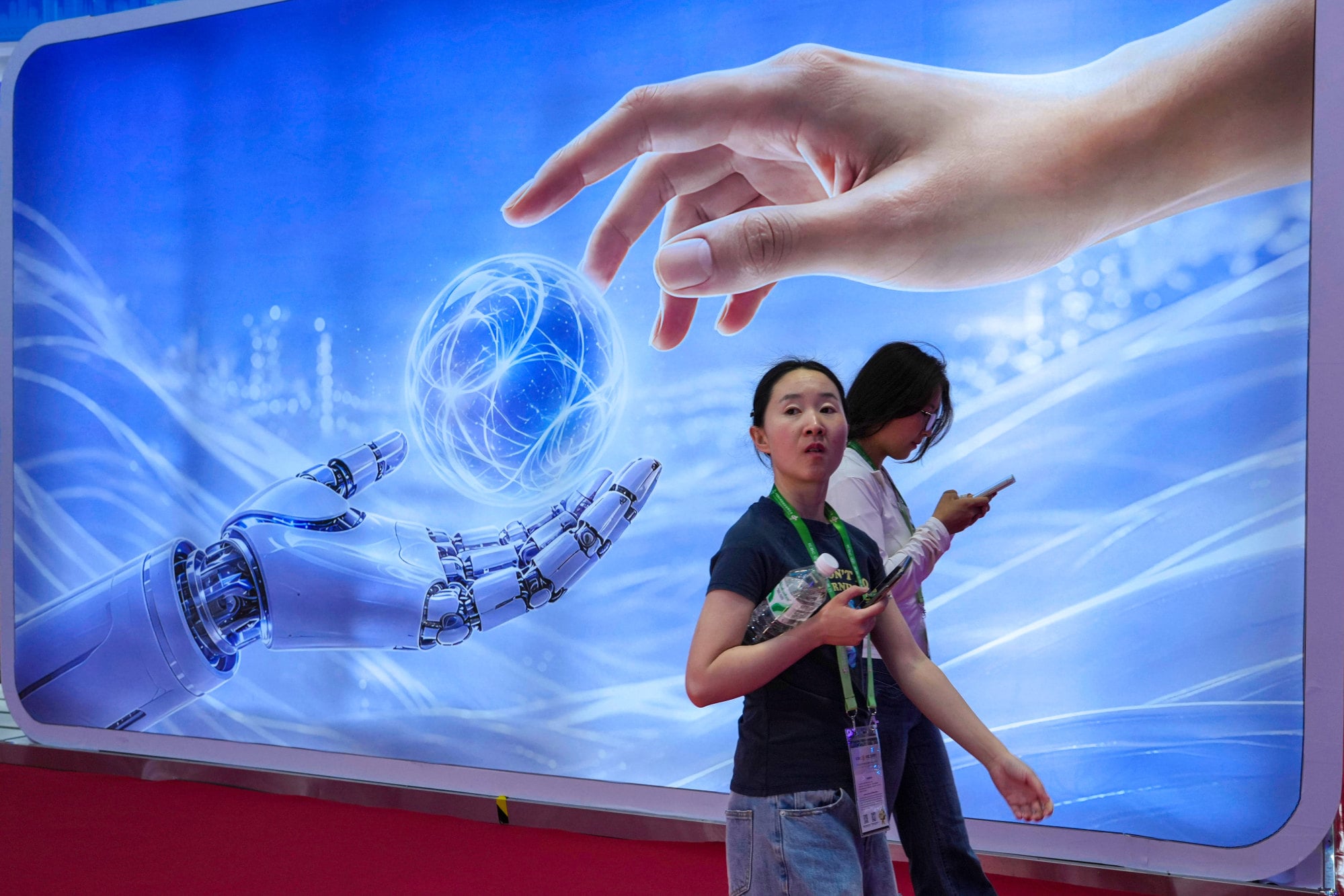
Automating AI research has emerged as a core battleground in US-China technological competition. While Chinese institutions continue to make rapid practical leaps, experts note that US firms maintain an early lead, largely due to superior access to compute resources.
“American companies still appear several months ahead of China and have access to more compute for deployment,” said Erich Grunewald, senior researcher at the Institute for AI Policy and Strategy. “Chinese researchers are very capable at squeezing performance from scarce hardware, but those compute constraints do still bite.”
Despite the challenges, Chinese firms are doubling down on autonomous training infrastructure.
Z.ai, known in China as Zhipu AI, said on Sunday it would allocate about 60 per cent of the net proceeds from its latest US$5 billion fundraising round to support the development of its next-generation GLM foundation models and its “fully self-training system”.
Researchers behind MiniMax 2.7 said in an article titled “Early Echoes of Self-Evolution” earlier this year that the model could update its memory and build complex skills while executing reinforcement-learning experiments, with the resulting experience feeding back into its learning process.
DeepSeek last month developed an agentic “harness” that gives models greater autonomy to navigate multi-step tasks, execute code and interact with external software.
The authors noted in their paper that progression through the five stages would vary widely depending on the AI field. Software engineering presented a relatively clear path forward, whereas robotics and scientific discovery faced steeper hurdles.
Safety remains another major concern. The researchers said that genuine RSI required strict safeguards, including verified testing environments to ensure updates were safe and beneficial before being deployed.
The authors provided no timetable on when RSI could be achieved. -- SOUTH CHINA MORNING POST


