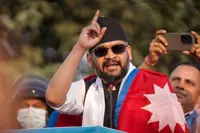
KATHMANDU: With ten days to go before Nepal’s Prime Minister Balendra Shah (pic) addresses the United Nations General Assembly in New York, there is much curiosity around how the young leader will frame Nepal’s climate vulnerabilities.
Amid mounting economic pressures and the heavy toll of recent Bhotekoshi floods, Shah’s upcoming address is expected to present a fierce international demand for climate justice, adaptation financing and equitable accountability.
The Bhotekoshi catastrophe has also renewed a longstanding question for Nepali diplomacy: How can a country with limited influence make its concerns heard in an international system largely shaped by powerful states?
Nepal has been raising the climate justice issue for years, arguing that countries that have contributed little to global emissions should not bear a disproportionate share of the consequences. But that appeal has largely been ignored, or so it seems.
In this context, the Kathmandu Post recently asked eight key voices—veteran diplomats, political leaders, climate experts, activists and writers—what Prime Minister Shah must tell world leaders.
Several of them say Shah should go beyond recounting the devastation and use it to demand practical measures, from stronger early-warning systems and scientific cooperation to dependable financing for recovery and resilient infrastructure.
Their answers vary widely, from regional early-warning cooperation and climate finance to UN reform, strategic autonomy and a more assertive voice from the developing countries. Taken together, they offer a map of the arguments Nepal could take to the world stage.
Former UN assistant secretary-general Kul Chandra Gautam, for one, has called for Nepal, India and China to establish a Himalayan climate-resilience mechanism to share data, improve early warnings and coordinate assistance when disasters strike.
Former prime minister Baburam Bhattarai, meanwhile, argues that Shah should challenge an international order in which powerful countries exercise disproportionate influence, while making a case for greater representation of poorer nations.
Others say Nepal should resist being drawn into geopolitical camps and instead pursue strategic autonomy, grounded in sovereignty, international law and national interest.
There is also a question of tone. Shah’s political appeal has been built partly on a rejection of conventional political language. Gopal Bahadur Thapa, veteran diplomat and former foreign ministry chief of protocol, argues that his UN address should reflect that identity, using simple language and striking facts rather than diplomatic formulas.
The recent floods, with its missing and dead, could provide the emotional centre of such a speech, Thapa says, but the address would need to move quickly from tragedy to proposals.
To be sure, a powerful speech can attract international attention, but attention does not automatically translate into funding, technology, institutional reform or regional cooperation. Nepal has estimated that as much as US$4.7 billion (or about Rs723 billion) will be required for recovery and rehabilitation after the floods. Of which, infrastructure accounts for the largest share of the estimated recovery bill, at Rs473.57 billion, or 65 per cent.
The value of Shah’s visit will ultimately depend on what follows the address, including the alliances he builds and the commitments he secures on the sidelines of the General Assembly.
His first appearance at the General Assembly is therefore both a diplomatic opportunity and a test of political maturity. He can present Nepal as a country seeking sympathy—or as one offering concrete ideas while demanding greater fairness from the international system. - The Kathmandu Post/ANN