TOKYO: A growing number of restaurants and clinics have introduced a reserved ticketing system that allows customers to gain priority entry through paying an extra fee.
Such a system aligns with the recent social trend of valuing time efficiency — or taipa (time performance) in Japanese — in which they are willing to pay extra to reduce wait times.
The system helps improve services and is also profitable for providers, creating a win-win situation both for vendors and consumers.
Feels like a great deal
A line formed outside Aidaya, a ramen shop in Taito Ward, Tokyo, in the early afternoon of mid-July as word spread on social media about its tsukemen dipping noodles and wagyu sirloin rice bowl.
The nine-seat counter area is often full on both weekdays and weekends, and customers sometimes wait 1½ hours to be seated during peak hours, the shop said.
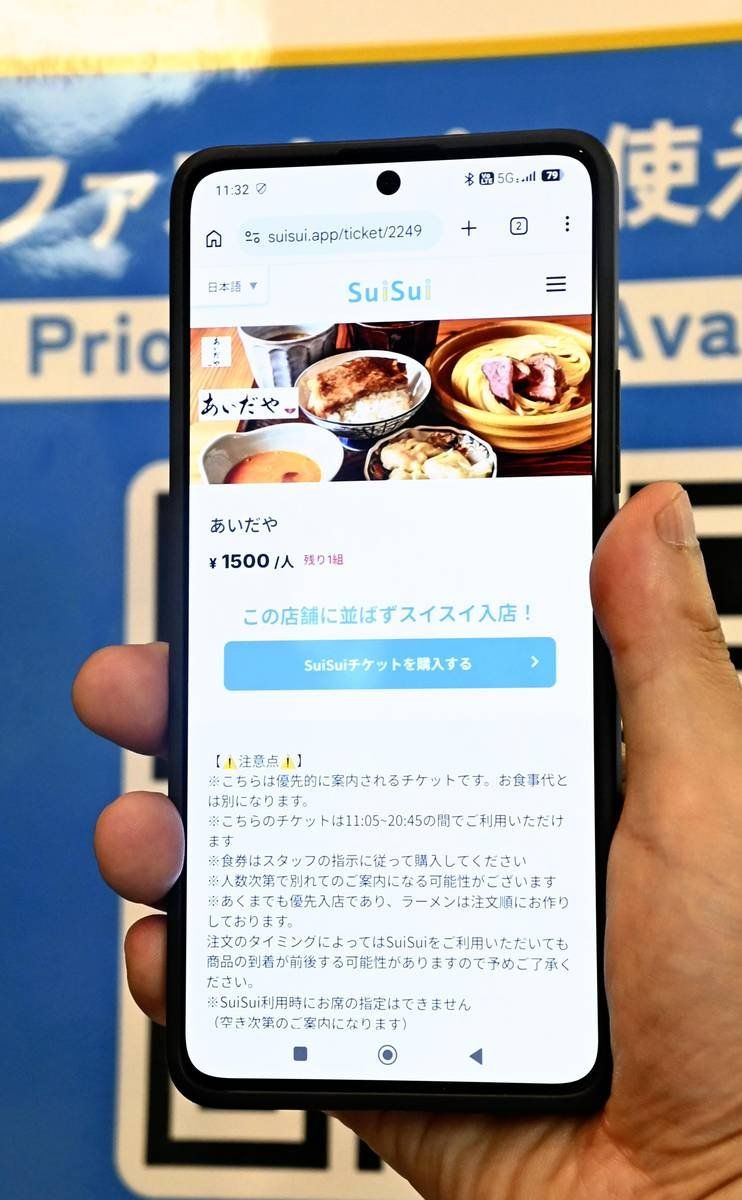
Aidaya has introduced SuiSui, a reserved ticketing system designed for restaurants, in which customers get priority entry by paying a fee separate from the meal cost.
The ticket price fluctuates based on usage conditions so as not to cause dissatisfaction among customers waiting in line. In Aidaya, the minimum ticket price, which varies by outlets, is set at ¥1,000.
Customers scan the QR code posted in front of the restaurant with their smartphone, which opens up a site to buy a ticket, and pay by credit card.
Hiroto Sakata, a civil servant from Yaizu, Shizuoka Prefecture, visited Tokyo’s Asakusa district on a day trip and purchased tickets for two people, which costed ¥2,000 total, and skipped the line.
“It feels like a great deal to get into a popular restaurant so quickly. It looks like we will have more time to explore Asakusa,” Sakata, 31, said.
SuiSui’s system is available in English, Chinese and Korean. A pair of men from Hong Kong purchased tickets for ¥1,500 each.
“This is a new source of revenue that allows us to keep prices steady even as food costs rise and to offer services like free rice refills,” said Aidaya manager Kazutaka Arita, 28.
Expanding nationwide
Keiichiro Sato, chief executive officer of SuiSui’s namesake operating firm in Nasushiobara, Tochigi Prefecture, said, “The system transformed waiting time into value and satisfies both the restaurant and the customer.”
Sato, 32, came up with the idea of adopting the so-called FastPass system, which was already in use at theme parks, at restaurants based on his own experience of waiting a couple of hours for a meal in his trip to Kyoto.
To date, about 100 restaurants nationwide have adopted SuiSui. The types of establishment vary widely, ranging from a tonkatsu pork cutlet restaurant in Hokkaido to cafes and soba shops in Kyoto’s touristy areas, and a steakhouse on Ishigaki Island in Okinawa Prefecture.
Misokatsu Yabaton, which serves a Nagoya specialty of miso source-dipped pork cutlet, introduced SuiSui to its five outlets in Nagoya.
“The greatest benefit is that we can create opportunities for people who in the past gave up due to long lines to actually enjoy our food,” a Yabaton spokesperson said.
Priority medical care
The Tokyo-based medical venture company Micin, Inc. has provided curon Smartpass, a cashless payment service specifically for outpatients, to clinics nationwide since 2022.
The system allows patients to check in and pay via smartphones. Last year, it added a reserved ticketing system.
Tokyo-based medical corporation Hozankai introduced the ticketing system at its clinics in Tokyo’s Meguro and Toshima wards.
Patients can receive priority treatment for internal medicine and other specialties by paying ¥500 in addition to the consultation fee.
“The clinics cannot determine the calling order even if there are patients who do not want to wait,” Hozankai Chairman Iwao Yamashita, 62, said. “Having a virtual queue option may make it easier for patients to visit the clinics.”
30% pay to save time
According to the Seiko Time White Paper 2026 released in June by Seiko Group Corp., 65.8% of the respondents believed that pursuing time efficiency was a social norm.
The survey was conducted online in April among 1,200 men and women nationwide aged 15 to 69.
In a survey of 1,400 people, including 200 high school students, on the type of activities they would like to spend less time on, the most common response was waiting in line at theme parks, followed by waiting in line at popular restaurants and browsing social media and the internet.
Meanwhile, 32% of the respondents said they have paid to save time, such as through virtual queue systems. Among the respondents in their 20s, 47.5% had done so.
“The number of people trying time-saving services is on the rise,” said Chiba University Prof. Makoto Ichikawa, a time studies expert who supervised the white paper.
“It is certainly appealing to those who want to use products worth paying for or visit popular establishments without having to wait in line.” - The Yomiuri Shimbun