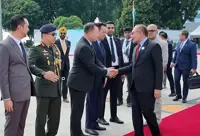
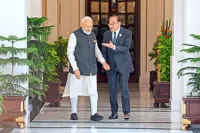
Prime Minister Narendra Modi and Chinese President Xi Jinping met on the sidelines of the BRICS summit in New Delhi, the latest effort by the rival neighbours to repair ties strained by a deadly border clash six years ago.
Xi said China has approached relations with India from a “strategic and long-term perspective” and called for the two countries to draw on each other’s strengths, support one another and pursue common development.
He also urged “high-quality cooperation” between the two countries, saying China and India, as major members of the Global South, should promote a more multipolar world and contribute to global peace and stability.
Xi said institutional exchanges between the two countries have gradually resumed and bilateral trade has expanded, according to China’s official Xinhua News Agency.
China and India are partners, not rivals, Xi said, and the two countries present opportunities for each other’s development rather than threats, according to Xinhua.
Modi thanked Xi for China’s cooperation in hosting next year’s summit.
BRICS stands for Brazil, Russia, India, China, the group’s founding countries, plus South Africa.
Modi said peace along the disputed border was essential for broader ties and urged both sides to honour existing agreements, a statement from India’s foreign ministry said later on Saturday.
Both leaders reaffirmed their commitment to a fair and mutually acceptable settlement of the boundary dispute, it said.
“Differences should not become disputes,” Modi said, adding: “Both sides must be guided by three mutuals: mutual respect, mutual sensitivity and mutual interest.”
The leaders discussed expanding people-to-people and business ties while addressing trade imbalances, supply chain issues and market access concerns, the statement said.
The two leaders held talks in China last year during Modi’s visit to attend the Shanghai Cooperation Organization, a regional political, economic and security group founded by China.
This year’s BRICS summit marks Xi’s first visit to India since 2019 and another effort toward a cautious thaw between the rival neighbours, six years after a deadly border clash that badly damaged ties.
A military clash in 2020 killed at least 20 Indian soldiers and four Chinese service members along a gruelling frontier in the cold desert region of Ladakh.
It turned into a long-running standoff in the rugged mountainous area, where each side has stationed tens of thousands of military personnel backed by artillery, tanks and fighter jets.
India and China have since taken steps to ease tensions, but deep mistrust remains.
Xi’s visit is expected to test whether the recent thaw can translate into a broader stabilisation of ties.
Since their 1962 war, the economies of both countries have grown substantially. — AP