
CHIANG MAI – Over 100 journalists, alumni, and partners of the Konrad Adenauer Stiftung (KAS) Foundation are joining the ‘Journalism in Transition: Marking 30 Years of the KAS Media Programme Asia’ conference from November 5-7, 2026 in Chiang Mai, Thailand.
Fabian Wagener, the director of the KAS Media Programme Asia, said in his opening remarks that KAS’ mission has remained clear: “To foster a free, responsible, and ethical press across the region – a commitment that remains at the very core of KAS work today.”
KAS was founded in 1996, and Thomas Stehling, founding director of the KAS Media Programme Asia, was also in attendance at the event.
“The overarching goal of our work as the Media Programme Asia is to support an ethical press, to promote young talents on their way into journalism, and to bridge continents by connecting leading Asian journalists with partners in Germany and across Europe,” said Wagener.
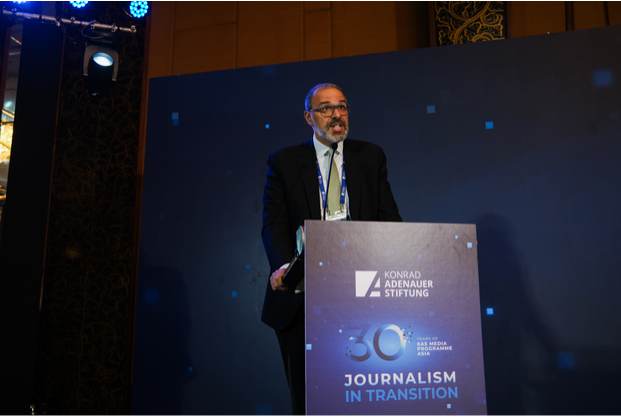
Christian Echle, in his opening address, said that the media landscape today has become vastly different from 30 years ago. Before, the question was how to get information to the public; today, it is increasingly about establishing which information the public can trust.
Echle said that KAS’ role in the foundation is to offer opportunities, connections, platforms, and support, and it is this understanding of partnership that has guided the KAS Media Programme Asia for the past 30 years.
“The fundamental ambition of the programme is to promote free, responsible, and ethical journalism, to strengthen professional standards, and to connect media professionals across national borders. I believe one of the programme’s greatest achievements is that it has remained faithful to its mission while constantly adapting to a changing world,” Echle said.
“Its history is not simply a history of projects and publications. It is a history of people, ideas, and partnerships. The Asia News Network is one important example,” he added.
KAS Media Programme Asia helped in the establishment of the Asia News Network (ANN) in the mid 1990s. ANN is an alliance of twenty leading newspapers across Southeast, East, and South Asia, working together to cover the defining stories of the region.
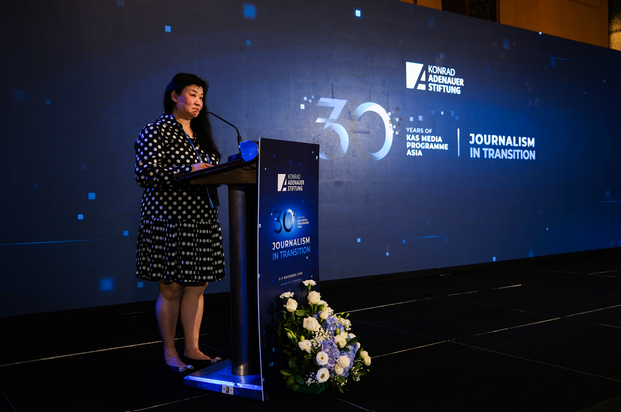
Asia News Network chairperson and Star Media Group chief content officer Datin Paduka Esther Ng, in her partner address, emphasised that journalists and editors at the conference may be different in terms of the type of media houses and the political, economic, and cultural environments they belong to.
However, they are similar as editors facing the same geopolitical tensions, especially with the rise of artificial intelligence, along with climate change and economic uncertainties.
Despite all these, the journalists and editors present serve the Asian public, many of whom share the same hopes, concerns, and dreams.
“At the heart of it all, Asians want to live in societies where their voices are not pushed aside, where their identities are respected and where progress is shared all round. This want is our common ground, and this is something we at ANN should hold on to strengthen,” said Ng.
Ng said the ANN’s partnership with the Konrad Adenauer Foundation reflects a shared conviction that journalism can play an important role in bringing people and an entire continent together.
“Asians have many stories, accounting for more than half of the world’s population, but there are so many stories told about us; just not enough told by Asians themselves,” said Ng.
“We need to remind everyone that we are not part of someone else’s narrative; we’re the authors of our own. This is where ANN comes in. We dictate our own narrative. Here is where we shift the discourse because here, we tell our own stories from our own backyard,” she added.
More than exchanging content or sharing headlines, ANN’s mission is to bring Asia closer.
Beyond news, the network has produced regional dialogues and collaborative projects, which prove to be even more valuable and essential at a time when everyone can publish information and artificial intelligence can generate convincing content.
“Regional journalism, by sharing experiences, investigating common challenges, and highlighting successful solutions, can help our people see the bigger picture.
“There is a continuing need for reliable information. Trust is the keyword here.
“We are not here to produce content but to help the people make sense of the world around them, to hold authorities to account, and give our audience accurate information,” said Ng.
She added that journalists’ competitive advantage must not simply be speed or technology, but credibility, and urged the audience to invest in professional standards, fact-checking and journalists’ development.
“Our edge is trust. Our archives are records of that history, providing a moment and reminder that helps our people understand how we got here. And where we are and where we want to go,” said Ng.
She emphasised that trust should be the centre of editorial strategy.
“We let our audience see that our decisions are padded with quotes from sound sources and guided by public interest.
“That is the real value of legacy media. The media, after all, is the mirror of society and it gives voice to the very people it serves,” said Ng.
ANN is hosting two Asia Dialogue panels during the conference.
The first is ‘Asia in a Multipolar World: Can the Region Find Its Own Path?’ moderated by Shefali Rekhi, ANN director and editor, Special Projects, The Straits Times (Singapore).
The next is ‘Trade, Tariffs, Technology: Can Interdependence Survive?’, moderated by Michelle Tam, ANN Editor and Editor, Online, The Star (Malaysia).
In closing, Ng called for the Asia Dialogue to be more than a meeting of minds.
“Let us discover our common ground and celebrate our diversity. And in bringing Asia closer, we are not only telling the story of the Asian century. We are helping to shape it,” she concluded.
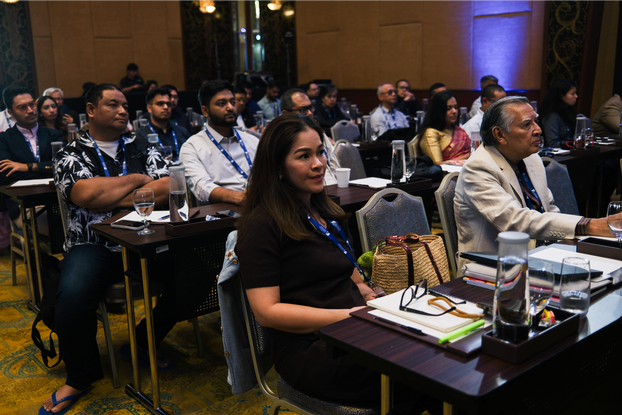
Going back to Echle’s opening remarks, the head of KAS’ Asia-Pacific Department said that journalists carry an enormous responsibility, and this responsibility requires fairness, accountability, and independence not only from governments but also from political parties and commercial interests – KAS aims to support independent journalism to defend journalists’ right to question institutions.
“We do not support independent journalism because we expect it to provide the answers we like. We support it because democratic societies need the freedom to discover answers we may not like. That is the meaning of the press as it falls in the state. It is not another branch of government. It is an independent institution of public scrutiny,” said Echle.
“Let us celebrate 30 years of achievement, 30 years of partnership, and 30 years of asking the right questions. And let us look forward to the next 30 years. The future of journalism may be uncertain, but the need for independent journalism is not.”
“Freedom of the press is not freedom from professional standards. It requires accuracy, fairness, transparency, accountability, and the willingness to correct mistakes. And it requires independence, not only from the government but also from political parties and commercial interests,” said Echle.
The KAS media conference in Chiang Mai isn’t just to look back at 30 years of history and collaboration; journalists and alumni of the programme are invited to also look forward – and to continue serving the public.
Over the next few days, journalists will be attending panels on press freedom, technology, disinformation, and climate reporting, as well as one-on-one labs and networking sessions. - ANN