




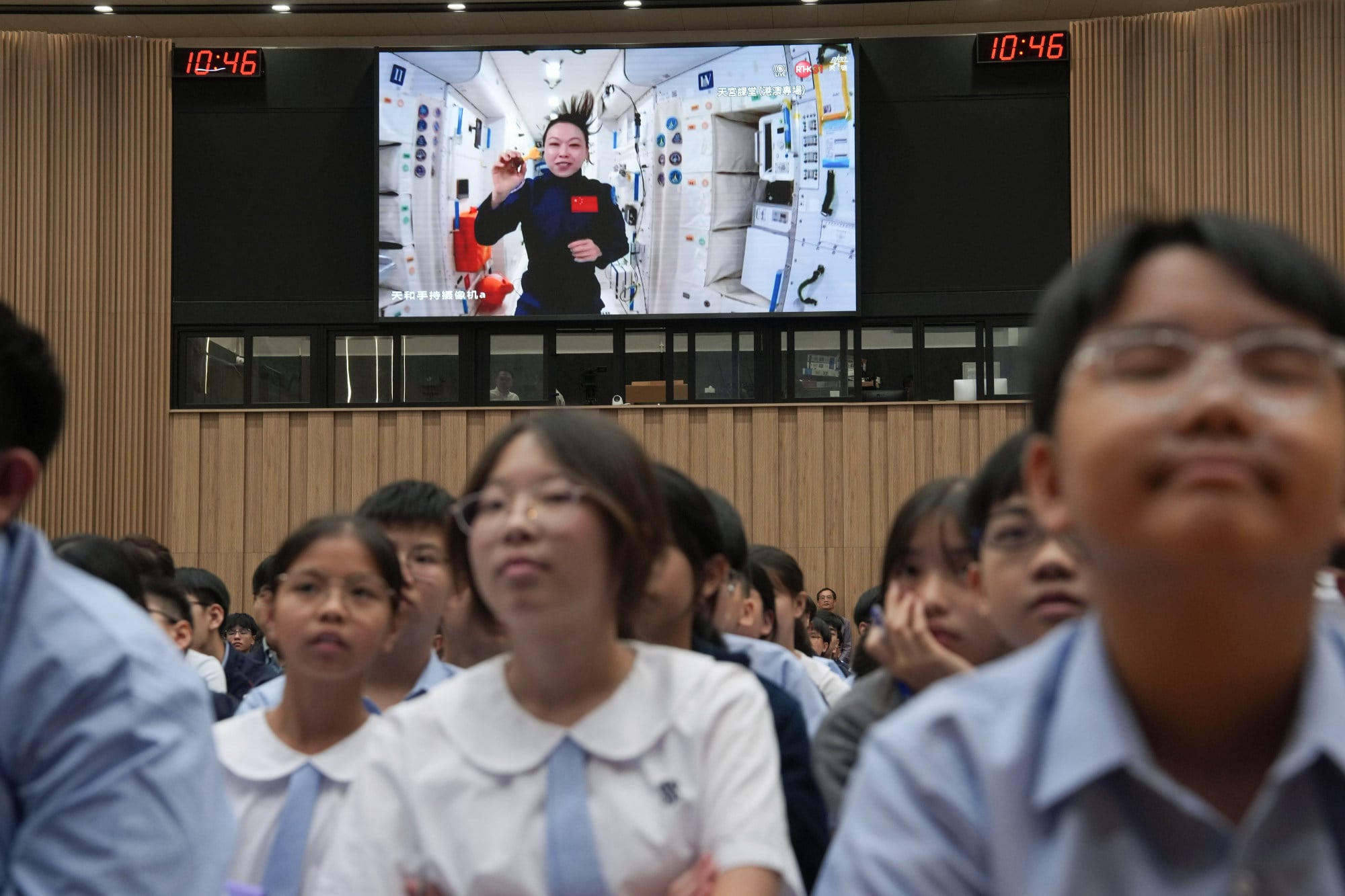
Hong Kong’s first astronaut, Lai Ka-ying, will deliver a live lesson from space to students and teachers at her alma mater on Wednesday morning, with the 90-minute event broadcast to campuses across the city and streamed live on television.
Lai and her two fellow Shenzhou-23 crew members – mission commander Colonel Zhu Yangzhu and Zhang Zhiyuan – will take part in the “Tiangong Class” at Tsuen Wan Public Ho Chuen Yiu Memorial College.
Representatives from the youth sector and innovation and technology community, as well as a visiting delegation from Macau, will also attend. The session will also be broadcast to students in Macau.
Jointly organised by the Hong Kong and Macau governments and the China Manned Space Agency, the event will feature an expert lecture, in-orbit demonstrations and a question and answer session designed to showcase the space environment.
Astronaut alumna inspires young minds
Form Five student Chan King-lam, who studies physics, chemistry, biology and extended mathematics, said the dialogue inspired him to explore science and he hoped to one day join the country’s research ranks.
“How Lai sacrificed family time for this career really earns our respect and makes me want to refine my science studies,” he said.
He said he was awed to see textbook physics principles demonstrated in microgravity during the broadcast.
“What impressed me most was watching them cook chicken wings and cakes. It really shows how difficult preparing fresh food is in space,” he said.
Form Six student Chan Tsz-ki said she was proud to see an alumna of her school become an astronaut and would take her as a role model in pursuing science.
“I feel very close to her as we are using the same campus, the same facilities and some teachers are still the same,” she said. “I will also study hard to contribute to the country.”
Lesson ends with Lai encouraging students
The 1½-hour space lesson ended before 11.30am, with Lai briefly interacting with Chief Executive John Lee. Lai also offered words of encouragement as she responded to letters written by Hong Kong and Macau students.
Lai said she often felt lonely and found the training and her mission hard, but she never thought about giving up, given the expectations of Hong Kong and Macau residents.
“My presence in space has demonstrated how the nation supports and attaches importance to Hong Kong. We are very lucky to experience an era of a strong and thriving nation. Our motherland has provided us many precious opportunities, I am confident that the youth of Hong Kong and Macau are full of potential,” she said.
“Living in such a great time, you must keep pushing and never fear hardships. Your future selves will thank you for the perseverance and hard work you put in today. You should hold the nation in your heart, and use your knowledge to give back to society and contribute to our motherland.”
She added that the nature of the city’s “Lion Rock spirit” and manned space flight spirit were the same, as they required courage and perseverance amid hardships and pursuit of dreams.
Be brave, Lai tells students
A Form Six student, who studies at Lai’s alma mater, asked Lai how maths and science subjects helped her to become an astronaut.
Lai said maths taught her how to analyse data, identify patterns and make judgments, while science taught her to observe, raise questions and use evidence to find out the answers.
She stressed that the space mission was not only about the two subjects, as she also held a doctorate in computer science and dealt with different fields. She added that the mission also required good communication skills and teamwork.
“I hope students take mathematics and science seriously, establish a solid foundation in language, expose themselves to different subjects, and learn how to connect the dots between different fields to put your knowledge into practice in the future,” she said.
Lai urged students to be courageous as they chased their dreams.
“My education background, research and development experience, and my career have laid critical foundations for me to seize this opportunity. I hope students can constantly equip themselves and be brave and proactive as opportunities come along,” she said.
‘Cherish everything’
During the 30-minute question and answer session, students asked Lai about life in space, her training and how she decided to apply to become a payload specialist.
Lai shared some of the toughest parts of her astronaut training. Among the most demanding were desert survival exercises, in which she had to work with teammates under extreme conditions.
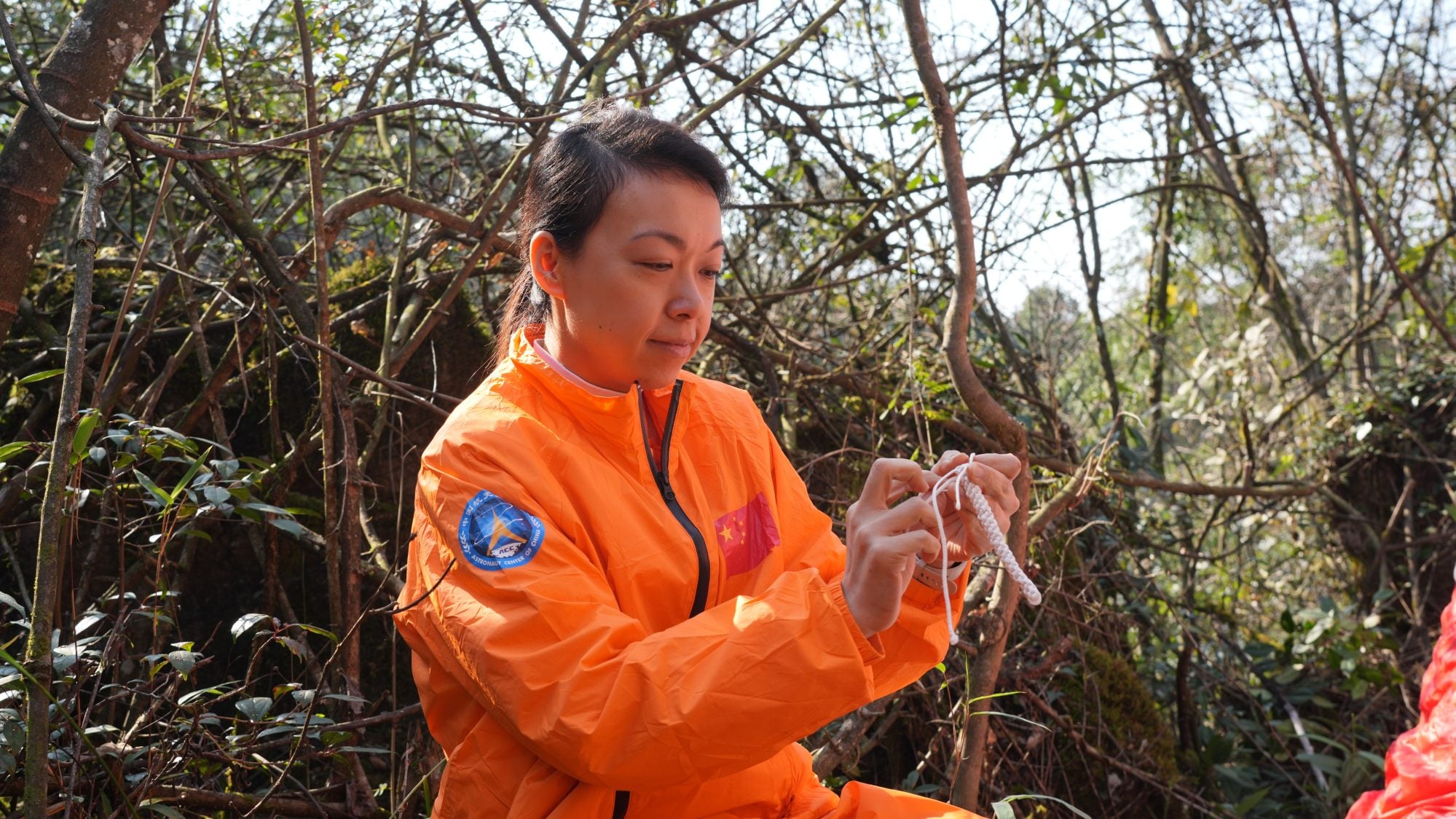
She also had to stay focused during a 72-hour sleep-deprivation test and complete a six-day cave training exercise, which she called a major physical and mental challenge.
“Every time I return to normal life after completing these high-intensity training sessions, I feel like I was as if in another lifetime and I should cherish everything I have,” she said.
“These training sessions have also made me realise that astronauts do not rely on themselves alone. What is even more important is discipline and teamwork. Only by helping and reminding each other can we accomplish the mission together.”
Lai added that becoming an astronaut was not her childhood dream, but she seized the once-in-a-lifetime opportunity when China opened selection to a candidate from Hong Kong.
Even after preliminarily confirming she was eligible for the mission, she said the decision was not easy.
“I can temporarily put down my job [in Hong Kong], but I have three young children. I felt uneasy about not being able to accompany them for a few years if I were selected. However, my family showed full support. Therefore, I decided to join the selection process,” she said.
AI, robots and animal tests
After a 30-minute tour inside the space station, the three astronauts shared details of their mission in about 25 minutes as representatives from several primary schools and secondary schools, and a University of Hong Kong student put questions to the crew.
In response to a question about whether they use AI in their missions, Lai said the station had begun trials and studies using AI and robots. The robots could help document the crew’s work and navigate narrow ventilation ducts.
She added that she expected more powerful AI systems to be deployed in the future to help astronauts complete their missions.
Responding to a question on animal tests in space, Zhang said such trials could help scientists understand how a zero-gravity environment affected living organisms and provided important data for future exploration and for safeguarding astronauts’ health.
Zhu described how the crew prepared for earlier extravehicular activities, including checking their spacesuits and practising with the equipment, when a student asked him how they felt while performing them.
He said the mission was “very exhausting” in the heavy suits, but the crew was moved by the view of Earth and felt a deeper sense of purpose in their work.
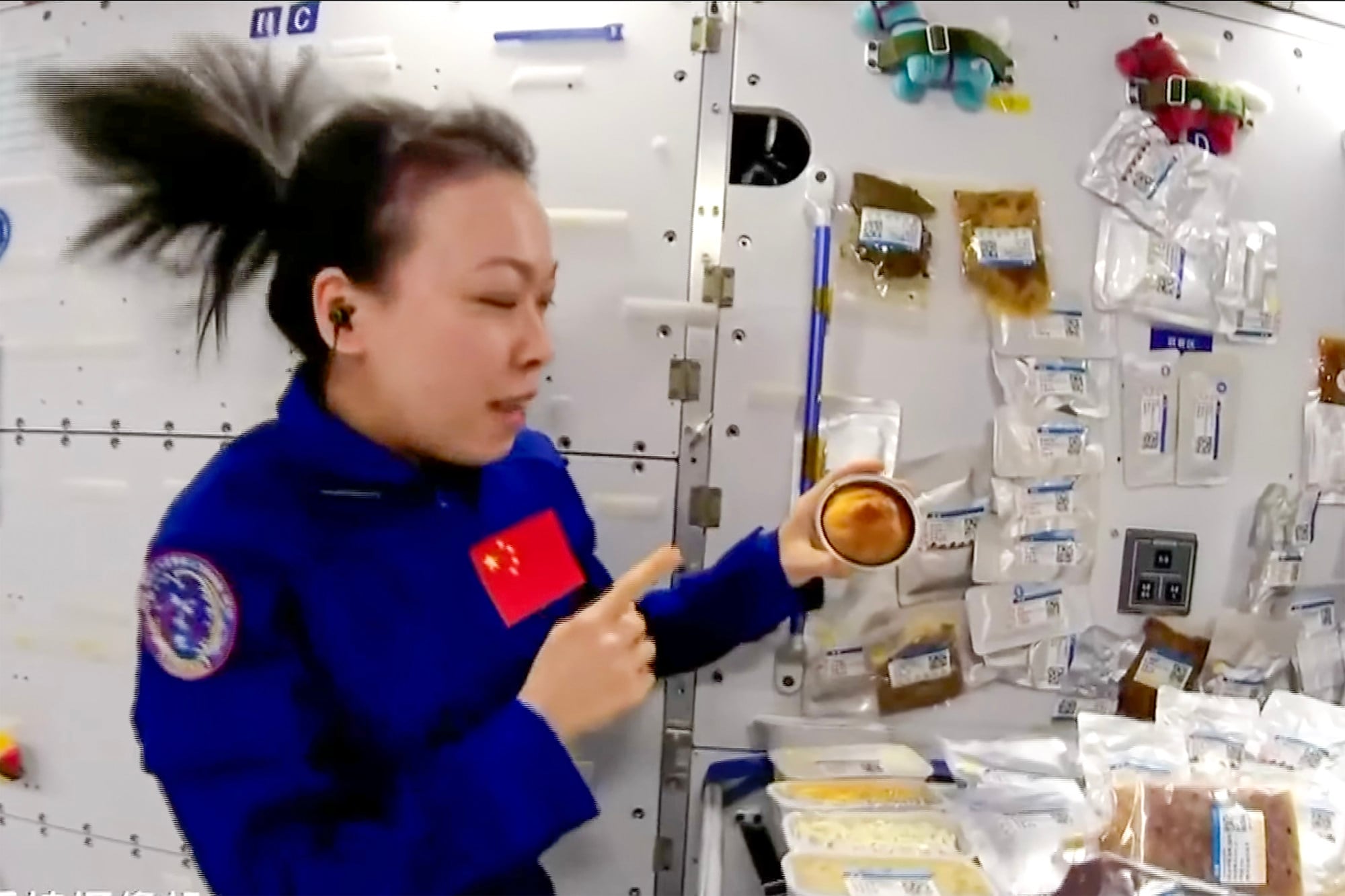
Lai’s sleeping space
During the dialogue, Lai showcased her sleeping zone, which is decorated with her children’s drawings and clay art, family photos, depictions of Hong Kong street food and Hong Kong police’s anti-scam mascot.
Lai said that she could observe the Earth from a window at her sleeping zone, while she also wondered what her family was doing as the space station passed over China.
“When we pass over China, I always look for the Greater Bay Area. Although Hong Kong is small in size, it has bright lights at night,” she said.
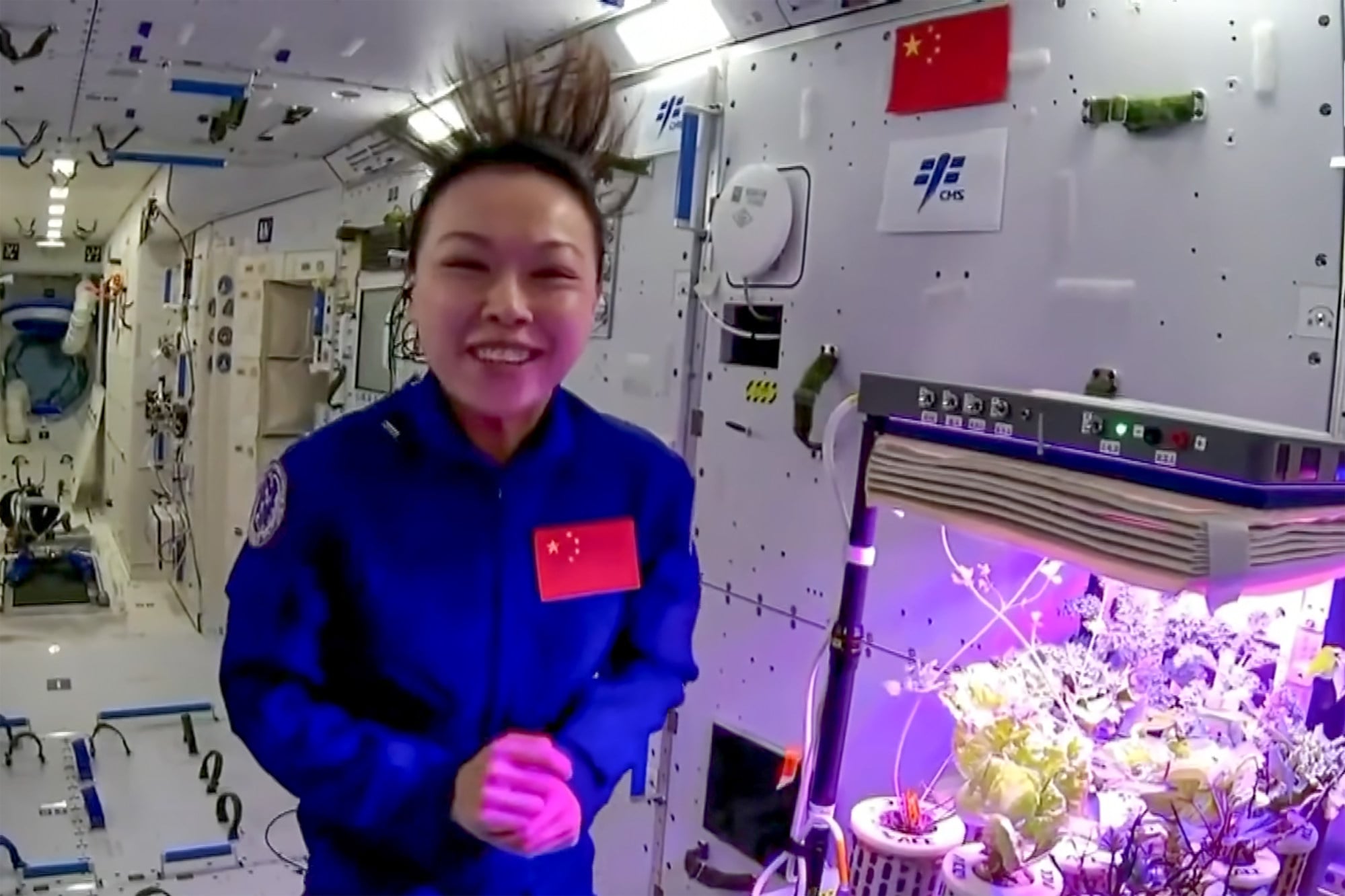
Lai also explained the operation of a small vegetable garden inside the space station, while Zhu demonstrated watering the plants and tasted lettuce grown in space.
The pair also played table tennis with a ping-pong ball made of water.
Tour of Tiangong space station
Zhu and Lai talked about their lives in space and introduced equipment inside the Tiangong space station, including devices for scientific research.
According to Lai, the astronauts enjoy balanced meals with rice, noodles, bread, vegetables and meats. The space station is equipped with cooking devices that can warm food and even bake a mini cake that makes Lai recall her favourite street food, Hong Kong-style egg waffles.
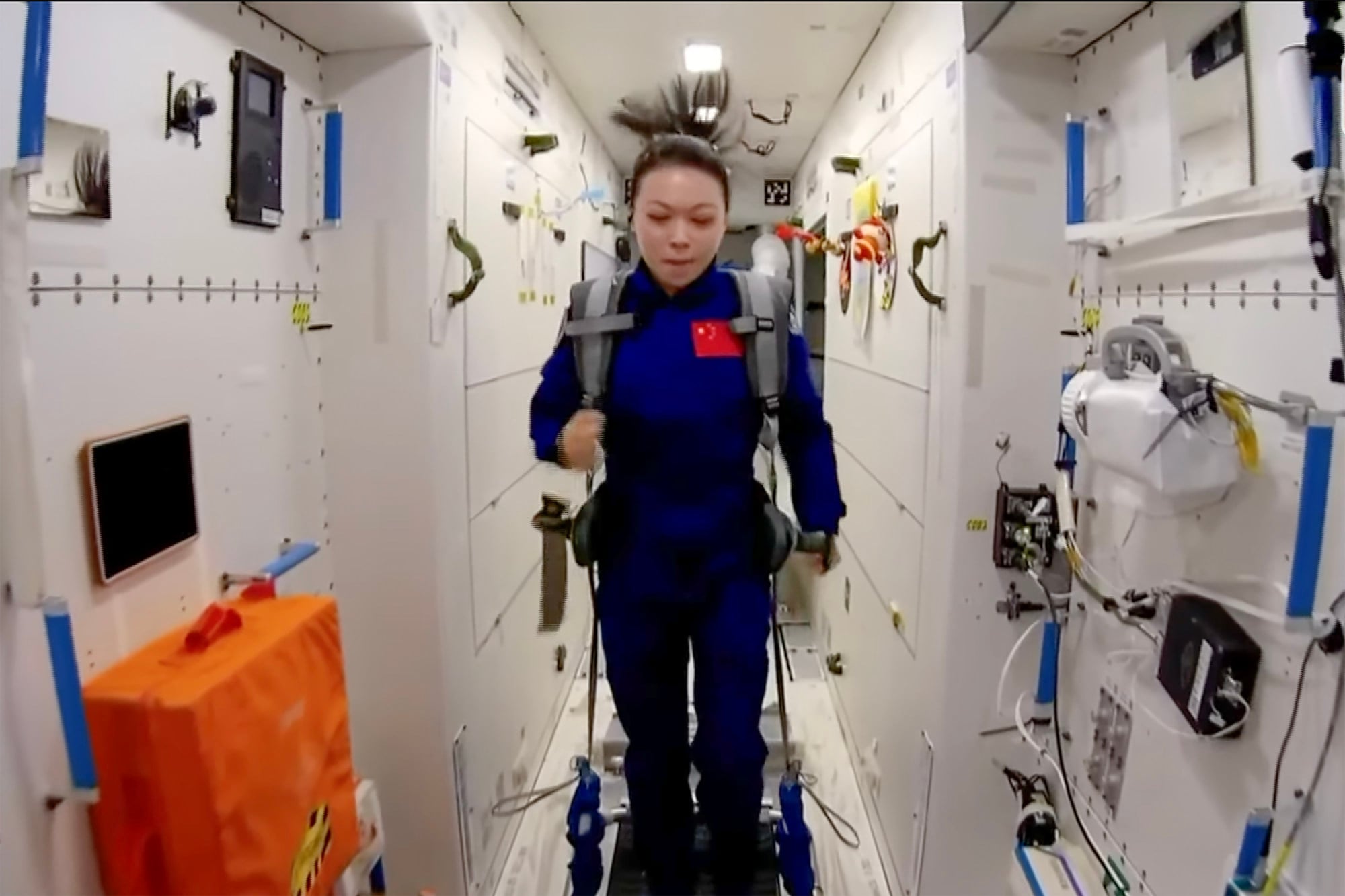
Lai told the students that astronauts had to exercise for one to two hours daily, as she demonstrated wearing a vest to stabilise herself on the running machine.
She further demonstrated wringing a towel in space, where water droplets do not stream down in a weightless environment.
Space dialogue begins with address, demonstration
The space dialogue began with the astronauts’ addressing the pupils, with Lai greeting the students and Chief Executive John Lee in Cantonese.
As part of the space lesson, Lai showed a spinning top, following the traditions of China’s previous space lectures, in which astronaut Gui Haichao and crewmates used everyday objects to explain physics in orbit.
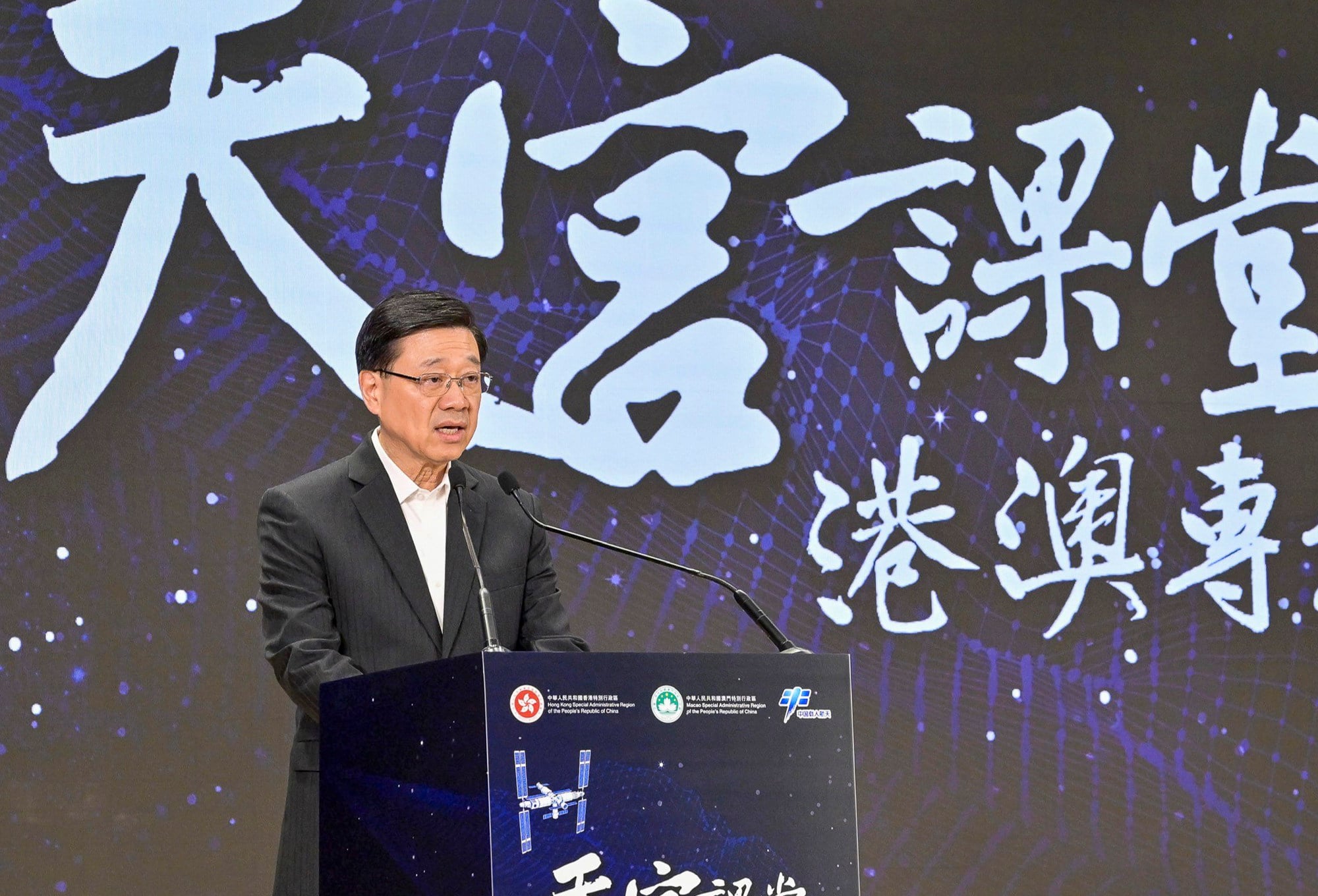
Lee urges younger generation to make astronauts their role models
Speaking at the college, Chief Executive John Lee said the government would begin an astronomy-themed popular science education and promotion effort, urging the public to actively participate in the activities.
“I also hope that the younger generation will take astronauts as their role models, strive to equip themselves, have the courage to pursue their dreams, and use their wisdom and hard work to contribute towards building the nation into a strong nation in space and opening a brilliant new chapter for the Chinese nation,” he said.
Lee added that the China manned space delegation’s visit to Hong Kong in 2023 had sown seeds of national pride, space exploration and pursuing dreams, while Hong Kong’s participation in the space exploration mission had demonstrated the growth of such seeds.
Space experts and Lai’s former teachers get lesson going
Before the live dialogue begins, Professor Wu Bo from Polytechnic University, Professor Su Hui from Hong Kong University of Science and Technology (HKUST) and Professor Yao Zhonghua from the University of Hong Kong (HKU) shared knowledge and their projects with students at Tsuen Wan Public Ho Chuen Yiu Memorial College.
According to Su, the Multi-Spectral Imaging Carbon Observatory, a greenhouse gas monitoring instrument spearheaded by HKUST, has been assembled and tested in orbit by Lai Ka-ying.
Su said her team was currently analysing the data and would unveil the results as soon as possible.
Lai’s former teachers also shared their interactions, including Chow Kam-pui, an honorary associate professor at HKU. Chow, who guided Lai through her master’s degree in cryptography and subsequent PhD in digital forensics from 2004 to 2011, said Lai was a team player and had strong analytical ability.
Lau Sui-yee, the school’s principal, said Lai was diligent and focused in class, and her former teacher remembered her as an active member of the student union where she handled external affairs.
Both teachers said Lai set an example for students to follow and explore the world beyond the classroom.
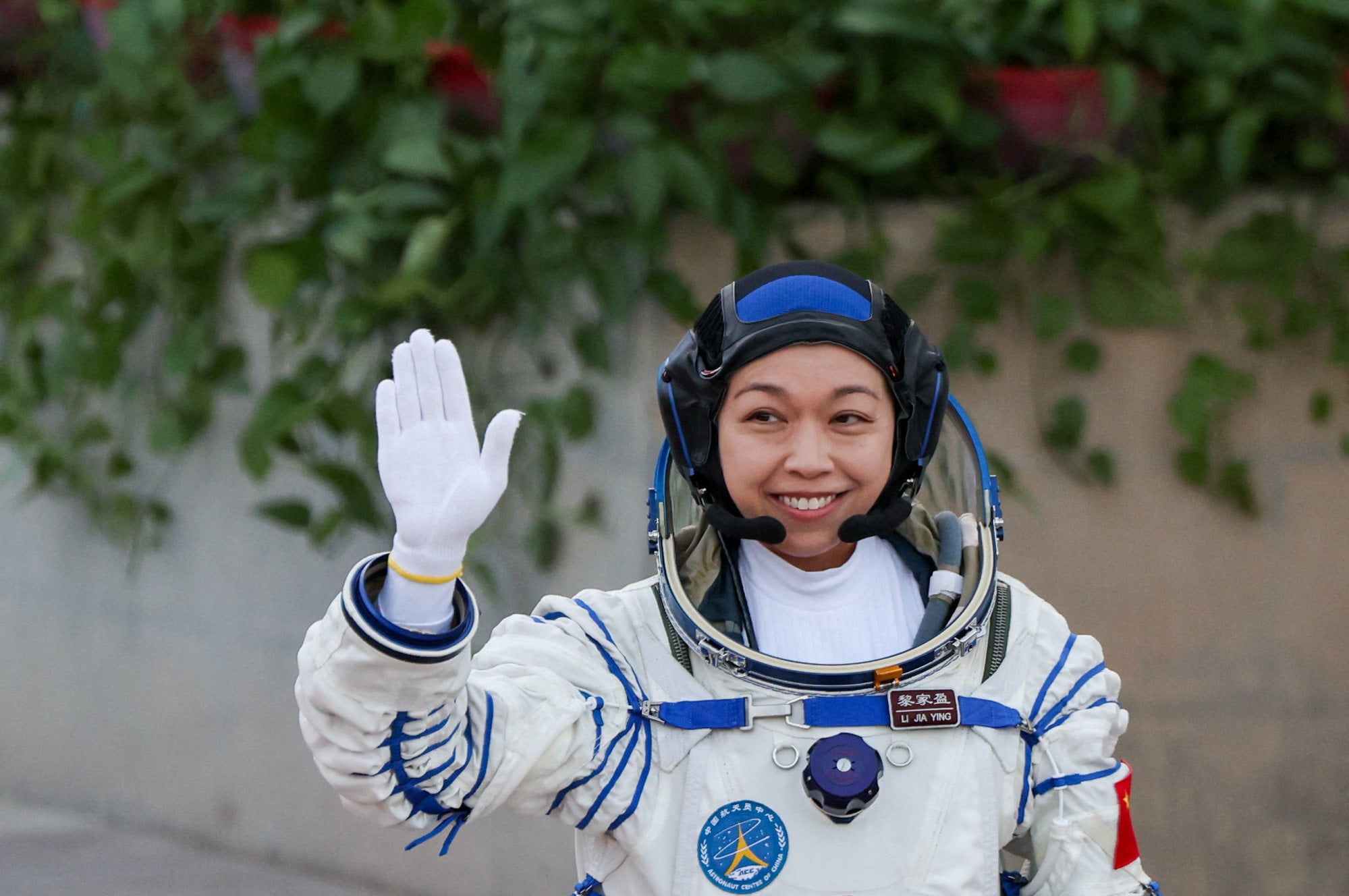
‘No doubt she can overcome any challenge’
Leaving her family behind was the most difficult part for Lai Ka-ying when she blasted off on May 24 for her six-month mission, according to her elder sister, Lai Ka-man.
According to the elder Lai, her sister’s three children were still in primary school when she chose to become a payload specialist in 2024. They are now being cared for by both sets of grandparents and other family members.
Ka-man attributed her sister’s strong will to their father, who taught both daughters to scrutinise every matter carefully and make thorough preparations in advance.
“I have no doubt she can overcome any challenge,” she said, citing her sister’s self-discipline, resilience and impressive composure, as well as her attentiveness and ability to listen well.
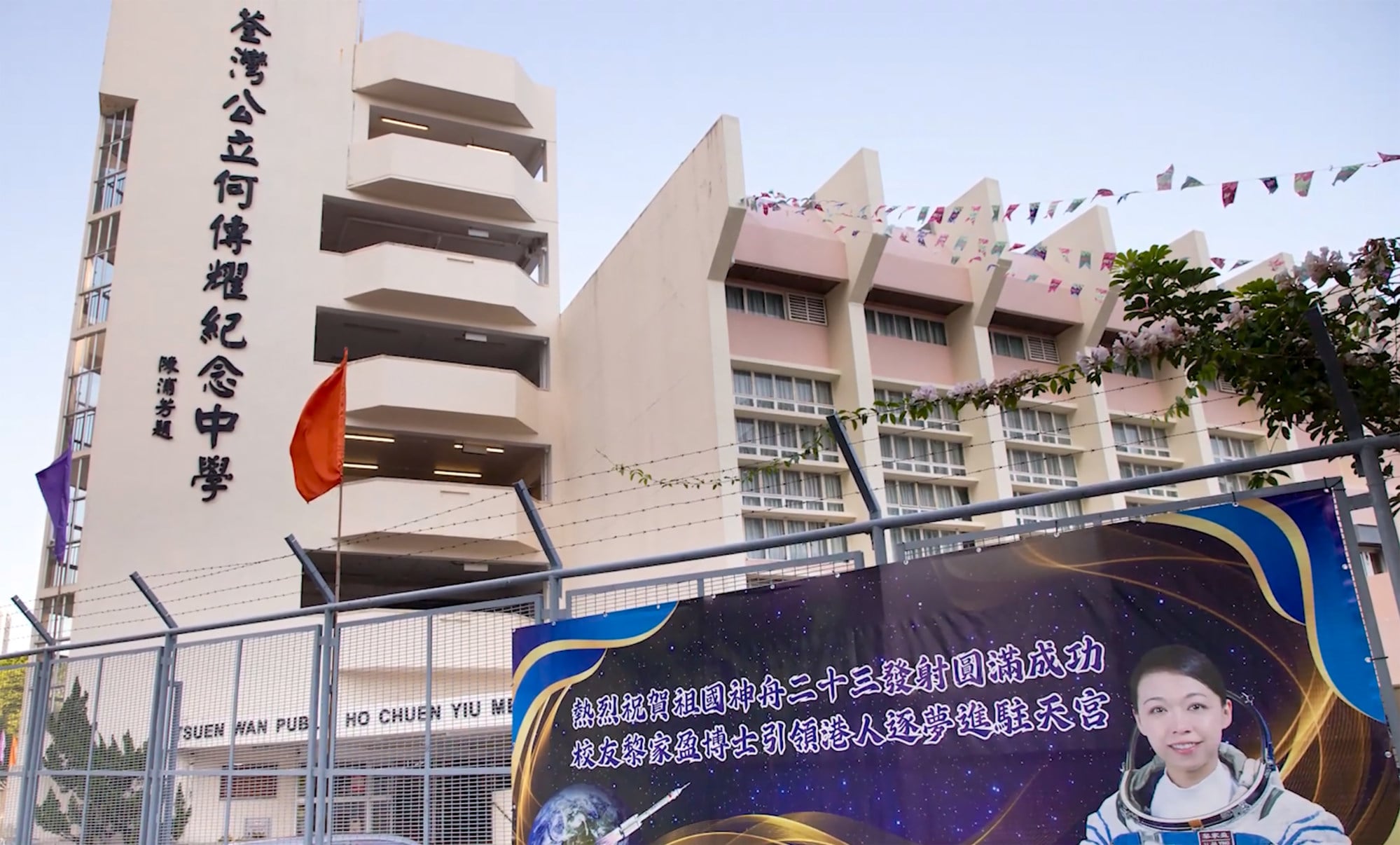
Unlocking quantum potential in orbit
Chow Kam-pui, Lai’s supervisor at HKU, said in May that computer science could support space exploration.
“For example, experiments in the space station will generate a lot of data. This would require the continued development of data science,” he said, noting data transmission as another key area to explore.
He added that further down the road, scientists were also interested in seeing how quantum computing performed in orbit, as the machines faced many limitations on Earth.
“The nature of quantum computers in space remains entirely unknown, with many new fields for exploration,” he said.
What is Lai doing in orbit?
During Lai’s time on the space station, the Shenzhou-23 crew will conduct more than 100 new scientific studies, including research involving zebrafish, mice and artificial embryos to examine reproduction in space.
They will also test aerospace medicine and a new energy-storage battery for use in space, and explore the effects of the space environment on new materials, such as rare earth permanent magnet alloys.
As a payload specialist, Lai’s duties include conducting on-orbit electroencephalogram tests and research into human adaptation to space. She has also taken part in rendezvous and docking training and equipment maintenance in the Wentian laboratory module.
The path to space
Lai’s path to becoming an astronaut began among about 120 applicants from Hong Kong when China opened its fourth batch of astronaut recruitment in late 2022, marking the first time applications were accepted from Hong Kong and Macau.
By May 2023, more than 10 candidates from the two special administrative regions had passed the preliminary screening round, including Lai.
The following month, as she and the other Hong Kong finalists prepared to travel to Beijing for the second round of the selection process, Chief Executive John Lee Ka-chiu met them at Government House.
She was then selected for training in 2024 as part of China’s fourth batch of astronauts.
Hong Kong’s first astronaut
Lai Ka-ying, then a Hong Kong police superintendent with a doctorate in computer science, was selected in 2024 as part of China’s fourth batch of astronauts. Before her selection, Lai was attached to the police force’s technical services division and was later transferred to the Security Bureau.
Lai grew up in Tsuen Wan and attended Tsuen Wan Public Ho Chuen Yiu Memorial College. She enrolled at the University of Hong Kong in 2001, where she majored in computer science and information systems, and later completed a doctorate there.
She lifted off aboard Shenzhou-23 in May 2026, becoming Hong Kong’s first astronaut and China’s first female payload specialist. -- SOUTH CHINA MORNING POST



