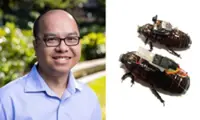
HANOI (VnExpress/Vietnam News): A team of Australian researchers led by Dr. Vo Doan Tat Thang has engineered a bio-hybrid robotic system that turns living cockroaches into search-and-rescue cyborgs.
"The idea grew out of a straightforward question: once a cyborg insect locates someone trapped in rubble, what else can it actually do to help them?" Thang, the Vietnamese director of the Biorobotics Laboratory, 41, tells VnExpress about the project's origins.
After completing a doctorate at Nanyang Technological University in Singapore and conducting postdoctoral research in Singapore and Germany, he moved to Australia in 2023 to lecture at the University of Queensland.
His laboratory focuses on bio-robotics, bio-hybrid insects, insect biomechanics, and nature-inspired robotic systems, merging the innate agility of living creatures with modern electronic engineering.
Turning cockroaches into miniature first responders is the work of a 13-member team from the University of Queensland and the University of New South Wales led by Thang and with three other Vietnamese doctoral candidates.
A cyborg, short for cybernetic organism, marries living biology with synthetic electronic hardware—a concept first coined in 1960 by Austrian scientist Manfred Clynes and American psychologist Nathan Kline.
Dr. Vo Doan Tat Thang, director of the Biorobotics Laboratory, pictured with the Paraborg prototype. Photo courtesy of Thang
Until now, Thang notes, most research on bio-hybrid insects stopped at passive reconnaissance comprising capturing footage, streaming sensor data, and pinpointing survivors.
That changed when he connected with Do Thanh Nho, director of the Medical Robotics Lab at the University of New South Wales. "My background is in cyborg insects and bio-robotics, while Nho specializes in soft robotics and medical devices," Thang says. "The two fields clicked immediately."
Even with a shared vision, it took the team nearly three years to build an electronic backpack, interface it with the insect's nervous system, refine locomotion controls, mount miniature cameras, and integrate an automated micro-injection unit into an all-in-one system dubbed Paraborg.
This micro-injection unit is designed to function as an "extended arm" for medical responders, capable of delivering critical aid such as emergency medication to survivors trapped in areas inaccessible to humans.
Their insect of choice: the giant burrowing cockroach, Macropanesthia rhinoceros.
"Compared to other species commonly used in bio-hybrid research, this cockroach is exceptionally large, robust, and capable of hauling electronics, cameras, or a micro-injector without losing its mobility," Thang says.
"That payload capacity is essential, because real-world search and rescue requires more than just remote steering—the insect needs to deliver practical aid."
Giant burrowing cockroaches also possess remarkably efficient locomotion, naturally navigating rough, uneven terrain and balancing themselves without the complex computational power required by conventional walking robots. By piggybacking on the insect's innate motor skills, the team only had to add a lightweight electronic layer to steer and communicate with it.
The Paraborg setup bundles sensory-interfacing electrodes, a miniaturized control board, a power unit, and a remotely triggered micro-injection mechanism.
Configured to suit specific missions with either optical sensors or injection tools, all components are strategically mounted on the insect's back to keep its legs, joints, and torso moving freely.
Once outfitted, the insect is guided via a custom stimulation protocol. Mild electrical pulses targeted at its sensory organs nudge it to turn or move forward, while the cockroach's nervous system retains full, autonomous control over stepping, surmounting obstacles, and keeping its balance.
Stimulating one antenna nudges the cockroach to veer in that direction. To spur it forward, electrodes deliver an impulse to the cerci—the tactile rear sensory appendages that insects naturally use to detect predators via vibrations and sudden air currents.
In benchmark testing, Paraborg completed close-range injections with a 95% success rate, while the full sequence—navigation through waypoints followed by targeted injection—hit 72%. As Thang explains, the gap highlights the complexity of the full operational loop.
When positioned within 15 centimeters of a target, the mechanical needle can easily strike the intended surface, yielding near-flawless performance.
By contrast, an end-to-end mission requires the cockroach to crawl through assigned waypoints, wheel into position, and hold steady under live control before the payload can be safely deployed.
"The steepest hurdle is sensory habituation, where the insect's response fades after repeated electrical pulses," Thang points out. "To counter this, we designed an adaptive control loop that varies stimulation intensity and incorporates rotational resets to restore steering responsiveness.
As it closes in on a target, the system cuts forward momentum, dials in the orientation, and steadies the cockroach before a human operator green lights the injection. A human is always at the controls; the insect never acts on its own."
Environmental variables pose another set of headaches. Ultra-miniaturized onboard cameras suffer from low resolution, restricted angles, poor low-light sensitivity, and minimal battery life. Dust, moisture, and smoke can easily cloud the lens, while the cockroach's natural scurrying creates jerky video and rapid shifts in perspective. Moreover, standard GPS signals cannot penetrate deep into structural debris, underground tunnels, or complex confined spaces, leaving positioning largely reliant on local tracking.
Currently a working prototype with no immediate commercial rollout, Paraborg could nevertheless find its way into active service within five to 10 years, Thang predicts.
The device is not designed to automate medical decisions, but rather to serve as an extended arm for doctors and first responders reaching spaces inaccessible to humans. Future iterations may automate routine steps such as mapping, collision avoidance, route planning, and postural stabilization prior to physical intervention.
In disaster-prone regions like Vietnam, Thang envisions bio-hybrid insects filling critical gaps in emergency toolkits. Following landslides or building collapses, cyborg cockroaches could slip through narrow fissures impenetrable to rescuers, sniffer dogs, or heavy machinery to detect life signs, relay real-time video, sample ambient hazards, and flag priority zones. While swift currents rule them out for open floodwaters, they could still prove invaluable across upper, unflooded levels of damaged buildings or isolated survivor pockets.
"Down the road, once the payload modules are certified safe, these insects could transport critical sensors, two-way communication links, or small emergency supplies directly to survivors," says Thang. "The goal is to supplement rescue teams, never to replace existing gear."
The breakthrough has drawn enthusiastic backing from frontline officials. Tim Hassiotis, a senior leader at Fire and Rescue New South Wales, believed the technology could dramatically extend the reach of emergency personnel.
"If cyborg insects can safely enter spaces we can't, locate casualties and ultimately help deliver emergency care, they could become another valuable tool in the future of urban search and rescue," Hassiotis told The Guardian. -- VnExpress/Vietnam News