
JAKARTA: Eight Indonesian airports, including two serving Jakarta, remained closed early on Monday (Sept 7) morning because of volcanic ash from eruptions of Mount Anak Krakatau, the transport minister said.
Ash from Anak Krakatau, which sits halfway between Java and Sumatra islands, has blanketed Jakarta and several surrounding areas since it erupted late on Sept 4, leading to the closure of the airports for safety reasons.
The transport ministry said 170,000 people have been affected by flight cancellations.
“We cannot ascertain when this will end due to the dynamic weather,” Transport Minister Dudy Purwagandhi said in a statement on Sept 7, adding that the eight airports, which included the ones serving Jakarta’s nearby provinces of Lampung and West Java, would remain closed until at least 8.59am local time (9.59am Singapore time).
The volcano-monitoring agency’s website showed the most recent Anak Krakatau eruption occurred on Sept 6 at 8.23pm local time.
The eruptions have seen ash reach as high as 6,000m on the Java side of the volcano, and 15,000m on the Sumatra side and some parts of Banten province in Java, meteorological agency BMKG posted on its website.
On Sept 6, the disaster agency called for people to wear masks while travelling outdoors due to the ash.
Schools in Jakarta and Lampung will use remote learning to counter health risks for students, state news agency Antara reported.
Passengers scrambling
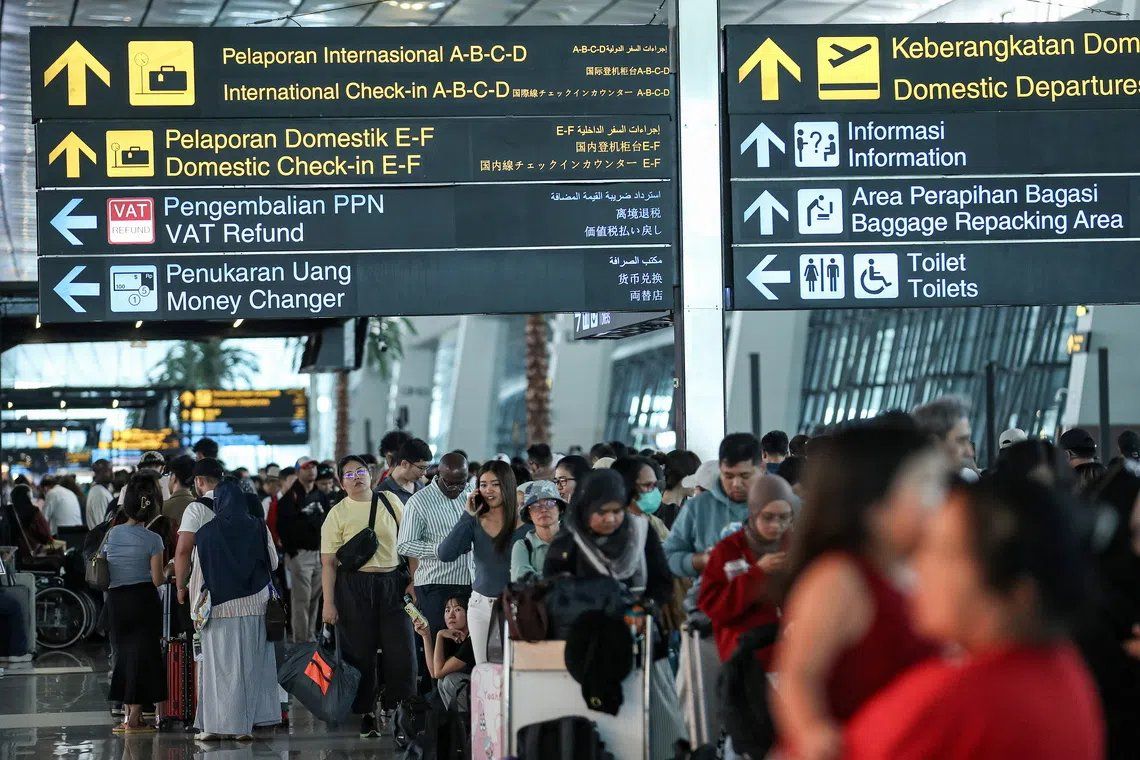
The disruption left some passengers scrambling to find alternative flights.
Henny Yensan, 44, who had hoped to go back to her home town with her mother, said “everybody was disappointed”.
“No one flew into a rage because, after all, this is due to a natural disaster,” the businesswoman who had to reschedule her flight to Sept 8 told AFP.
Samuel Guiberteau, a Danone executive on a business trip to Lombok since Sept 4, said “nothing is certain for the moment”, as he searched for alternative flights back to the capital.
“I had found another flight on Citilink, but it was also cancelled,” the 47-year-old told AFP by phone, adding that he had no alternative but to stay in Lombok for the time being.
Volcanic ash also reached the city of Bandar Lampung in the southern tip of Sumatra, blanketing parked cars and roadsides.
“I’m worried it could seriously affect the lungs and cause a lung infection,” Andre Bayu Saputra, 25, told AFP on Sept 6.
Hazard warning
Anak Krakatoa, which means “child of Krakatoa”, sits in a strait that separates the islands of Java and Sumatra.
Ships passing through the strait were asked to increase vigilance for possible disruption to navigation safety due to volcanic activities.
Vessels are prohibited from approaching an exclusion zone of 3km radius from the volcano, local port authorities said in a statement.
The volcano has been sporadically active since it emerged from the sea at the beginning of last century in the caldera that formed after the 1883 eruption of Mount Krakatoa.
That disaster was one of the deadliest and most destructive in history, with an estimated 35,000 people killed.
Geology agency head Lana Saria said “seismic activity indicates the movement or release of volcanic fluids within the volcanic system”.
“However, the timing, magnitude and nature of the next eruption cannot be precisely predicted,” Lana added.
Lana warned against approaching Anak Krakatoa, saying materials ejected from the volcano could endanger those within the exclusion zone.
She said the most recent series of eruptions does not have the potential to trigger a tsunami at this time.
A 2018 tsunami triggered by a collapse of parts of Anak Krakatoa killed 429 people and left thousands displaced.
Indonesia, a South-east Asian archipelago nation, sits on the Pacific Ring of Fire, where the meeting of continental plates causes high volcanic and seismic activity. - Reuters, AFP