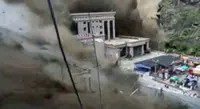
When a wall of icy debris from a glacial collapse on the China-Nepal border tore through his village last week, Pemba Chhring Tamang watched the landscape he had known all his life disappear.
“The flood was one like I had never seen before,” said the 57-year-old, rescued from his Himalayan village in Nepal’s devastated Rasuwa district. “It destroyed everything, our homes, our village.”
The Aug 26 disaster, one of Nepal’s worst climate-linked catastrophes, brought grief but also anger.
“What has Nepal done to deserve this?” asked Tashi Lhazom, a Nepali climate activist and politician.
“It is among the most climate-vulnerable countries, but at the same time, it is also the most climate-friendly.”
The huge wave of debris killed more than 1,200 people and left more than 4,750 missing in Nepal and China’s Tibet region, smashing towns, roads, bridges and multiple hydropower dams.
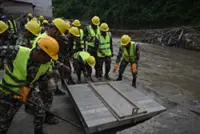
Rescuers are still searching for survivors and the dead, while helicopters ferry food and medicine to those left with nothing.
While the exact cause of the glacial collapse is unclear, climate change is causing glaciers to melt worldwide, heightening the risk of such disasters.
“We have been hearing news about climate change, and there have been floods before – but never like this,” said Tamang in Kathmandu.
Nepal, a largely rural nation of 30 million people that has contributed little to the greenhouse gas emissions driving global warming, says reconstruction could cost “billions” of dollars.
“We are suffering for a crime that we did not commit,” Lhazom said.
Nepali glaciologist Tenzing Chogyal Sherpa said wealthy industrialised countries driving global emissions should accept their role.
“They should take some responsibility, and there should be some accountability,” he said.
Scientists say the warming climate is already altering the risks facing the Himalayan region.
Disaster specialist Saswata Sanyal, at Kathmandu-based International Centre for Integrated Mountain Development, said the region is warming roughly “at twice the rate” of anywhere else in the world.
“We have seen cascading disasters, like what we saw Aug 26, where one event triggers multiple events,” he said.
Nepal’s leaders say the country needs long-term international support to adapt to a rapidly changing mountain environment.
Prime Minister Balendra Shah said Nepal must “strongly raise” with the international community the disasters it has experienced as a result of climate change.
Foreign Minister Shisir Khanal called it a “warning signal”.
He said that the support to Nepal should not be viewed only “from an angle of aid or charity, but should be seen from a perspective of climate justice as well”.
For communities living beneath the world’s highest mountains, a seemingly small rise in global temperatures can bring devastating consequences, Lhazom said.
“Just a degree increase in temperature may not seem much to most people, but it has a very different meaning in the mountains,” Lhazom said.
“A change in a degree can translate to the loss of thousands of lives and livelihoods.”
Lhazom pointed at richer countries.
“Are those who are causing it doing enough for Nepal and other vulnerable countries? No,” Lhazom said.
The United Nations launched a “loss and damage” fund in 2025 to aid the impacts of climate change, though it has not yet begun distributing its limited cash.
A UN preliminary assessment estimated building damage from Nepal’s floods at US$158mil (RM 638.57mil) alone, warning that total losses – including damage to roads and bridges, agricultural land and humanitarian costs – would be far higher.
Khanal said the disaster underlined the “impetus and urgency” needed to build data-sharing mechanisms to help warn of future disasters, noting that neighbouring China had shared key data after the flood.
Glaciers across the wider Hindu Kush-Himalayan region are a vital water source for 240 million people in the mountains and another 1.65 billion downstream across South and South-East Asia.
“With climate change intensifying, there is no indication that such hazards will stop,” said Dhondup Wangmo, a research fellow at the Tibet Policy Institute, a thinktank linked to the exiled Tibetan government in India.
“In fact, they are more likely to occur in the future, potentially with even more tragic consequences.”
For Nepal and its neighbours, the danger does not end in the mountains.
“It impacts the entirety of the Himalayan region’s civilisation,” Khanal said. — AFP