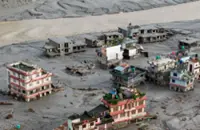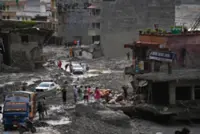
Local families held symbolic funerals to “liberate the souls” of relatives missing since deadly flash floods swept away their villages and homes in the Himalayan region a week ago.
Emergency teams have recovered more than 1,100 bodies, and nearly 4,500 people are still missing after the gigantic wave of freezing water, rocks and debris triggered by a high-altitude glacial collapse roared down the China-Nepal border on Aug 26.
After days of searching shelters and mortuaries, relatives of some of the missing lost hope and began conducting last rites, burning straw effigies in Hindu rituals.
“We had to do this to set his soul free so that he is at peace and happy wherever he is,” said Dolma Newar Tamang, flanked by her sobbing son, at a funeral for her husband.
He had been en route to China when the disaster struck.
“I saw the news and called him. I called repeatedly, but he never picked up.”
A week on from the colossal disaster, Nepali rescuers are still seeking survivors, including by digging through packed sludge that has entombed multiple tunnels of hydropower plants.
So far, rescuers have recovered only bodies from tunnels, but teams were still digging, drilling and blasting through debris.
Nepal’s Foreign Minister Shisir Khanal said he still hoped some missing could be alive.
“Miracles do happen,” he said. “At this point, I do not want to completely give up hope.”
There is growing anger at the scale of destruction that has hit Nepal, a largely rural nation of 30 million people.
The country has contributed little to the greenhouse gas emissions driving global warming but is among those suffering its consequences.
Nepal’s Prime Minister Balendra Shah warned the catastrophe was “a serious indication” of the risks the Himalayan nation faces.
Scientists say the Himalayas, the world’s highest mountain range, are warming rapidly as global temperatures rise, accelerating glacier melt.
Glaciers in the wider Himalayan and Hindu Kush ranges are a crucial water source for around 240 million people in the mountainous regions, as well as for another 1.65 billion people in the South Asian and South-East Asian river valleys below.
“Climate change is a global contribution, and disaster response is also a global responsibility,” Shah said in a social media post.
With mortuaries overflowing in Nepal, authorities have had to bury hundreds of unidentified bodies after DNA sampling.
Nepal said 1,114 bodies had been recovered by Wednesday, while 3,916 people remained missing. China’s state media reported 16 dead and 546 missing. That takes the overall number of reported dead to 1,130, and missing to 4,462.
More than 800 foreigners from over 30 nations are among the missing: 583 in Nepal and 261 in China. — AFP