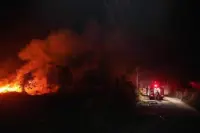
JAKARTA: As Indonesia continue to burn, civil society groups are blaming poor forest governance and demanding sweeping regulatory reform on forestry affairs to prevent future wildfires and other hazards.
In recent weeks, the country has seen more forest and land fires particularly across Kalimantan, Sumatra and Papua, triggering haze that has been damaging the health of the local population as well as neighbouring countries of Malaysia, Singapore and Brunei Darussalam.
Data from the Forestry Ministry shows that around 107,000 hectares of land nationwide have been burned between January and late June. By late July, the figure spiked to more than 202,000 ha, more than the size of three Jakartas.
The widespread fires have put the country’s health at risk. More than 3.4 million people across Kalimantan, Sumatra and Papua have been impacted by forest and land fire haze as of Monday (Aug 24), according to the Health Ministry.
In Riau, where around 16,000 ha have been engulfed by fire, the provincial administration reported more than 260,000 cases of respiratory illness since January, with an influx in emergency room visits being recorded over the past week.
Hundreds of kilometres away from the burning forests and peatlands, the House of Representatives approved a revision to the 1999 Forestry Law as an initiative during a plenary session at the Senayan legislative complex in Jakarta, marking the start of formal deliberations of the bill.
The bill revises 26 of 84 articles in the 1999 law and adds two new chapters on financing as well as data and information, according to a copy of the draft law obtained by The Jakarta Post.
The revision, fourth for the Forestry Law, would also redefine forests’ status and functions, strengthen public participation in the designation of forest areas and formally recognise customary forests.
It also contains expanded and new provisions on forest protection, conservation and social forestry, including mandatory rehabilitation of critical or unproductive forests and requirements for more systematic and integrated forest inventories.
But the planned revision of the Forestry Law was deemed insufficient to solve issues surrounding the forestry affairs in the country.
In a press briefing in Jakarta on Thursday, representatives of 33 civil groups under the banner of Reset Kehutanan (Reset the Forest) criticised the partial revision of the 1999 law, calling the proposed amendment failing to address the country’s poor forest management.
Environmental group Forest Watch Indonesia (FWI), a member of the alliance, noted that poor oversight of forest conversion in Indonesia has amplified the ongoing large-scale forest fires across the country.
“Many wildfire hot spots are located within business concessions and even across state forest areas, including in protected and conservation landscapes,” said FWI campaign manager Tsabit Khairul Auni.
“This indicates ecosystem protection has not yet been prioritized to safeguard the ecosystem and sidelined enforcement,” he continued.
According to FWI, there have been 8,918 wildfire hot spots with high indication of being burned since the beginning of 2026. More than half of the figures were located inside mining and plantation concessions, mostly in Kalimantan.
Around 1,100 fire hot spots were also located in close proximity to territories where indigenous communities live.
In a separate report, peatland-focused NGO Pantau Gambut found 936 business concessions occupying a total of 8.3 million ha of peat ecosystem, a water-rich landscape, highly flammable once drained often to be converted into plantations.
With the recent widespread fires linked to decades-long poor forest governance in Indonesia, Indonesian Center for Environmental Law (ICEL) executive director Lasma Natalia Panjaitan argued the Forestry Law revision should also look into strengthening legal enforcement in the forestry sector.
“Repeating fires frequently occur in concession areas,” Lasma said. “The government sometimes focuses on imposing administrative punishments without being able to ensure that restoration efforts are truly guaranteed.”
Separately, researcher Swetha Peteru of Landscape Alliance underlined the importance of long-term investments in sustainable land-use planning, landscape-level peat hydrology rewetting and incentives for smallholders to do fire-free livelihood alternatives that support peatland management.
“Until drained peat ecosystems are restored to their natural hydrological function,” Peteru said, “the risk of recurring transboundary haze during dry weather will remain an ongoing regional vulnerability.”
Forestry Ministry spokesperson Ristianto Pribadi said on Thursday the government would be open to receiving more inputs from all stakeholders, including academics and NGOs.
He added the end goal of the law revision should be ensuring sustainable forest management and legal clarity, protecting the public and restoring the ecosystem. - The Jakarta Post/ANN