
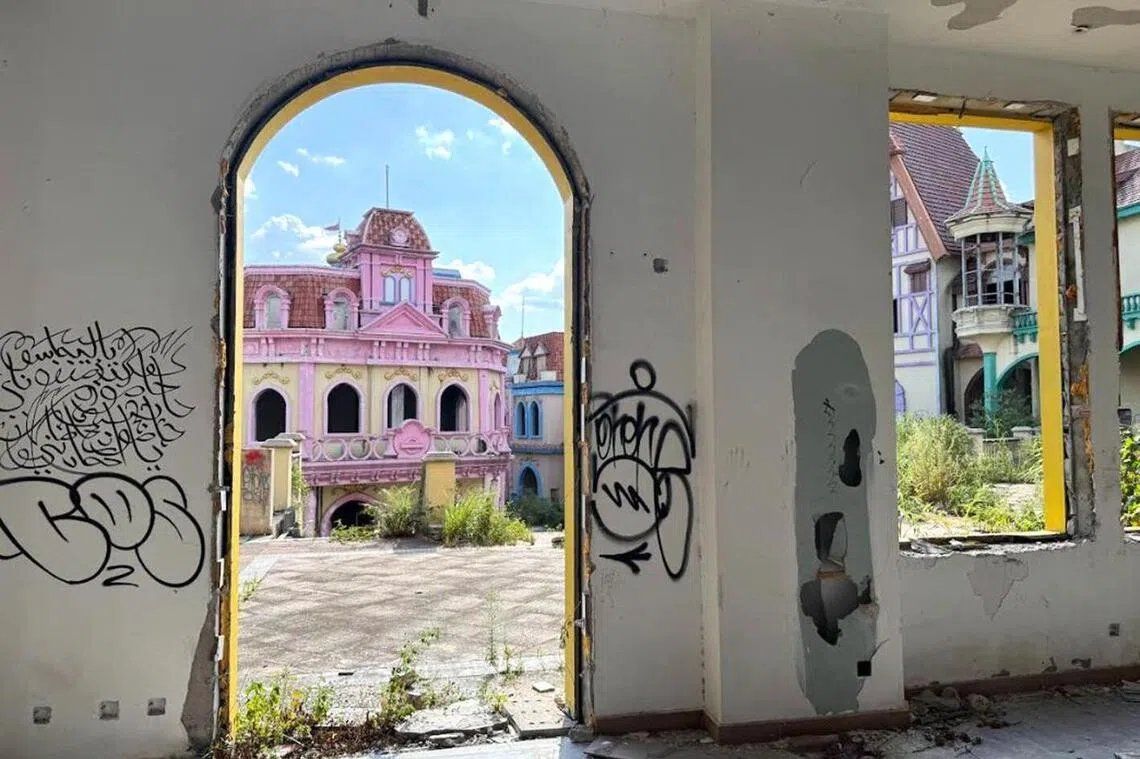
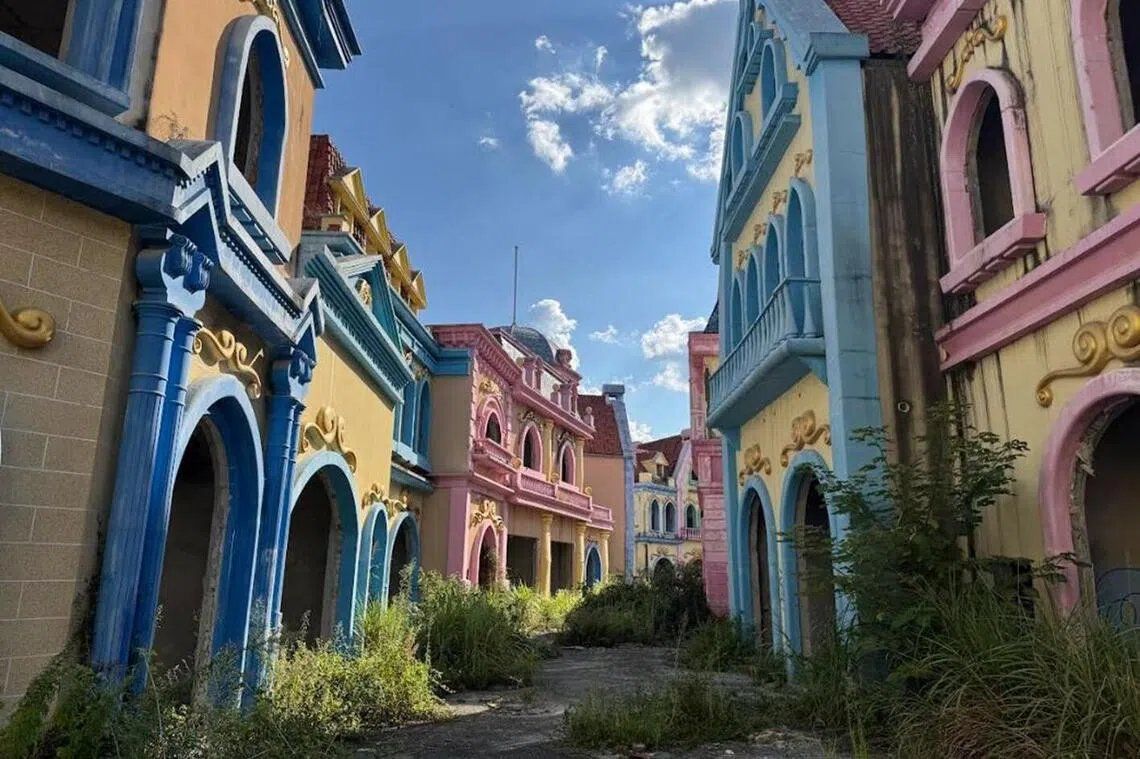
GUIYANG, Guizhou (China): A broad flight of stairs leads up to rows of pastel-coloured buildings with tiled roofs that resemble castles from a children’s fairytale.
But the crowds they were built to impress never came.
Weeds have taken over the steps and many walls have been vandalised. Instead of music and children’s laughter, there is only the crunch of broken glass underfoot as I walk through the eerily quiet site.
This is part of the Evergrande Cultural Tourism City, an ambitious mega-project about a 45-minute drive from central Guiyang, the capital city of Guizhou province in southwestern China. Construction began at the height of China’s property boom in 2018 but the project was left unfinished after its developer China Evergrande ran into a debt crisis in late 2021.
Spanning more than 8,000 mu (about 559 ha) and involving planned investment of more than 100 billion yuan (S$19 billion), the development was supposed to house European-style hotels, a sports centre, an international convention centre, a shopping mall, and other cultural and tourism facilities.
A Children’s World theme park was projected to receive nearly 10 million visitors annually, according to local reports in 2018 when the project was launched.
These days, the site sits largely abandoned, with only faded promotional posters offering glimpses of the original vision in artists’ impressions along with a line: “A cultural tourism destination for the world.”
“This could have been so lively if they built it up,” said the 26-year-old driver who took me there. A Guizhou native who goes by the name Xiao Luo, he had jokingly referred to the development as a chengbao, or castle.
“What a pity it’s now just a lan wei lou,” he said.
Lan wei lou, literally “rotten tail building”, is a term commonly used in China for buildings where construction has stalled often because developers run into financial difficulties.
Emblem of a property crisis
The crumbling facades of Evergrande Cultural Tourism City are a physical emblem of the property crisis that continues to weigh on the world’s second-largest economy, even as the Evergrande saga that came to symbolise it reaches something of a conclusion.
Evergrande founder Hui Ka Yan, known as Xu Jiayin in Mandarin, was on Aug 20 sentenced to life in prison for “multiple combined crimes”, including financial fraud and bribery, committed during the rise and fall of the property empire he built.
Hui, 67, was stripped of his political rights for life and all his personal assets were confiscated. Evergrande Group was fined 8.82 billion yuan, along with a separate 7 billion yuan fine on its onshore unit.
News of Hui’s life sentence prompted little sympathy on Chinese social media.
Some netizens expressed a strong sense of justice, viewing the punishment as a fitting end for a tycoon whose lavish lifestyle had triggered some anger as Evergrande unravelled. Others said that even life imprisonment was insufficient, pointing to homebuyers still grappling with unfinished homes and lost savings.
Founded by Hui in 1996, Evergrande expanded rapidly into a sprawling conglomerate on the back of heavy borrowing.
At its peak in 2017, the company was worth more than US$50 billion and, for a time, the country’s largest developer by contracted sales. Forbes reported that Hui had a net worth of US$45.3 billion in 2017, making the former steel technician from rural Henan province the richest person in Asia.
Meanwhile, money was flooding into real estate as the emerging middle class poured savings into housing, long viewed as a favoured store of wealth. By 2019, property and related industries accounted for nearly a third of China’s total economic activity.
But cracks began to show after Beijing moved in 2020 to rein in excessive borrowing by developers.
By the time Evergrande defaulted in late 2021, it was buckling under more than US$300 billion in liabilities, sending shockwaves through China’s property market and raising alarm bells over the financial health of China’s entire real estate sector as a broader housing downturn took hold.
In rare signs of protest, small crowds of angry homebuyers and investors gathered outside its Shenzhen headquarters demanding repayments and answers.
Evergrande was delisted from the Hong Kong Stock Exchange in August 2025 and its shares were effectively worthless. Liquidators are still pursuing assets from the failed developer while creditors have long faced the prospect of recovering only pennies on the dollar.
No end in sight?
For home buyers caught in Evergrande’s unfinished developments, the more immediate concern is whether the homes they paid for will ever be delivered.
But putting Evergrande’s founder behind bars for life does little to resolve the broader economic problems exposed by China’s property bust.
The prolonged property slump has become a drag on China’s economy, eroding household wealth and confidence, weighing on jobs and squeezing local government finances at a time when Beijing is trying to get Chinese households to spend more and reduce the economy’s reliance on investment and exports.
Dan Wang, a director on Eurasia Group’s China team, described Evergrande as the poster child for China’s debt-fuelled property boom, but not the underlying cause of the prolonged downturn.
“The collapse of this one company wouldn’t drive down the Chinese property sector. It’s the high debt for the whole sector that’s not sustainable,” she said.
Rather than mounting a blanket rescue of indebted developers, Beijing’s response has been focused on ensuring pre-sold homes are delivered by directing financing towards projects deemed viable through a “white-list” mechanism.
Across China, the result is a patchwork of developments in various states of limbo, with some being gradually completed or taken over. Others remain stalled for years as local governments, banks and developers grapple with how to deal with them.
Even at Evergrande’s sprawling Guiyang development, not everything has been abandoned.
In June, Plot 51 of the Guiyang Evergrande Cultural Tourism City received approval for the sale of 615 completed homes and 17 commercial units, according to local media citing Guiyang housing authorities, in a sign of efforts to salvage viable parts of the project.
However, completing or salvaging individual developments addresses only part of China’s property problem.
With home prices still falling as at July 2026, potential buyers are holding back in the hope that prices will fall further.
“The biggest problem for housing is really there’s not enough new demand,” said Eurasia’s Wang.
“Most of the people are simply watching, waiting for it to reach the bottom. But the market remains far from reaching a bottom,” she said.
Outside the abandoned development in Guiyang, there is little sign of the tourism boom Evergrande once envisioned, with visitors meant to be drawn to its sprawling complex of entertainment, shopping and other attractions.
Instead, much of the surrounding landscape remains sparsely developed, punctuated by data centres that have proliferated as part of Guizhou’s growing push in computing power in the era of artificial intelligence to drive its economy.
A short distance away, a road sign points to a “Swiss-style town”, one of the few leisure attractions in the area. It amounts to a grassy park centred on a lake, with a white chapel-like building, a handful of decorative hot-air balloons and a cottage providing the European flourish and photo spots.
There were few visitors on the afternoon I went. Among them was a retired local couple walking their energetic six-month-old rescue dog.
“We come to this park quite often,” they said. “To be honest, this area is not that developed and there’s really not much to do, so we just keep going to the same few places.” - The Straits Times/ANN