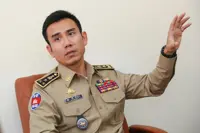
PHNOM PENH: Minister of Interior Sar Sokha has used the swift return of assault suspect Chheng Pharun from Vietnam to issue a broader warning against fleeing justice, saying offenders “cannot run away for an entire lifetime” and should instead surrender and accept responsibility for crimes.
The warning came on Monday (Aug 24), after Cambodian and Vietnamese police coordinated Pharun’s return to Cambodia, less than a day after Phnom Penh police declared that he had fled to the neighbouring country through the Bavet International Border Checkpoint following an alleged assault with a wine bottle.
Sokha praised officers from the Criminal Department of the National Police, the immigration police at the border crossing for coordinating the return of Pharun to face legal action.
He also expressed “deep gratitude” to the Vietnamese side, from senior police officials to border officers, for their cooperation, which he said had brought the case to a successful conclusion.
The minister then turned the case into a broader message on personal responsibility.
“I strongly urge everyone to control their emotions and avoid committing any impulsive criminal act,” he said.
Sokha noted that once an offence has been committed, the perpetrator should have the courage to accept responsibility rather than attempt to escape.
“You cannot run away for an entire lifetime,” he said, adding that offenders should surrender, admit wrongdoing and face punishment prescribed by law rather than wait for senior officials or law enforcement agencies to publicly call on them to come forward.
He said law enforcement officers would continue to welcome those who came to their senses and voluntarily surrendered.
The minister’s comments capped a rapidly developing case that began with an alleged violent incident at a drinking venue.
Authorities accused Pharun, who is not believed to hold public office, of striking a shop keeper in the head with a bottle before fleeing. No details of the victim’s injuries were released.
By the afternoon of Aug 23, Lieutenant General Chuon Narin, deputy National Police chief and Phnom Penh municipal police chief, publicly identified Pharun as the suspect and announced that investigators had established that he had crossed through Bavet into Vietnam.
Narin made clear at the time that crossing an international border would not end the police pursuit.
“Our authorities will not give up on pursuing and arresting this person,” he said, while calling on the suspect’s associates and family to persuade him to surrender. He similarly warned that Pharun could not remain on the run for the rest of his life.
The case drew increasing social media attention, which led to direct intervention from Sokha.
On the night of Aug 23, the interior minister gave Pharun 48 hours to surrender to authorities and undergo legal procedures, while encouraging his family and friends to provide information and persuade him to turn himself in.
Sokha also contacted Vietnamese Minister of Public Security Luong Tam Quang directly and requested cooperation from Vietnamese authorities to locate and detain the suspect after learning that he had crossed the border, according to reports on the operation.
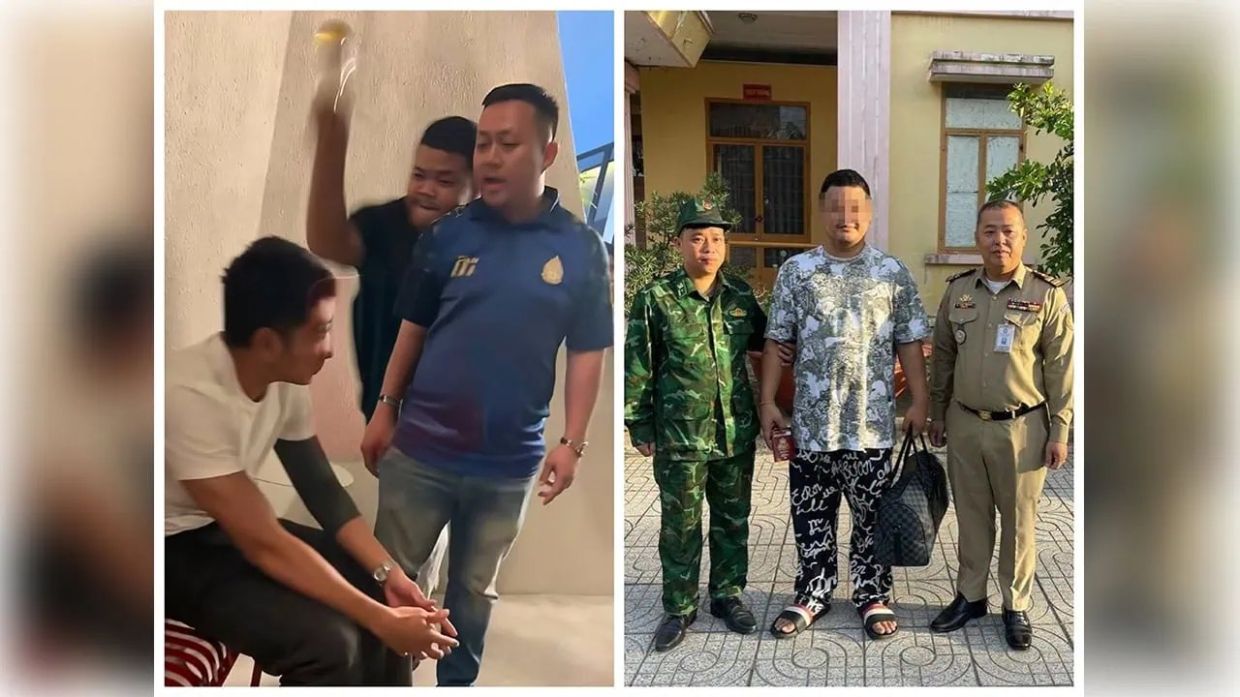
The cross-border effort moved quickly. According to Narin, Pharun reached the border area at around 11pm on Aug 23.
Because the crossing had already closed for the night, the Vietnamese arranged for him to stay overnight in nearby accommodation, under Vietnamese supervision.
Cambodian officers were already waiting at the border, including Pol Rattana, deputy director of the Criminal Department, and the Boeung Keng Kang district police chief.
On the morning of Aug 24, Pharun was taken into Cambodian custody, and transported to the Phnom Penh Municipal Police headquarters.
Sokha’s statement placed particular emphasis on cross-border cooperation, portraying the case more than the return of one suspect but an example of coordination between Cambodian and Vietnamese law enforcement when a person sought by Cambodian authorities crosses the shared border.
His remarks sought to send a deterrent message beyond Pharun’s case.
For Sokha, however, the lesson began before the cross-border operation became necessary.
He urged people to exercise restraint when angry, while stressing that those who fail to do so and commit an offence should face the consequences rather than compound the situation by fleeing.
His message was unequivocal: surrender remains an option, but escape should not be regarded as one. - The Phnom Penh Post/ANN