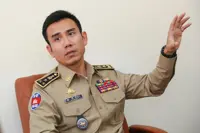
PHNOM PENH: Minister of Information Neth Pheaktra has countered Thailand’s rejection of Cambodian allegations of territorial encroachment, arguing that Bangkok’s denials cannot erase physical evidence now being observed and documented by Asean monitors, foreign diplomats and the UN.
His Monday (Aug 24) remarks came after Air Chief Marshal Prapas Sornchaidee, director of Thailand’s Joint Information Center (JIC), rejected Cambodian accusations that Thai forces are encroaching on Cambodian territory, through road construction, military fortifications and other activities.
Prapas claimed Thailand had no policy of invading or occupying a neighbouring country and maintained that its activities were intended to protect troops and civilians and safeguard sovereignty in areas Bangkok considers under its control.
He acknowledged that the presence of troops and security infrastructure could not determine the international boundary, saying territorial questions should instead be settled through maps, evidence and the JBC, according to Thai media.
On that principle, at least, his remarks align with Cambodia’s longstanding position that the boundary must be determined through agreed legal and technical mechanisms rather than military control or faits accomplis on the ground.
Pheaktra’s response focused on what he presented as a critical change in the dispute: Cambodia is no longer the only party documenting conditions on the ground.
“Evidence on the ground cannot be hidden,” he said, pointing to shipping containers, razor wire barriers and other physical changes in areas Cambodia maintains are under its sovereignty.
The minister said the significance was that “the eyes of third parties” were now seeing those conditions, reducing the dispute from being merely competing Cambodian and Thai narratives.
The Asean Observer Team in Cambodia (AOT-KH), led by its Philippine head of mission, recently inspected three affected areas in Banteay Meanchey province.
At Boeung Trakuon in Kouk Romiet commune, Thma Puok district, observers inspected 44 containers at 14 locations, where Cambodia says 7,873 residents from 1,869 families, including 1,847 children, remain unable to return home.
At Chouk Chey and Prey Chan villages, the team inspected another 72 containers across 10 locations.
Combined, the three areas contain 116 containers across 24 locations, while Cambodia says 13,259 people, including 3,416 children, are unable to return to their homes.
Pheaktra argued that these were no longer conditions reported exclusively by Cambodian authorities.
“There are third parties watching. There are observers verifying. Diplomatic representatives have seen the actual locations,” he said.
He also pointed to comments by UN Special Rapporteur on the situation of human rights in Cambodia Tom Andrews, who visited displaced communities and the border region during his July mission.
Andrews subsequently reported that about 650,000 Cambodians were displaced at the height of the conflict and more than 20,000 remain unable to return.
He said people he met told him they could not return to homes in areas occupied by Thai security forces and called for their safe return.
For Pheaktra, the Asean inspections, diplomatic visits and Andrews’ observations form an increasingly important third-party record of the humanitarian and physical situation on the frontier.
However, those observations do not themselves constitute an Asean or UN determination of sovereignty.
The AOT’s role is to observe and verify ceasefire conditions, while Andrews’ mandate concerns human rights. Determination of the boundary remains a separate legal and technical matter.
Pheaktra nevertheless rejected the argument that military control or security requirements could justify altering conditions in territory Cambodia claims as its own.
“Shipping containers are not border markers. Barbed wire is not a treaty. Trenches are not boundary maps. Planting a flag is not a title deed to territory,” he said.
Cambodia maintains that the boundary must be determined through the Franco-Siamese treaties and conventions, historical maps and boundary documents, the 2000 Cambodia-Thailand border MoU, the 2003 Terms of Reference and the JBC process.
Prapas noted that neither country could determine sovereignty merely through public declarations.
Thailand would continue protecting what it considers its territory and would not halt security measures solely in response to unilateral Cambodian demands, he said.
This leaves the two sides fundamentally divided over the facts on the ground: Thailand says it is protecting its sovereignty and troops, while Cambodia says Thai forces are using that justification to establish physical control over Cambodian territory.
Pheaktra argued that independent observation is therefore increasingly important.
Cambodia also links the territorial issue to Point 4 of the Dec 27 ceasefire agreement, which provides for affected civilians to return to their homes on their respective sides without obstruction and in safety and dignity.
For Pheaktra, thousands of Cambodians still unable to return behind containers and other barriers represent physical evidence that the post-war situation remains unresolved.
“A ceasefire is not a licence to create new facts on the ground,” he said.
His message to Thailand was that denial alone was no longer sufficient when outside observers could visit the locations themselves.
“Containers may block the road home, but they cannot block the truth,” Pheaktra said.
“Barbed wire may obstruct civilians, but it cannot obstruct the eyes of the world,” he added. - The Phnom Penh Post/ANN