In a global first, leading Chinese commercial rocket company LandSpace has recovered a stainless-steel booster after an orbital launch, marking a major step in the country’s efforts to develop lower-cost, reusable rockets.
Previous reusable boosters deployed in such launches have been made from aluminium alloys, which can be more expensive to develop due to higher design and raw material costs.
China is also the first country to succeed in orbital launch recovery down distinct technological pathways, pulling off a dual-track strategy that even the United States – which pioneered reusable rocket technology – has yet to execute.
The Zhuque-3 is China’s first commercial rocket to both reach orbit and have its first stage recovered.
LandSpace also became the fourth entity – after US companies SpaceX and Blue Origin, and state-owned China Aerospace Science and Technology Corporation (CASC) – to achieve controlled recovery of a reusable vehicle from an orbital launch.
Like SpaceX’s Falcon 9 and Blue Origin’s New Glenn, the Zhuque-3 uses landing legs to recover its rockets.
But last month, China was the first to recover a booster on an orbital launch with a different technique, after the first stage of CASC’s Long March 10B was recovered using a unique sea-based net capture system.
SpaceX’s Super Heavy booster, which is also made of stainless steel, is awaiting US Federal Aviation Administration approval for its first recovery flight to send the Starship into orbit.
The Super Heavy will also attempt a non-leg-based orbital recovery, using mechanical “chopstick” arms mounted on a tower to catch the booster.
Wednesday’s milestone is just the start of China’s reusable rocket recovery efforts, while the US already has hundreds of successful booster recoveries and reuses under its belt.
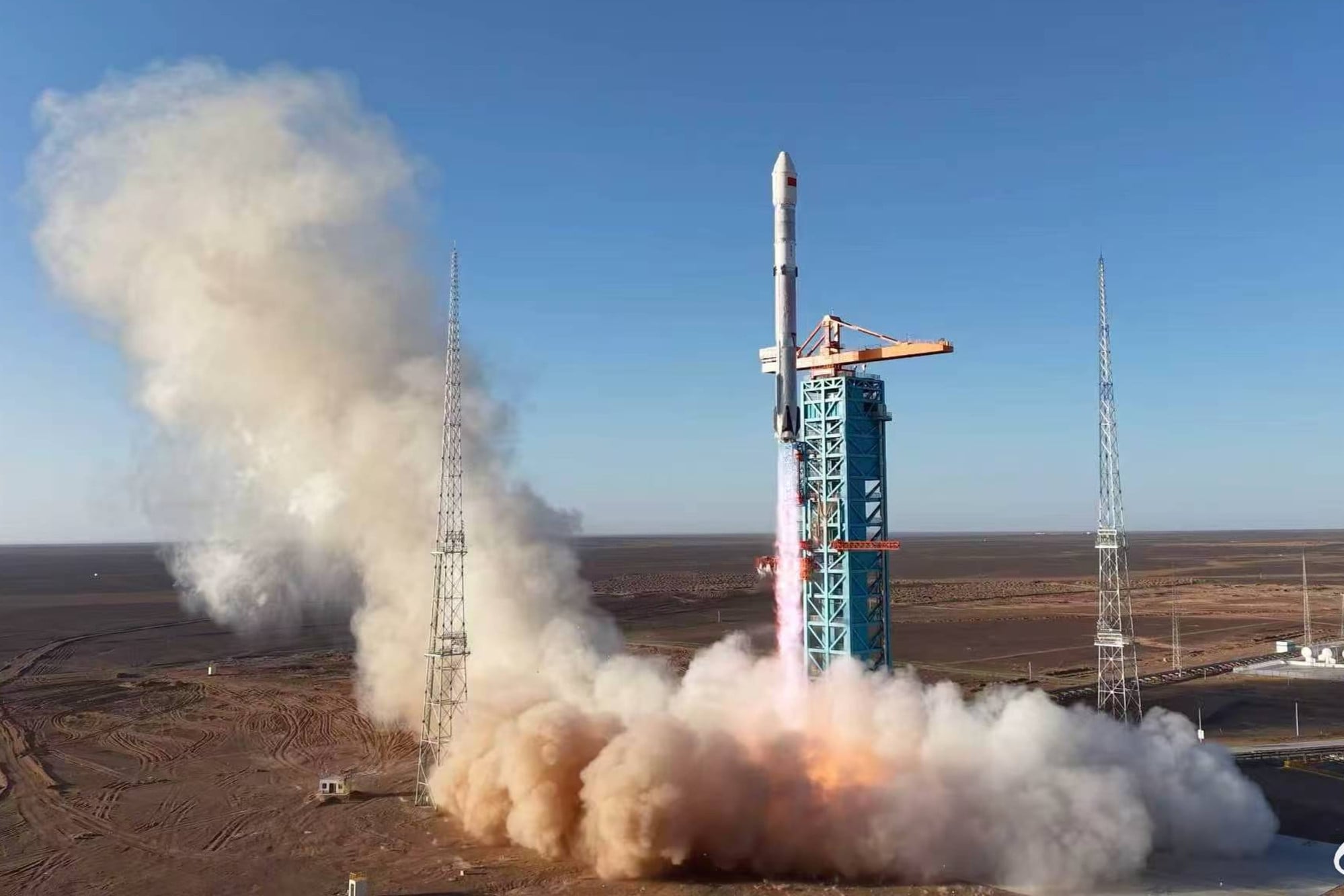
The 66-metre (217-foot) Zhuque-3 rocket, powered by liquid methane and oxygen, lifted off from the Jiuquan Satellite Launch Centre in the Gobi Desert at 7.35am on Wednesday, according to state news agency Xinhua.
The rocket delivered a Honghu-3 internet satellite into its designated orbit, while its first stage returned to Earth and touched down vertically at a recovery site in Minqin county, Gansu province, about 390km (242 miles) southeast of the launch pad.
“This mission marks China’s first successful recovery of a first-stage reusable launch vehicle using landing legs, and also China’s first successful land-based recovery of a first-stage orbital-deployed launch vehicle,” LandSpace said.
“LandSpace will continue to advance the iteration and engineering verification of reusable technology, helping my country further improve its low-cost, high-frequency and highly reliable space transport capabilities,” the company added in a social media post.
Dong Kai, the rocket’s deputy chief designer, told the LatePost news outlet on Wednesday that LandSpace aimed to reuse the recovered rockets as soon as possible, adding that he hoped to launch the Zhuque-3 10 times a year.
Wednesday’s launch was LandSpace’s second attempt to put the Zhuque-3 into orbit and recover its first stage.
During the rocket’s maiden flight in December, the second stage reached orbit but the first stage erupted in a dramatic fireball during its final powered descent towards the landing pad.
After that mission, Zhuque-3 project chief Dai Zheng told state broadcaster CCTV that the recovery had failed because the first stage’s engine had not reignited when it was about 3km above the ground as required.
LandSpace said on Wednesday that, following the first attempt, the rocket was optimised for reusable flight by reducing the number of landing ignition engines, improving the on-board autonomous safety control system, and enhancing thermal protection for re-entry.
Now, the Zhuque-3 is China’s second orbital rocket to demonstrate first-stage recovery. The first was the state-developed Long March-10B, whose first stage was captured by a huge net on an offshore platform after launching from Hainan province in July.
The two rockets have broadly similar payload capacities and are in about the same class as SpaceX’s workhorse, Falcon 9. In expendable configuration, the Long March-10B and Zhuque-3 can carry about 22 and 21 tonnes to low Earth orbit, respectively. With their first stages recovered, the figures fall to about 16 and 18 tonnes.
Unlike the stainless steel design of the Zhuque-3, the Falcon 9 is made using an aluminium-lithium alloy. Dong said that the welding process for stainless steel was easier than for aluminium alloy, adding that the material was also cheap and had good heat resistance.
Recovering the two rockets could prove crucial to the construction of China’s broadband internet megaconstellations. Like SpaceX’s Starlink, Chinese projects such as Guowang and Qianfan envisage eventually placing more than 10,000 satellites in orbit to provide global broadband coverage, creating both a potential global market and infrastructure of strategic military importance.
So far, Starlink has deployed more than 10,000 operational satellites and attracted over 12 million customers worldwide. Its extensive use by Ukrainian forces for battlefield communications has shown the military value of such a network.
By comparison, Beijing’s Guowang constellation and the Shanghai-backed Qianfan network have each deployed only around 200 satellites. Their expansion has been constrained partly by China’s lack of a reusable workhorse comparable to the Falcon 9.
Wednesday’s feat suggests China could translate its engineering talent and manufacturing abilities into cheaper, faster launches, positioning it to compete with the US as both nations accelerate the roll-out of internet satellites.
While US space agency Nasa has left reusable rocket development to commercial partners like SpaceX, China is playing on both fronts, with its state-run space programme building reusable boosters alongside the commercial sector.
The China National Space Administration said on Wednesday that it helped coordinate the Zhuque-3 launch team, adding that it would continue to support the country’s reusable rocket technology.
The next test for China’s reusable rockets will be whether the recovered boosters can be refurbished and flown again, which is necessary to reduce launch costs and support more frequent launches.
LandSpace said the recovery of the Zhuque-3 laid a foundation for subsequent maintenance and reuse flights, and would help China improve launch capabilities to support commercial missions and the deployment of satellite constellations. -- SOUTH CHINA MORNING POST